Hidden in Plain Sight: The Book!

Please forgive a shameless self promotion …

Hidden History of Litchfield County, my book based on this blog, will be published by the History Press on November 4th.

You can learn more about it here.

Books are available for pre-order through The History Press or Amazon.

I will be doing book talks at the following locations:

Salisbury Association, November 15th, 4pm

Cornwall Library, November 22nd, 4pm

Litchfield Historical Society, December 7th, 1pm

None of this would have been possible without the readers who have supported this blog.  Thank you all very much!

Hidden Nearby: John Sedgwick’s Grave and Monumenthttp://youtu.be/PVDBNIzGi6ghttp://youtu.be/PVDBNIzGi6gPVDBNIzGi6ghttp://youtu.be/PVDBNIzGi6g

P1160343

Author’s note:  See a related video about Litchfield and the Civil War done in cooperation with litchfield.bz here:   http://youtu.be/PVDBNlzGi6g

Along Route 43 in Cornwall Hollow lies the grave of one of the highest-ranking Union generals killed 150 years ago in the Civil War, Major General John Sedgwick.

The battles of the Mexican War in which John Sedgwick participated, from the monument in Cornwall Hollow.

The battles of the Mexican War in which John Sedgwick participated, from the monument in Cornwall Hollow.

Sedgwick was born in Cornwall Hollow on September 13, 1813. From a military family, he enrolled at the United States Military Academy after attending Sharon’s one-room schoolhouse. Graduating from West Point in 1837 he fought in the Seminole War and the Mexican War. While serving on the Kansas plains in the 1850s he received word that his family’s Cornwall Hollow home had been destroyed in a fire. He took leave from the army to build the house that still stands near his grave.

Major General John Sedgwick

Major General John Sedgwick

Sedgwick’s star rose rapidly after the firing on Fort Sumter. He was commissioned a brigadier general, then was promoted to command a division and ultimately the Sixth Corps of the Army of the Potomac. He was beloved by his men, who called him “Uncle John.” One of his soldiers described him as “an old bachelor with oddities, an addiction to practical jokes and endless games of solitaire.” He fought at some of the war’s most famous battles: Antietam (where he was wounded three times), Chancellorsville, Gettysburg.

"The Death of General Sedgwick, Spotsylvania, May 9, 1864" by Julian Scott.

“The Death of General Sedgwick, Spotsylvania, May 9, 1864” by Julian Scott.

Commanding his corps at Spotsylvania Court House on May 9, 1864, Sedgwick was surprised to see his men dodging the fire of a distant sharpshooter. “What, what!” he proclaimed. “Men dodging this way for a single bullet? What will you do when they open fire along the whole line. I am ashamed of you.” Laughing, Sedgwick announced, “They couldn’t hit an elephant at this distance.” Almost instantly a bullet struck “Uncle John” just under the left eye. His lifeless body fell into the arms of his chief of staff.

photo (7)

Sedgwick’s body was taken to Washington, DC, where a military procession was held. Another procession was held in New York City. More than 2,000 people turned out for the Cornwall Hollow funeral. In 1892, the Grand Army of the Republic marked the grave with an obelisk bearing the Greek Cross, symbol of Sedgwick’s beloved Sixth Corps. In 1900, Mr. and Mrs. Carl Stoeckel, friends of the general’s sister, erected the monument across the street, which bears the names of the Mexican and Civil War battles in which the general fought, and the inscription “the fittest place where man can die is where man fights for man.”

Hidden Nearby: Woodbury’s “Benjamin Franklin Mile Stone”

BF1

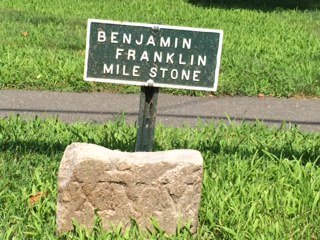
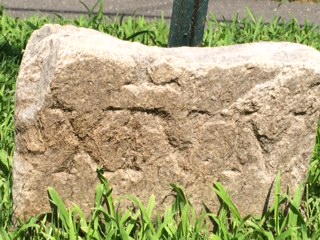
Some legends become carved in stone, or, in the case of Woodbury’s milestone, cast in iron.  The small plaque accompanying a milestone along Main Street in Woodbury states, “Benjamin Franklin Mile Stone.” The milestone itself reads “XIV M,” or fourteen miles. While there is a long-standing tradition that Franklin had these markers laid out – sometimes the legend even states that Franklin himself was involved in the placement of the stones – he was almost certainly not involved.

benjamin-franklin-520

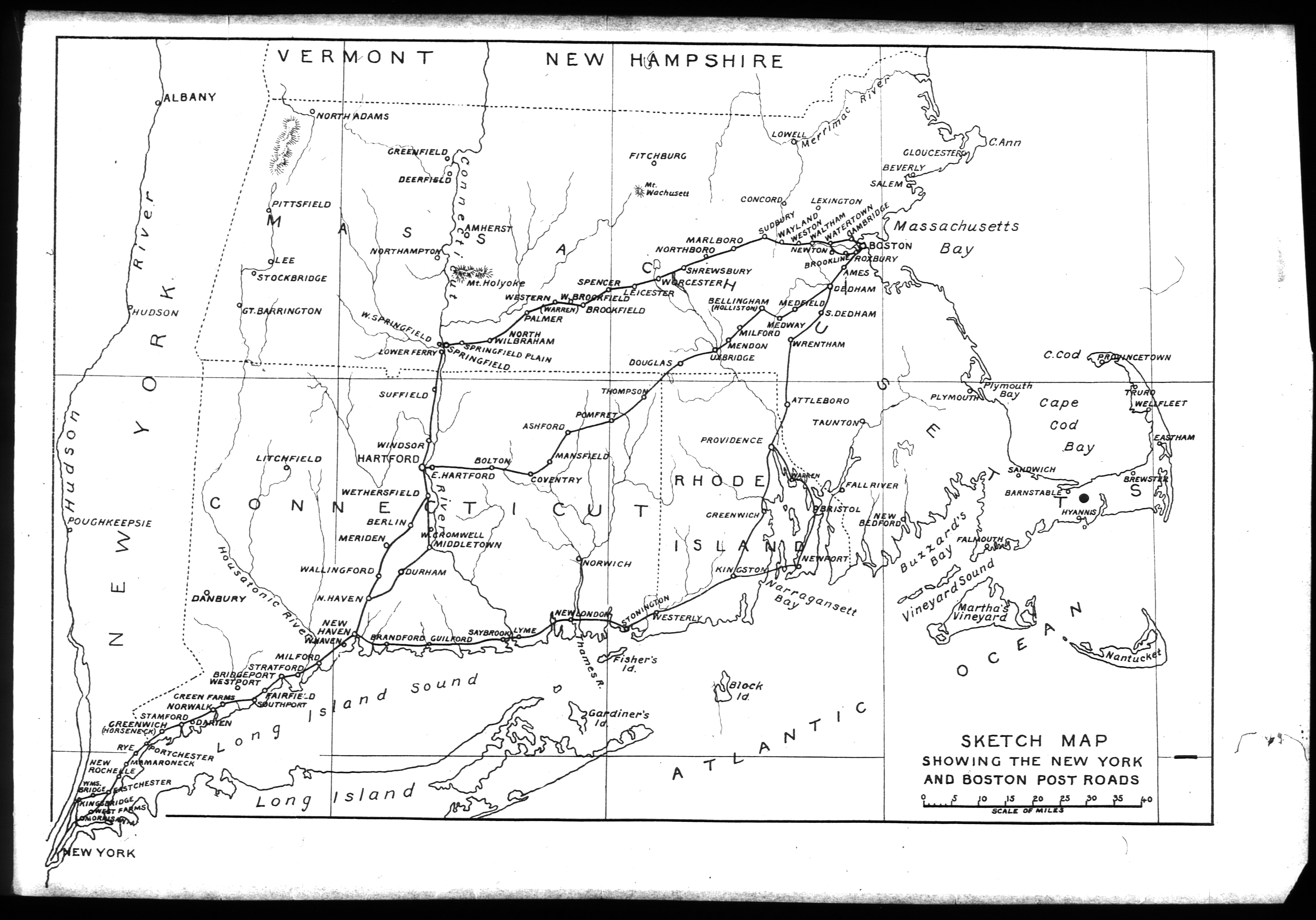
Certain facts about the legend are true. Franklin did serve as one of two deputy postmasters general for the British colonies from 1753 to 1774. Franklin did oversee the modernization of postal roads during his tenure. And, the cost postage in that era was calculated by distance. However, there is no evidence in Franklin’s papers to corroborate the story, and while Franklin did serve as deputy postmaster general for 21 years, he was actually in the American colonies for only 6 years. The rest of the time he was in England on business representing the Pennsylvania colony.

Boston_Post_Road_map

Colonial post roads.

 A specific aspect of the legend claims that Franklin erected a series of milestones between Woodbury and Litchfield while on a trip to New England from June to November 1763. However, Franklin not only didn’t set foot in Connecticut on that trip, but neither Woodbury nor Litchfield had a post office at the time.

 BF2

Milestones had little to do with postal operations, being mostly “embellishments” set up in towns to aid passersby. Post riders were quite familiar with their routes, well aware of the mileages between different points. Still, there are mysteries surrounding the milestones. If it wasn’t Franklin, who did put them up? The series of milestones seems to be the work of different people, done at different times. And what does the distance relate to? Along modern Route 6, it is thirteen miles from Woodbury to both Thomaston and Newtown. Perhaps further study will reveal who constructed the milestone, and for what destination.

Sandy Beach Memorial

2013-08-06 15.06.02

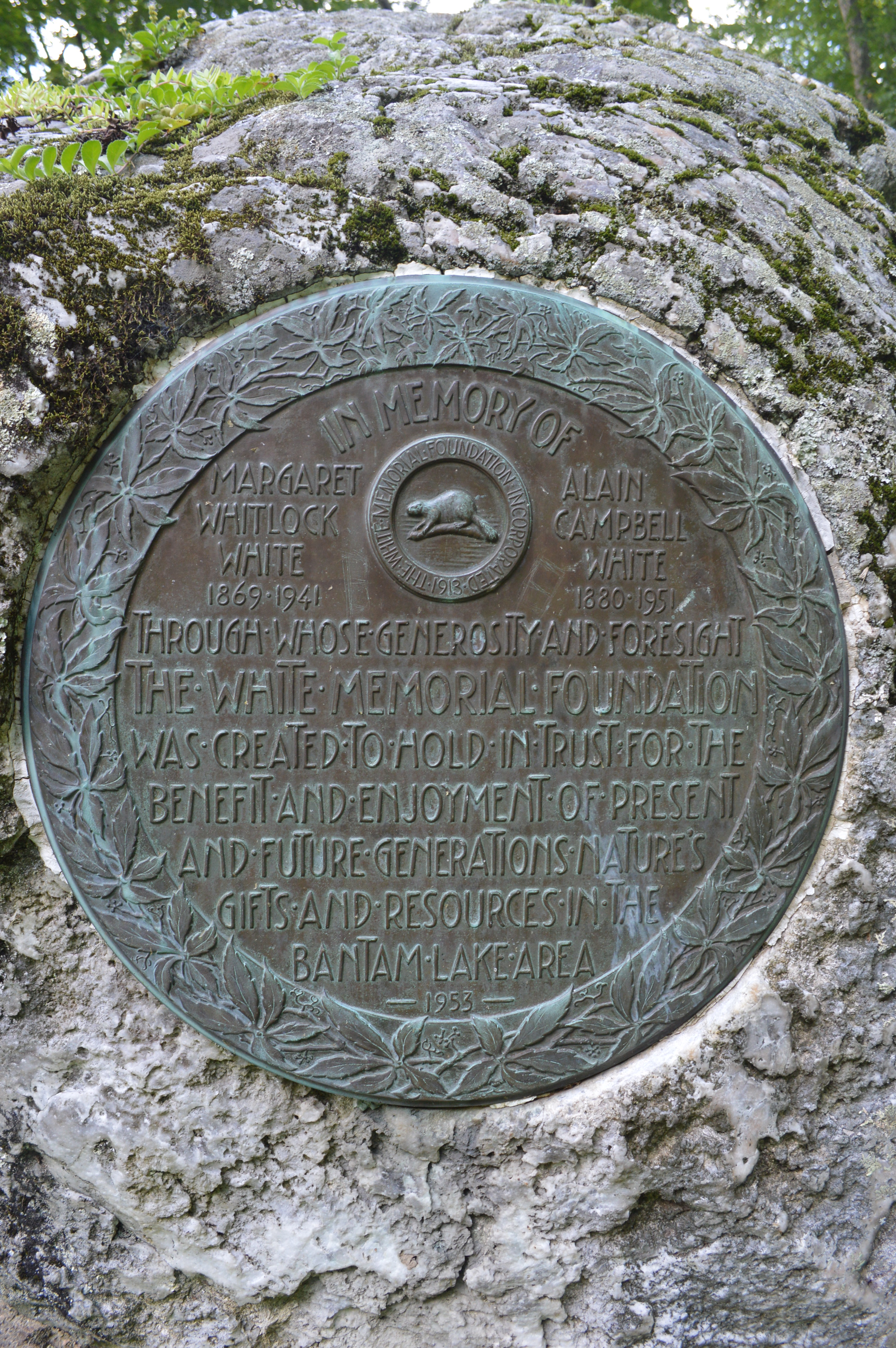
An earlier post examined the memorial to Alain and May White that stands near the Plunge Pool.  That monument, an inscribed boulder in the woods, was erected in 1980.  An earlier monument to these great conservationists stands at the entrance to Sandy Beach.

2013-08-06 15.06.24

In 1953, the White Memorial Foundation dedicated this monument.  It was designed by James Kip Finch, who served on the Foundation’s board of trustees from 1925 to 1966.

Sandy Beach, c. 1930.  (Courtesy Litchfield Historical Society)

Sandy Beach, c. 1930. (Courtesy Litchfield Historical Society)


Sandy Beach is an appropriate place for such a memorial, as one of the goals of the Whites was to make Bantam Lake’s shoreline available to local residents.  The Whites purchased the land in the 1920s from the Wadhams family, who farmed the area.  By 1929 Sandy Beach sported 30 bathhouses as well as a concession stand and a float in the lake.  Sandy Beach was widely popular from its inception.  It hosted nearly 650 visitors on a single day in 1929, and 30,000 people utilized the beach in 1930.  The beach offered cheap entertainment to a region facing the Great Depression.

Photo courtesy of litchfield.bz

Photo courtesy of litchfield.bz

The Whites established the Sandy Beach commission in 1928, which worked with the  Foundation to manage the site.  In 1976 stewardship of the beach passed to the towns of Litchfield and Morris.  After more than 80 years, however, Sandy Beach continues to serve its original purposes of offering local residents a refuge from the summer heat.

The Phelps Block and the Fire of 1886

DSC_0238  Litchfield’s great fire began at 1:30 a.m. on June 11, 1886 in Moore and Maddern’s General Store, which stood on West Street next to the Mansion House, a large hotel on the corner of West and South Streets.  A New York Times article reported that “the flames spread rapidly, there being no adequate means of fighting them.”  The fire, which burned both down South Street and West Street from its origin, was extinguished only when it had burned all the flammable structures it could reach.

Ruins of the Mansion House.

Ruins of the Mansion House.  The Litchfield Historical Society.

Guests at the hotel were able to escape with their possessions, but the structure itself burned to the ground.  The Times aptly reported, “it is fortunate that the blaze did not occur during the height of the season, when it certainly would have been accompanied by serious loss of life.”

West Street ablaze, 1886.  The Litchfield Historical Society.

West Street ablaze, 1886. The Litchfield Historical Society.

The court house was also destroyed, although the county records were saved.  Thirty feet west of the court house stood a brick building.  Here the westward progress of the flames were halted. The town’s business district was described as “simply cleaned out.”  Estimates of the cost of the destruction ranged between $60,000 and $200,000, an amount that, adjusted for inflation, would be in the tens of millions of dollars today.

DSC_0234The town received an ultimatum that the court house be rebuilt, otherwise judicial proceedings would be moved to New Milford or Winsted.  A new court house was constructed at a cost of $13,000.  Tragically that court house was destoyed twenty-six months later when another fire swept the town; this one began on the lower end of West Street and burned up to the court house.  Town fathers immediately revoked all building permits for wooden structures and rebuilt the business district.  The Mansion House was replaced by the Phelps Block, built by merchant and real estate developer Eugene Phelps.  With five shops on the ground floor and an opera house on the top, it was the crown jewel of the rebuilt town.  The stone carved “Phelps Block 1887” still bears witness to the town’s recovery from the fires.


Hidden Nearby: Sharon’s George Whitefield Monument

george whitefield


The Great Awakening, which swept the American colonies in the 1740s, arose in response to the increasingly pedantic tone of Congregational ministers and the increasingly structured and formal organization of the churches. Instead, those ministers involved with the Great Awakening (who became known as New Lights as opposed to the Old Lights who favored the traditional ways) looked to shift the emphasis of their congregants to a religion based upon spirituality. Among the best known of the New Lights were Jonathan Edwards and George Whitefield.

pgeorge-whitefield

George Whitefield

Litchfield County, a bastion of traditional Congregationalism, was only lightly touched by the Great Awakening.  However, Whitefield preached in Sharon in June of 1770, an occasion commemorated with a marker that still stands on the Sharon Green.

whitefield

Whitefield preaching.

Whitefield was born in England in 1714 and first came to the American colonies in 1738, landing in Georgia.  He preached there for about a year, returning to England to raise money for an orphanage to be built near Savannah.  He traveled to the colonies again in 1740, preaching before thousands in New England and New York, before traveling on horseback from New York to Charleston, the longest such trip undertook to that time by a European.

Another image of Whitefield preaching.

Another image of Whitefield preaching.

A devout Calvinist, Whitefield believed that God maintained sole agency over salvation, but did freely offer the gospel, ending his sermons by saying, “Come poor, lost, undone sinner, come just as you are to Christ.”   Whitefield preached to tens of thousands during his many visits to America, and his sermons were tremendously influential.  By challenging the traditional power structure of the Congregational church, he planted seeds in the minds of Americans that they could also question authority in monarchical government.  While Whitefield died in September 1770, a few months after his visit to Sharon, the town’s ardent commitment to the patriot cause was perhaps influenced by his preaching.

Carriage Steps

A prominent carriage step along North Street.

A prominent carriage step along North Street.

An earlier post examined the history of Litchfield’s hitching posts.   A similar reminder of Litchfield’s transportation history are the carriage steps (or mounting blocks) that dot North and South Streets.

2013-08-06 12.06.38

Mounting blocks were simple stone blocks – often granite – that allowed passengers and easier way of climbing on board a carriage or stagecoach.  Carriage steps were a fancier alternative, with two steps often carved into the stone.

2013-08-06 11.47.23

A remnant of a mounting block along South Street.

While they were often found outside the homes of the town’s wealthier residents, they speak to the importance of carriages and stages and means of transportation.  These conveyances brought students to the Tapping Reeve Law School and Sarah Pierce’s female academy.  The wealth and cultural refinement of these students helped establish the cosmopolitan atmosphere of Litchfield in the early 19th century.

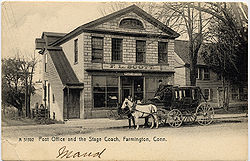
A stagecoach in Farmington; it was perhaps bound for Litchfield.

A stagecoach in Farmington; it was perhaps bound for Litchfield.

Historian Lynn Brickley has written that while stagecoaches were forbidden from traveling at night, advertisements stated that the stage would leave Litchfield at 3 a.m.  A stage could travel 4-5 miles per hour, with stops every ten miles to change horses.  Still, rugged roads could slow the process, and the stage took 14 hours to travel 24 miles.

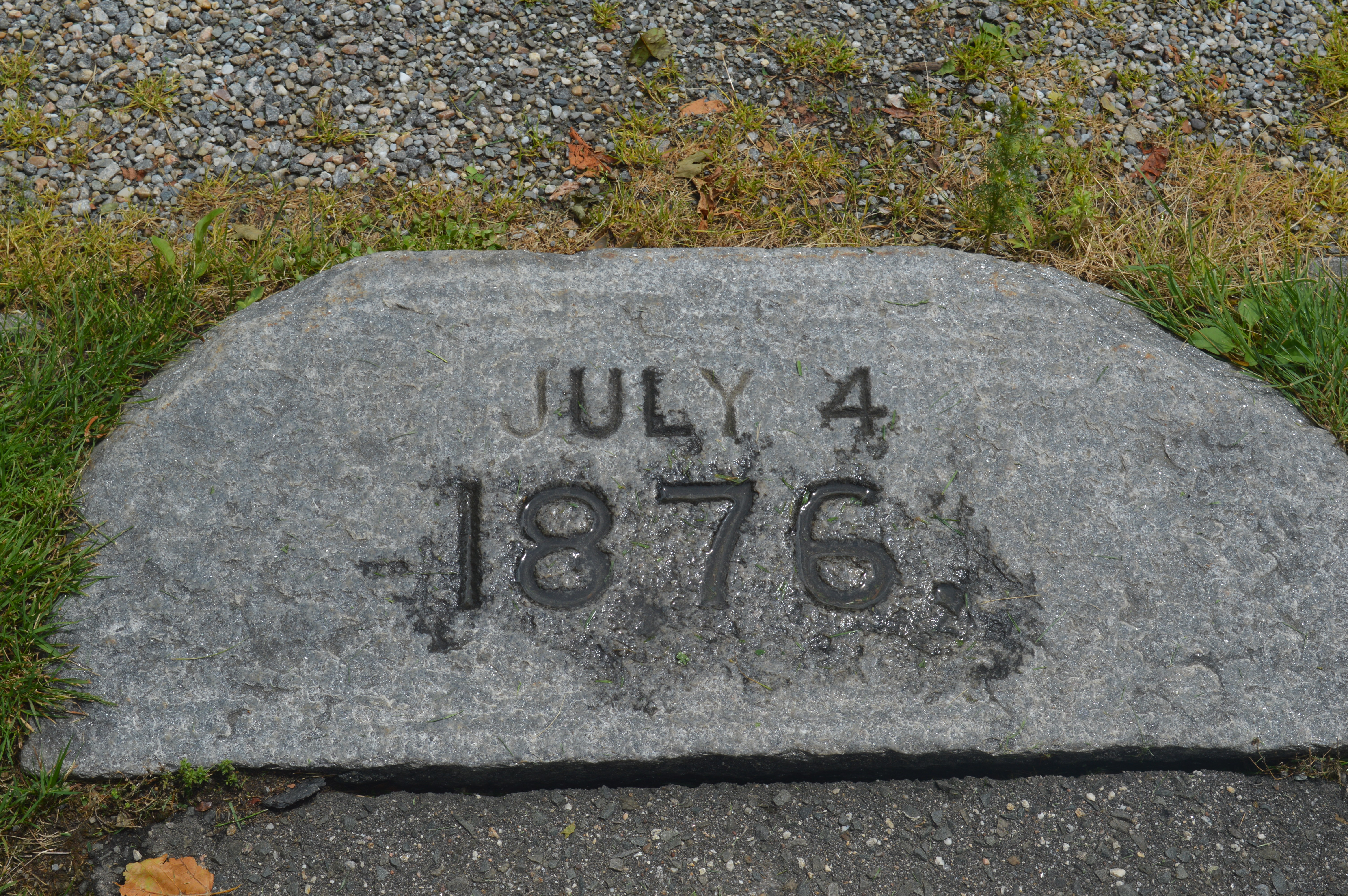
George Woodruff's centennial inscription may have served as a mounting block.

George Woodruff’s centennial inscription may have served as a mounting block.

Ultimately the arrival of the railroad would make stagecoaches no longer economically viable, and automobiles would do the same to carriages.  The implements of horse-drawn travel – hitching posts and carriage steps – remain as testimony to their importance in an earlier age.

Hidden Nearby: Sharon’s Moravian Monument

Jan_Hus_2

Jan Hus

The Unity of Brethren, better known as the Moravians, also played an important role in the early religious history of the county.  The group’s nickname stems from the refugees from Moravia, an area of the present day Czech Republic.  The Moravians were essentially followers of the Catholic revolutionary Jan Hus, who advocated for giving lay people a more prominent role in the church and having masses said in vernacular languages.  Hus was burned at the stake in 1415.
Nikolaus_Ludwig_von_Zinzendorf_(portrait_by_Balthasar_Denner)

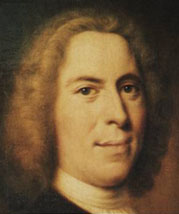
Nicolaus von Zinzendorf

One of the principal tenets of the Moravian church is the “ideal of service,” which emphasizes the importance of educational and missionary work.  At the forefront of these ideals was Count Nicolaus von Zinzendorf, a German social reformer and Moravian bishop who led efforts to spread Christianity through the Native Americans of the Northeast.  Around 1740, von Zinzendorf himself came to America, and preached to Indians in New Milford.  He was so successful in igniting the fire of Moravianism that the natives agreed to move with Zinzendorf to Bethlem (today Bethlehem), Pennsylvania.  Harsh conditions and illness, however, soon led the Native Americans to return.

V05-26

Monument to Rauch in Pine Plains, NY. Courtesy of Ancestry.com

Around the same time, a second Moravian mission was established in Sharon to minister to the settlements at Shekomeko (Pine Plains, NY), Wequagnock (near Sharon), and the Schaghticokes in Kent.  The mission was founded by the Reverend Christian Henry Rauch, who presided for two years before turning the work over to 26 year-old Reverend Gotlieb Buetner, who died two years later, and was buried at the site of the mission.
DSC_0656

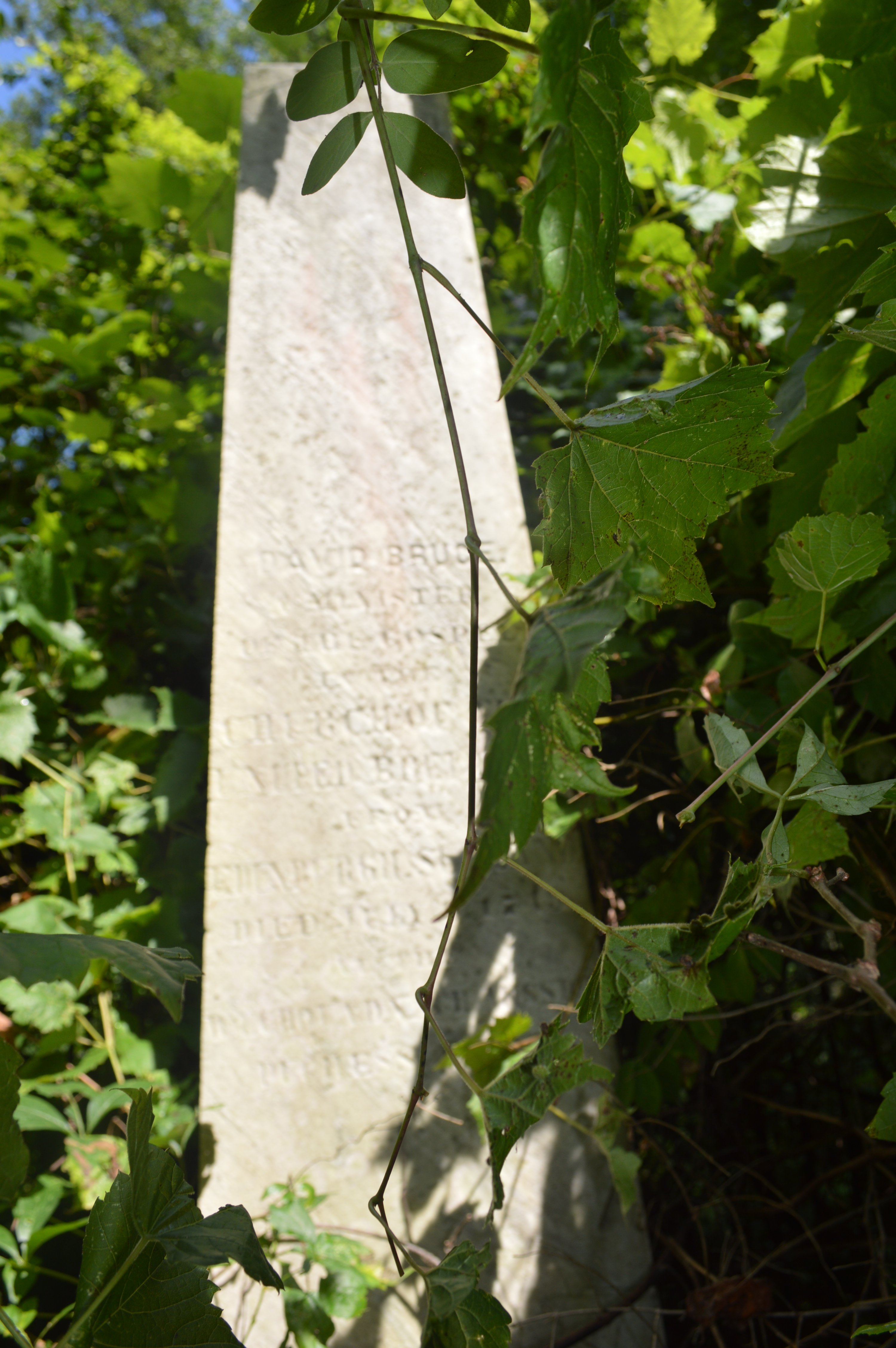
New York State chased the Moravians out of their borders in 1745, fearing that the missionaries were secret emissaries of the Catholic Church.  This led numerous Christian Indians to settle around Sharon, where the Moravian mission continued under the leadership of David Bruce, a Moravian teacher from Edinburgh, Scotland.  In 1789, George Loskiel wrote of Bruce’s activities in his History of the Moravian Missioners Among the North American Indians:

Bruce … resided chiefly in a house at Wequagnock … but sometimes resided at         Schaticook, whence he paid visits to Westenhunk, by invitation of the head chief of the Mohikan nation, soweing the seeds of the gospel wherever he came …. Twenty Indians were added to the church by baptism.  Brother Bruce  remained in his station till his happy departure out of time …. He was remarkably cheerful during his illness, and his conversation edified all who saw him.  Perceiving that his end approached, he called his Indian brethren present to his bedside, and, pressing their hands to his breast, besought them fervently to remain faithful unto the end, and immediately fell asleep in the Lord.

DSC_0658

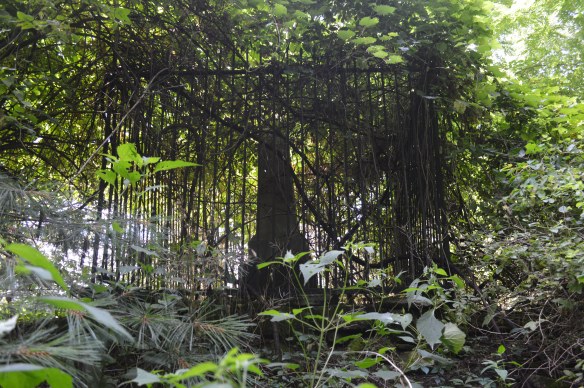
That was July 9, 1749.  A monument to Bruce and Joseph Powel, a later Moravian missionary, was erected in Sharon in October 1859, 110 years after Bruce’s death.  The monument still stands, hidden deep within the woods along Route 361.  On its east face is the following passage from Isaiah:

How beautiful upon the mountains

Are the feet of him that bringeth

Good tidings, that publisheth peace,

That bringeth good tidings of good,

That publisheth salvation.

Special thanks to my friend and colleague Warren Prindle of Sharon for not only bringing this monument to my attention, but also hacking through the woods with me to find it!

Hidden Nearby: The Harwinton Sign Post

DSC_0298

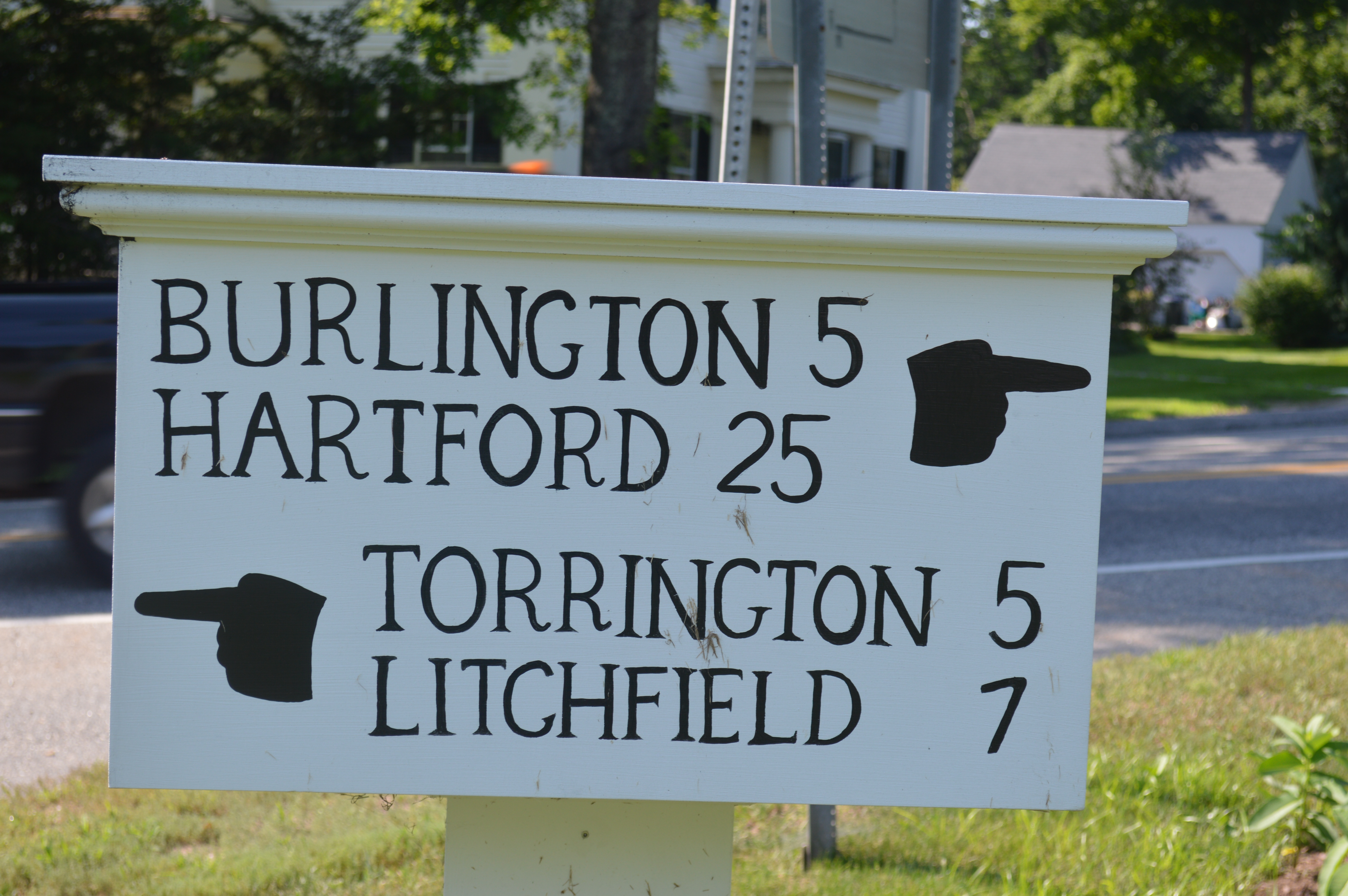
Harwinton derives its name from the fact that it was settled in 1726 by emigrants from Hartford and Windsor, and it was originally called “Hartford and Windsdor’s Town..”  Those settlers from Hartford were given land rights in the eastern part of town, while those from Windsor were given the west side of town.  A post was put on the dividing line, and that post evolved into the Harwinton’s well-known Sign Box.

greencoverreduced

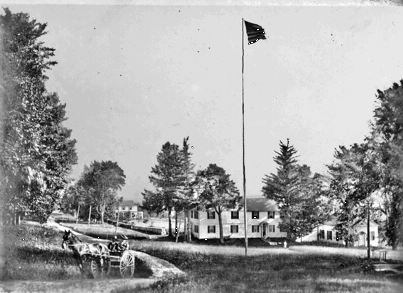
An old image of the Harwinton green, courtesy of the Harwinton Historical Society.

The sign box was designed by Lewis Smith, who served as the town’s probate judge from 1844 to 1860.  In addition to providing directions and distances to nearby towns, the sign box also provided residents a means of posting notices to their fellow townspeople in the days before other forms of communication.

DSC_0300

In 2006 a wayward motorist destroyed the sign box, which was soon replaced.  In May 2013, Larry Connors, a woodworker in town, constructed a more permanent structure and Amanda Surveski, a student at Lewis S. Mills High School, painted the letters, distances and directions.

DSC_0299

While thousands of drivers pass it every day without noticing it, the Harwinton sign box is one of those landmarks that give our New England towns their character.

The Beecher Monument

2013-06-28 11.30.30

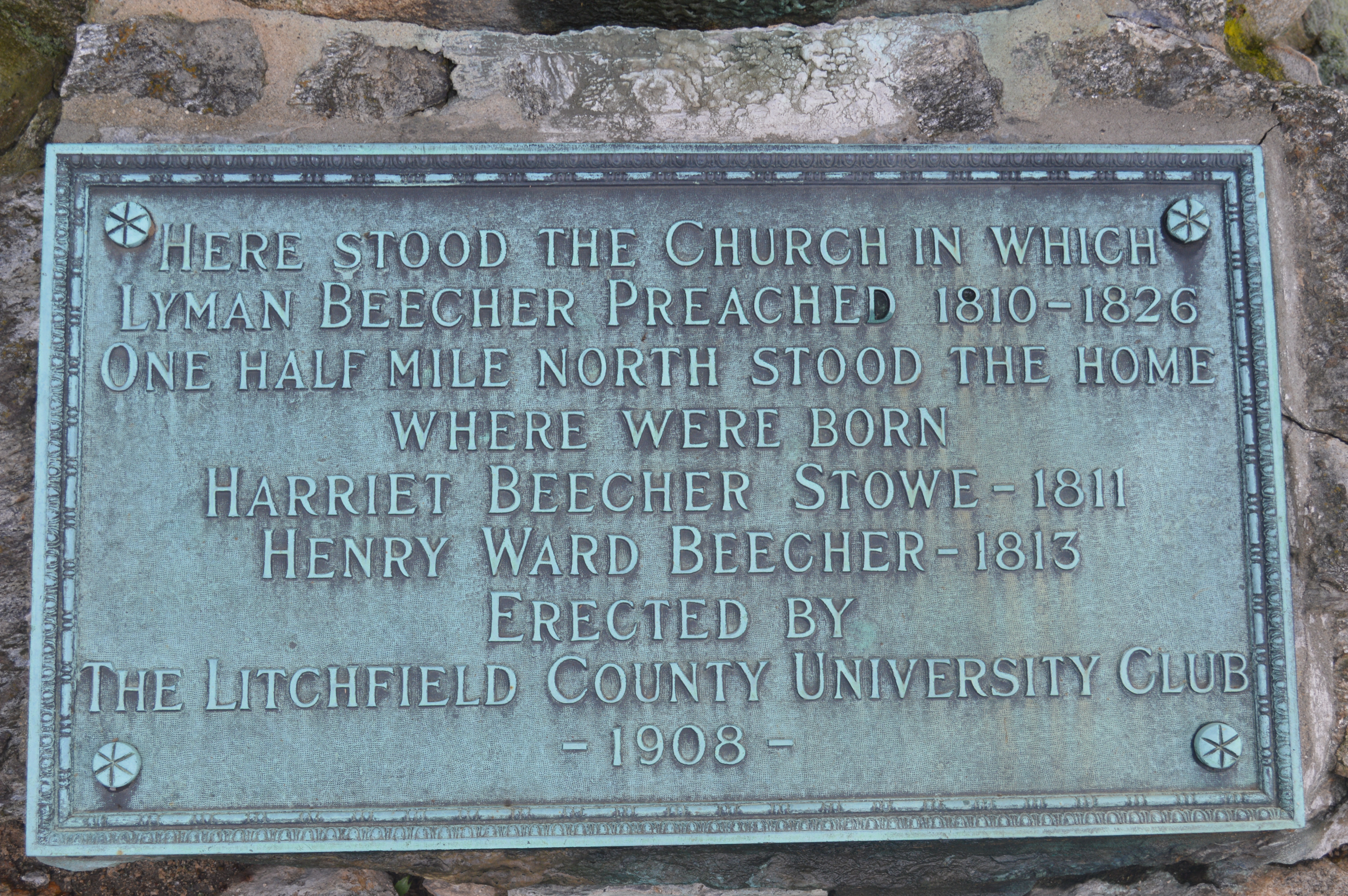
The monument sits prominently on the eastern end of where Route 63 passes through the Litchfield green, a fitting location for the monument to Litchfield’s most prominent family.

Lyman_Beecher_-_Brady-Handy

Lyman Beecher (1775-1863)

Lyman Beecher was born in New Haven in 1775 and graduated from Yale in 1797.  The following year he became the pastor of the East Hampton (Long Island) Congregational Church at an annual salary of $300.  He remained there for twelve years before he was hired by the Litchfield Congregational Church, where he remained for sixteen years. (It is interesting to note that the monument sits at the site of Beecher’s church; the current Congregational Church was moved to its site in 1929).

DSC_0028

Beecher remembered his time in Litchfield as the most “active and laborious” of his life.  In his autobiography he wrote that he “found the people of Litchfield impatient for my arrival and determined to be pleased, if possible, but somewhat fearful that they should not be able to persuade me to stay.  The house yesterday was full, and the conference in the evening, and so far as I have heard, the people felt as I have told you they intended to.  Had the people in New York been thus predisposed I think I should not have failed to give them my satisfaction.  My health is good and I enjoy good spirits, some time past, am treated with great attention and politeness and am become acquainted with agreeable people.”

S4859-lgTimothy Dwight, the president of Yale University, preached the sermon at Beecher’s installment service.  Beecher very quickly established himself as one of the nation’s most important religious leaders.  He was central to the establishment of the Litchfield County Foreign Mission Society, and from the pulpit at the Congregational Church gave the Six Sermons on Intermperance, that when published in book form in 1826 were widely circulated on both sides of the Atlantic and were “among the earliest and most effective” statements on behalf of the temperance movement.

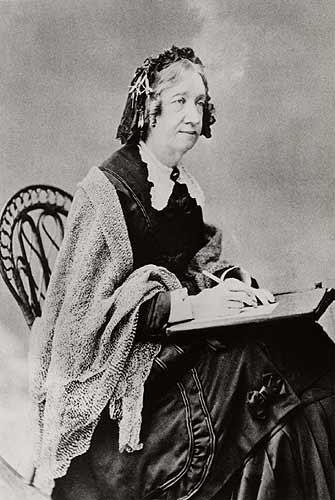
stowe-crop

Harriet Beecher Stowe

Lyman Beecher’s achievements have largely been eclipsed by those of his children; in fact, Theodore Parker, the noted writer and abolitionist said that Lyman was the father “of more brains than any other man in America.”  Harriet Beecher was born in Litchfield the year after Lyman was installed as pastor.  One townsperson shared a recollection of Lyman Beecher serving as the judge of an essay contest among the students of Sarah Pierce’s academy.  Upon hearing one essay he immediately brightened and asked who had written it.  He beamed when he learned it was his daughter’s work.

230px-Henry_Ward_Beecher_-_Brady-Handy

Henry Ward Beecher

Henry Ward Beecher, soon to surpass his father’s fame as a minister, was born in Litchfield in 1813.  He was  remembered by his classmates for building a pulpit out of hay and impersonating the elder Beecher’s sermons.

beecher_008

Catharine Beecher

Catharine Beecher, Lyman’s oldest child, would become a reformer and leading proponent of the cult of domesticity.  While not born in Litchfield, she had fond memories of the annual “minister’s wood sled” when members of the congregation would bring Beecher wood for the winter and in return the Beecher children would serve them cider, hot cakes and doughnuts.

DSC_0030

The Beechers’ time in Litchfield ended in 1826 when Lyman moved to a congregation in Boston.  Harriet achieved her fame in Cincinnati and Maine, Henry Ward headed the Plymouth Church in Brooklyn, and Catharine opened a school for girls in Hartford.  Still, they had a great impact on Litchfield, as remembered by this monument which was erected by the University Club in 1908.