The Constitution Oak

2013-06-28 11.18.57

Connecticut, the “Constitution State,” has a unique history of state constitutions.  The “constitution” that is celebrated on our license plates is the Fundamental Orders of 1638.  This document stated that Connecticut held no political allegiance to England, but rather was loyal to its local government.  In 1662 the Fundamental Orders were replaced by a royal charter exerting the King’s authority over the colony.  However, Connecticut residents paid little attention to this document and continued to abide by the provision of the Fundamental Orders.  This continued until 1818, when provisions establishing the Congregational Church as the official religion of Connecticut were deemed incompatible with the relatively recent First Amendment.  A new state constitution followed.

The Civil War monument in front of the state capitol was erected at the time of the convention in 1902.

The Civil War monument in front of the state capitol was erected at the time of the convention in 1902.

By 1901 it was apparent that there were significant flaws in the 1818 constitution.  Senatorial and House districts were set up according to geographic rather than population guidelines.  The end result was that Union, with a population of 1,000, had the same number of representatives as New Haven, with more than 100,000 residents.  In 1901, Connecticut voters called for a constitutional convention by a 2-1 margin.  The convention put forth a proposal that would award towns between one and four representatives based on population.  This was not enough for the cities, but too much for the small towns, and the proposal was voted down by another 2-1 margin.

Charles Andrews

Charles Andrews

That convention would be all but forgotten except that each of the 168 delegates (representing every municipality in the state) was given a pin oak seedling to plant in their town.  Charles Andrews, one-time governor (1879-1881) and then chief justice of the state supreme court was Litchfield’s representative and the presiding officer of the convention.  He planted his at the eastern end of the town green.

2013-06-28 11.19.48

Periodic surveys of these trees have revealed dwindling numbers.  Of the 168 original oaks, 110 were still standing in 1939 and 86 in 1986.  The last survey, conducted in 2002, revealed only 74 remain.  While a new state constitution was finally approved in 1965, Litchfield’s oak – a reminder of a failed constitution – still stands.

Periodic surveys:

1902 168
1937 110
1986 86
2002 74

Hidden Nearby: The Kent Falls CCC Trail

DSC_0234

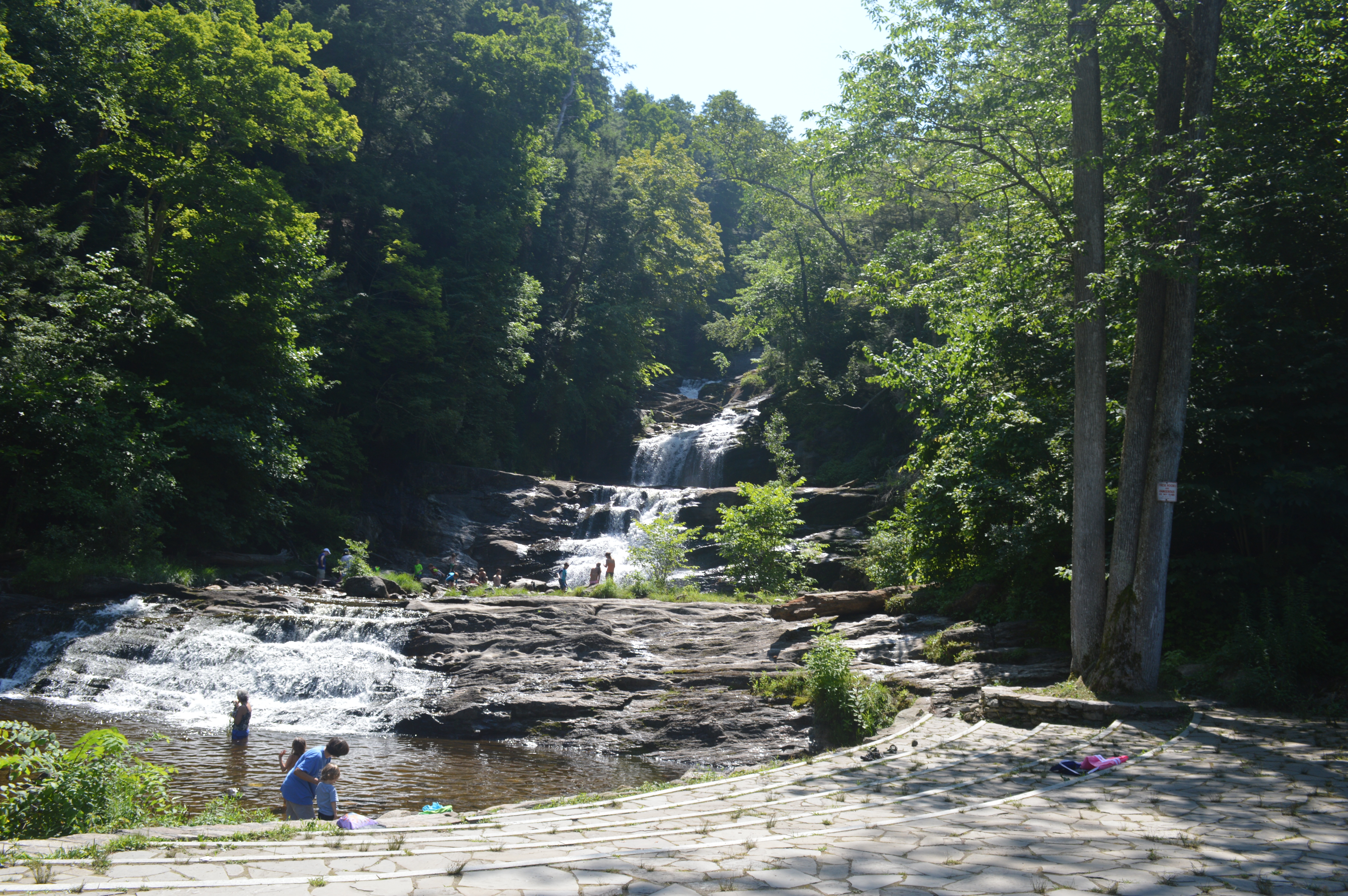
Kent Falls is one of Connecticut’s most popular state parks, with hundreds of thousands of people taking advantage of its picnic area and cooling waters every summer.  There remains at least one part of it, however, that is hidden in plain sight.

DSC_0216

Nearly all visitors who hike to the top of the falls do so via the paved path and steps.  At the northern end of the parking lot, however, is the red blazed trail.  Following this trail for a tenth of a mile brings the explorer to the yellow blazed trail.  The reward for the additional effort is a gradual switch-backed ascent to the top of the falls, with magnificent stone retaining walls supporting the trail (which is an old road bed.)

DSC_0221

The stone walls were built by the men of the Camp Macedonia unit of the Civilian Conservation Corps during the Great Depression.  The camp opened in June 1935 and employed 202 men.  While originally opened to build what would become Macedonia State Park, suitable land for a camp was not available near Macedonia Brook.  (The site of Camp Macedonia has only within the last five years been located; its location is not being shared as means of preserving it are determined.)

DSC_0226

In addition to the stone walls, the CCC also constructed the picnic area and the other trails to the top of the falls.  In exchange for their labor, the men received $30 per month, $25 of which had to be sent home to their families.  They were also provided with food, lodging, medical care and education, a desired commodity as most of the men had only an eighth-grade education.  Responsible men were paid an extra fifty cents a weeks to serve as leaders, helping the two army officers stationed at the camp with its administration.

DSC_0235

Most go to Kent Falls to admire its natural beauty.  It is appropriate, however, to also spend a moment reflecting on the men who made this natural beauty accessible to us.

The Bantam Lake Ice House

This observation tower along the Lake (Yellow) Trail at White Memorial sits at the point where ice was taken out of the lake and sent to the ice house.

This observation tower along the Lake (Yellow) Trail at White Memorial sits at the point where ice was taken out of the lake and sent to the ice house.

This post marks a new partnership between Hiddeninplainsightblog.com and Litchfield.bz.  Litchfield.bz will occasionally be providing videos showing some of the sites discussed on this blog.

In the days before refrigerators foods either needed to be preserved (through canning, smoking, or salting) or kept fresh through the use of ice boxes.  Ice boxes were dependent upon a steady supply of fresh ice, no easy proposition in the summer months.  To satisfy the demand for blocks of ice, ice was harvested from New England ponds and lakes in the winter (usually in January and February when temperatures were the coldest).

Forty acres of Bantam Lake had to be harvested to fill the ice house.

Forty acres of Bantam Lake had to be harvested to fill the ice house.

The earliest ice harvests were done in the same manner as harvesting crops, with neighbors and friends pitching in and being compensated with a share of the crop.  Specialty tools, including gang saws, chisels and saw plows, were used to cut the ice into blocks which were then transported to ice houses for keeping.  Ice houses were designed with the floor one foot off the ground to allow for the passage of air under the ice.  They featured double walls, one foot apart and packed with shavings or saw dust for insulation.  The floors of these ice houses were pitched to allow for drainage.

DSC_0276

The former machine shop at the ice house complex.

The largest ice harvesting operation in Connecticut was the Berkshire Ice Company (later part of the Southern New England Ice Company) on Bantam Lake.  Their facility stood near the present Litchfield Town Beach on North Shore Road in Bantam.  Here the foreman’s house and machine shop still stand, and the remains of workers’ dormitories and, most impressively, the 700 foot by 125 foot ice house are visible.

The ice house had fourteen  30-foot high storage sections that each held 4,000 tons of ice for a total of 56,000 tons of ice.  It would take 40 harvested acres of ice to fill the warehouse.  The particular challenge the workers faced was getting the ice into the storage house.  This was especially difficult as the ice was cut into the 300-pound blocks preferred for wholesale purposes.  (Retail ice was cut into 25, 50, or 100 pound blocks).

DSC_0248

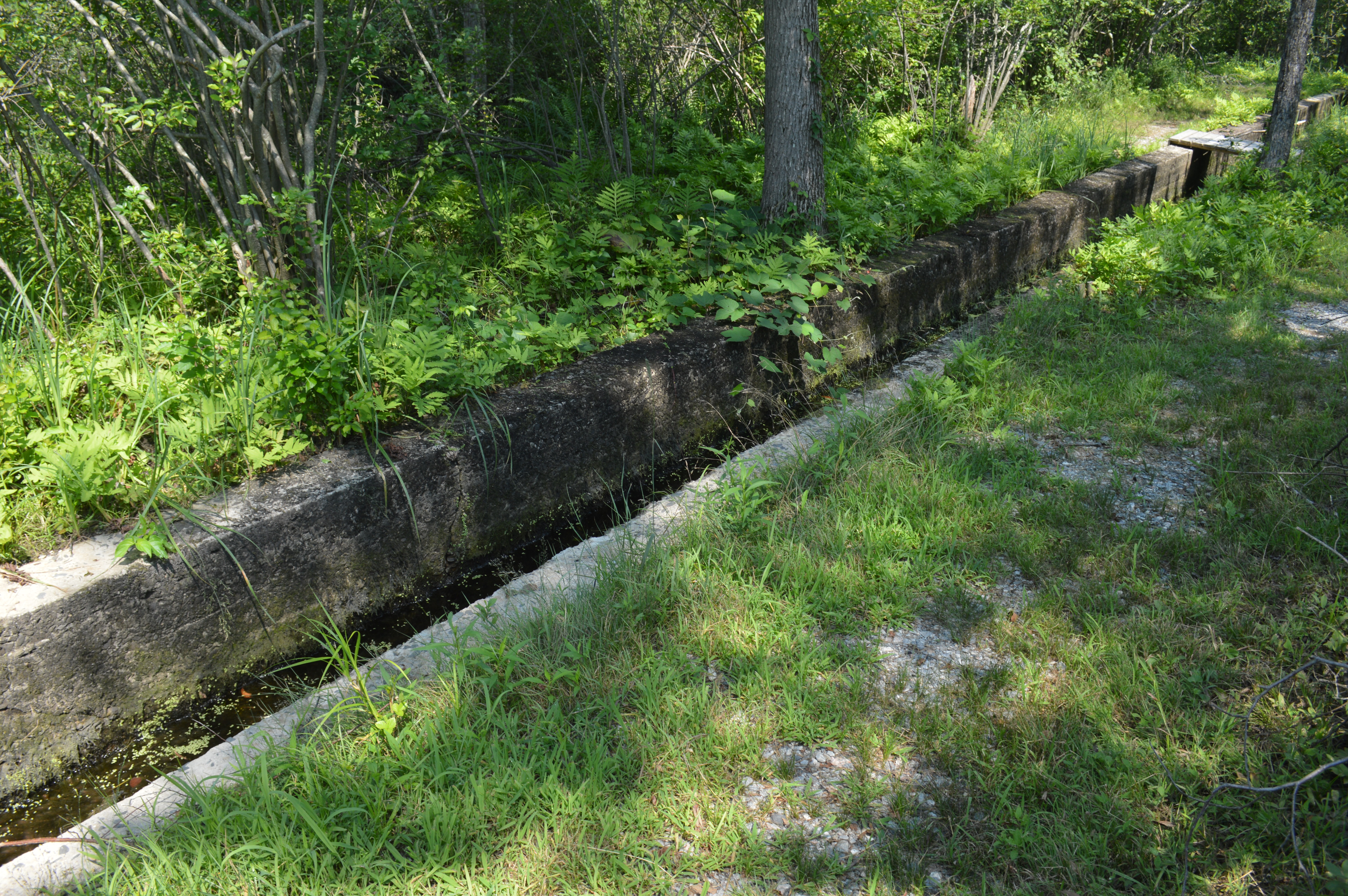
Prior to the conveyor belt system, ice was floated to the ice house via this canal.

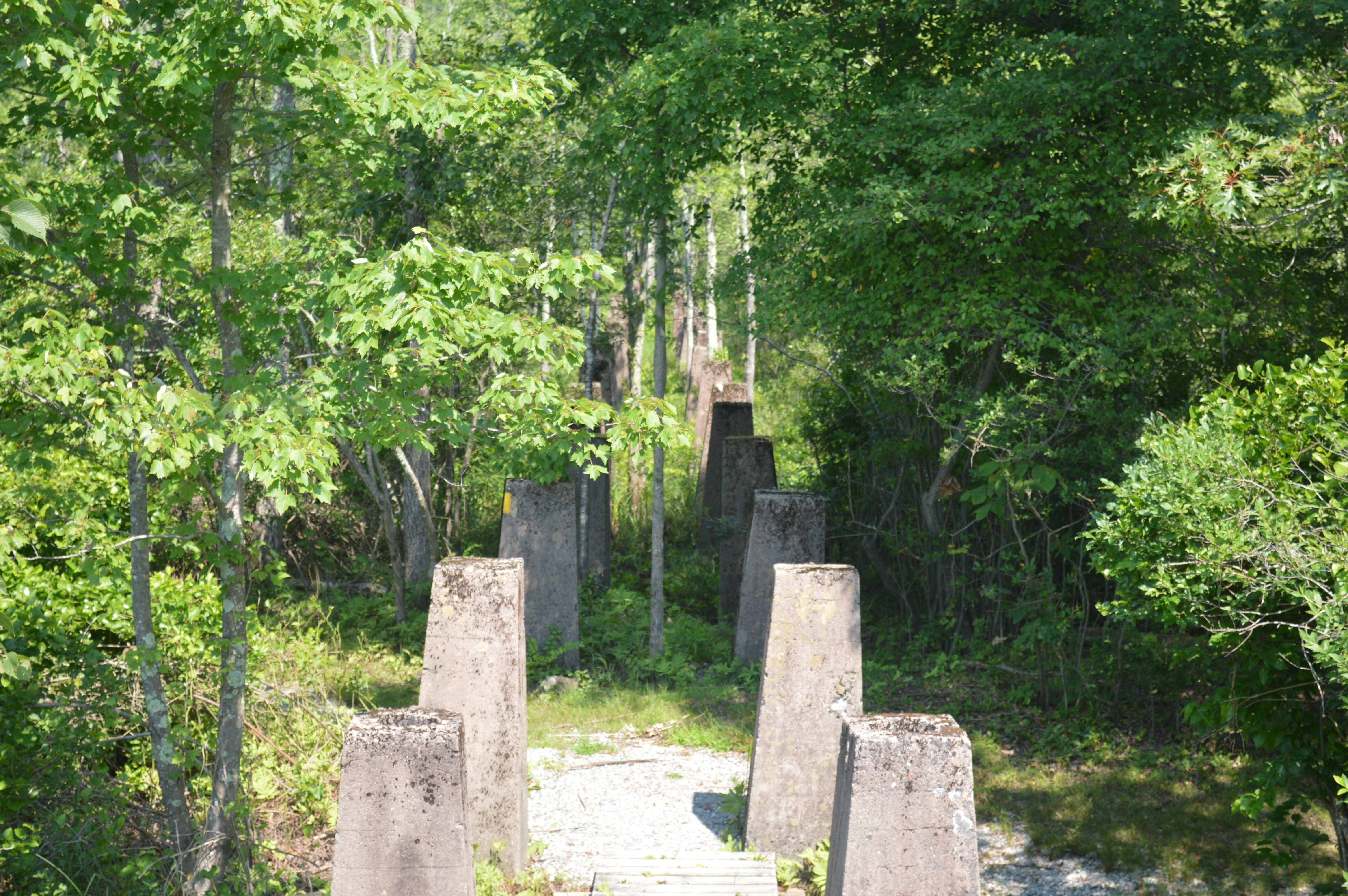
Channels were cut into the lake, and the workers (who were paid 60 cents an hour and worked seven days a week in the mid 1920s) utilized poles to float the ice to a ramp on which rested a conveyor belt.  The concrete pillars of this system still stand as ghostly sentinels in the swampy grounds of White Memorial; the final pillars today support an observation tower on the shores of Bantam Lake.  The conveyor belt was powered by a 100-horse power engine that derived its energy from the Bantam Falls power plant.

DSC_0241

Concrete pillars mark the path of the old conveyor belt.

The conveyor belts ran approximately 1000 feet from the lake to the ice house.  In the summer months, a spur of the Shepaug Valley Railroad ran from the Lake Station (today, the Cove Shops on Route 202) to the ice house, where it split to run parallel so cars could be filled from both sides of the structure.  Up to 20 box cars a day were filled, and the ice was transported as far as Bridgeport.   Alain White, in his History of Litchfield, described the “long trains,” which “pull out daily in the summers, carrying concentrated relief from the Litchfield Hills to the larger cities southward.”

DSC_0278

Remains of the ice house foundation, at the southern end of the Butternut Brook trail.

The spread of electricity and refrigerators to households in the 1920s led to a severe decline in the demand for harvested ice.  On August 8th, 1929, a massive fire swept through the facility.  Some have speculated that the fire was caused by spontaneous combustion of either the hay or sawdust at the site, while others reported that their were several cases of arson in the area.  Either way, over $350,000 in damages resulted from the destruction of the ice house building, nine railroad cars, and over 50,000 tons of ice valued at $200,000.  The next year the Southern New England Ice Company sold its land to the White Memorial Foundation; as a result, the foundations remain to remind us of this once vibrant industry.

For the Litchfield.bz video of the Bantam Lake ice house, click here

The Litchfield Garden Club

DSC_0024

This stone flower urn stands at the intersection of North Street and Norfolk Road in Litchfield.  There are no markers or inscriptions to tell the curious passerby when or why it was built, or by whom.  Further investigation, however, reveals that this is one of the many contributions made by the Litchfield Garden Club to beautify the town.

LGC-CentLogoFinal_jan2012_722013 marks the 100th anniversary of the Litchfield Garden Club.  On September 9, 1913, nine women from the Litchfield area met at the home of Edith and Alice Kingsbury on North Street and organized the club, with annual dues of two dollars.  S. Edson Gage, an architect who had designed the Litchfield Playhouse that stood at the  site of the current town hall, was elected president.

2013-06-29 08.36.45

The old Litchfield train station on Russell Street.

The organization’s first civic project took place in 1914, when – in cooperation with the Village Improvement Society – they spent ten dollars for plantings at the town’s train station on Russell Street.  After the First World War the club was active in maintaining the plantings at the train station as well as beautifying the grounds of the town’s schools and library, and in creating Litchfield’s Wild Gardens on land leased from White Memorial.

trough

Flowers planted by the Garden Club in the trough of Litchfield’s Water Monument.

The Norfolk Road planter was installed in 1954 (the club’s website indicates there may have been others along Norfolk Road), flowers were planted at traffic intersections, and the organization was also instrumental in getting Litchfield’s Historic District added to the National Registrar of Historic Places.  More recently, the club has replanted the trees along North and South Street that were originally planted by Oliver Wolcott, Jr. to commemorate the original 13 states and installed period lighting on the Litchfield Green.

Happy 100th anniversary to the Litchfield Garden Club, which has done so much to enhance the natural beauty of our town!

The Frances Howe Sutton Bridge

sutton bridge

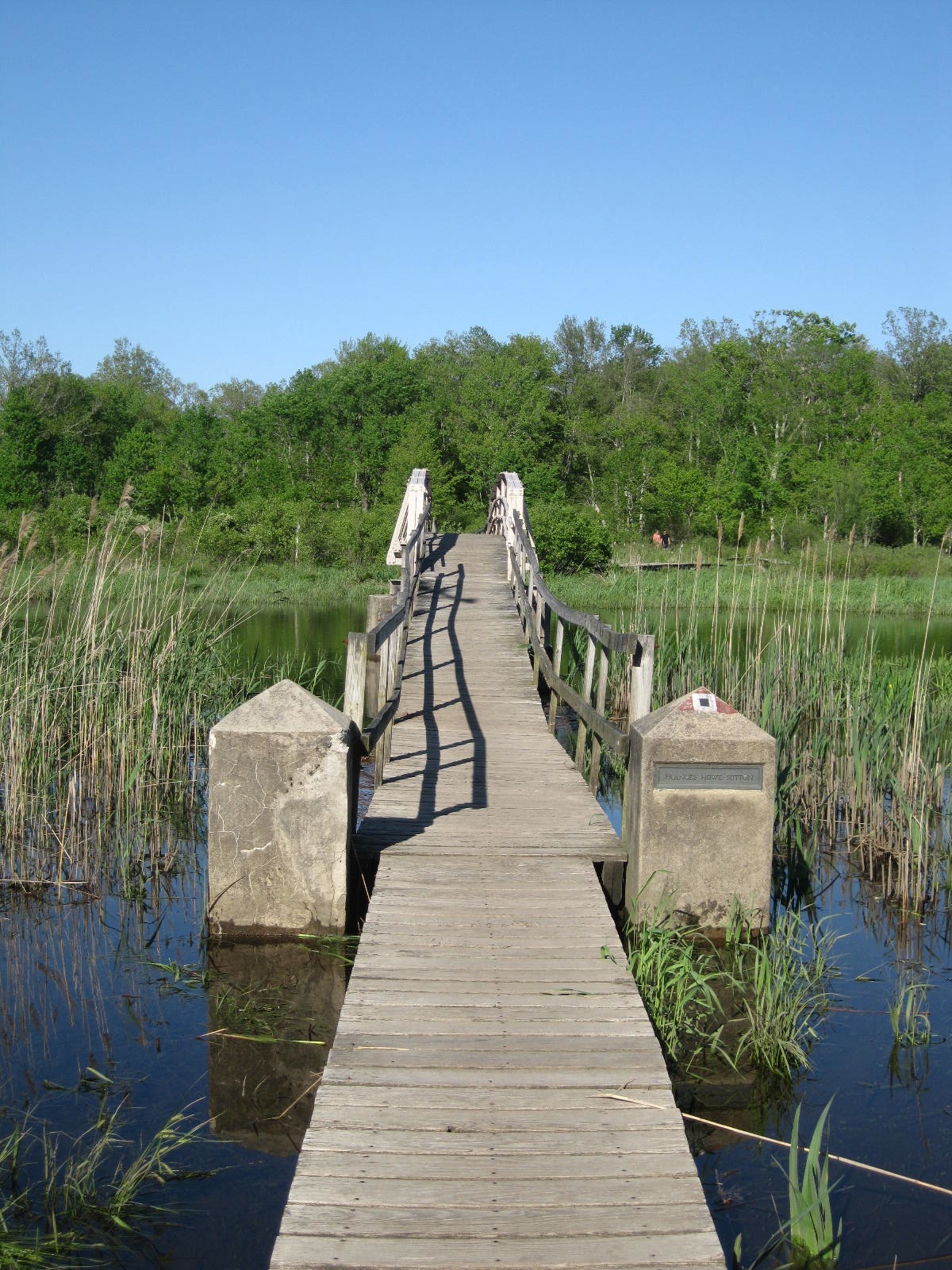
The Frances Howe Sutton bridge on the Little Pond Trail in White Memorial Note the plaque on the right side of the bridge.

The most popular trail in the White Memorial Foundation is the boardwalk that encircles Little Pond.  The bridge in the photograph above, which carries a plaque honoring Frances Howe Sutton, spans the outlet of the pond, where the Bantam River turns toward Bantam Lake.

Wild Garden Map

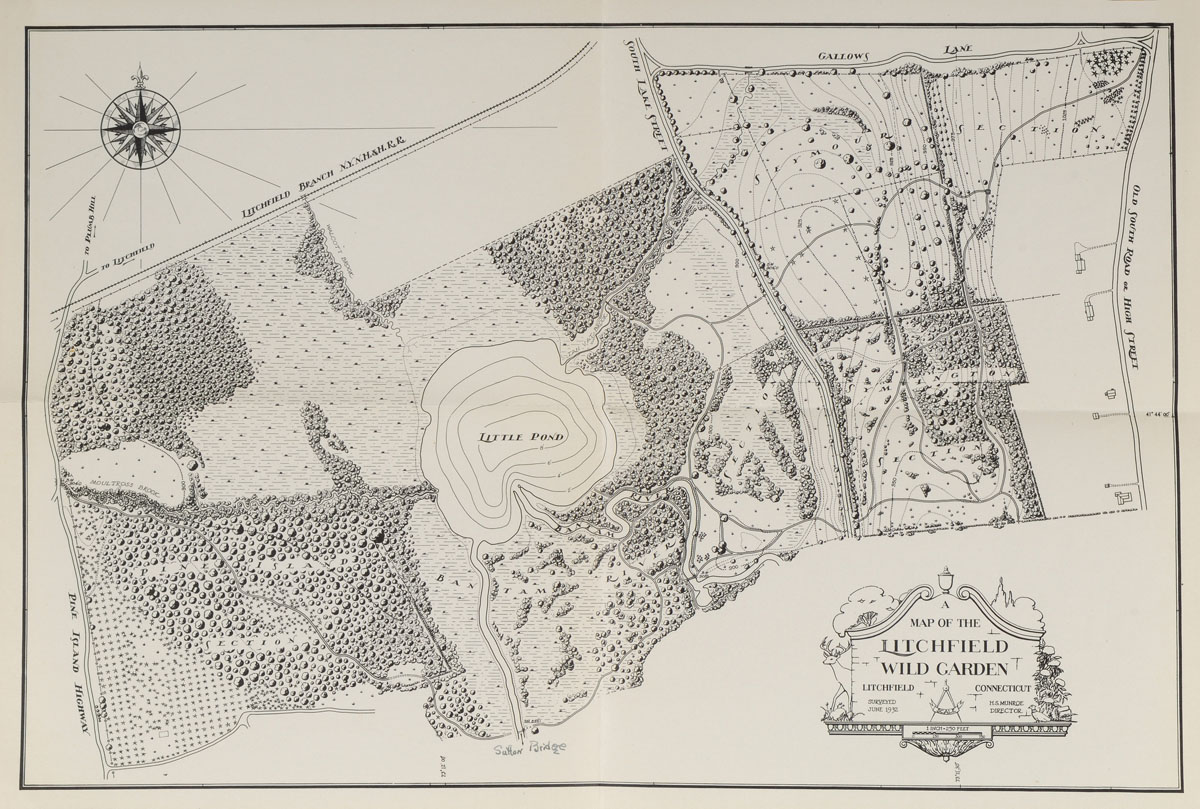
A 1932 map showing the Litchfield Wild Garden. The Sutton Bridge appears at the bottom. “Map of the Litchfield Wild Garden” Litchfield Historical Society, Helga J. Ingraham Memorial Library. Thanks to Linda Hocking at the Litchfield Historical Society for providing the digital image.

In 1922, the White Memorial Foundation leased 150 acres east of Little Pond to the Litchfield Garden Club for the “creation and maintenance of a wild garden containing trees, shrubs and flowers native to Connecticut and to Litchfield County.”  (The Garden Club paid $1.00 to lease the land for ten years.)  The garden club created trails through this area to allow visitors to access the flora.  This became known as the Litchfield Wild Garden.  In 1928, the Munroe Bridge was built to offer visitors access to the west side of the Bantam River as it flowed into Little Pond.  (This is the bridge near the Litchfield Country Club.)

suttonTen years later, Herbert L. Sutton financed the construction of a second bridge, which was built in memory of his wife, Frances Howe Sutton.  This bridge crossed the river as it flowed out of Little Pond, and gave visitors access to the Pine Island section of White Memorial.

sutton 3In subsequent years management of the Wild Garden passed from the Litchfield Garden Club to the Wild Garden Association and then to the Litchfield Hills Audubon Society.  In 1959, the boardwalk was completed around the entirety of Little Pond, in memory of Ralph T. Wadhams.  Finally, in 1975, the area of the Wild Garden reverted back to White Memorial.  While the trails in this area are no longer maintained, the careful observer can still locate where they once ran.

little pond

The view from the bridge.

In September 1985, flooding from Hurrican Gloria necessitated a rebuilding of the boardwalk.  Ultimately this project required 57,000 board feet of lumber, 2,600 hours of labor, tons of nails, and $73,000 to repair the 1.2 mile trail.  While entire sections of the trail and uncounted individual boards have been replaced since 1985, the structure of the boardwalk remains today.  Those who have ventured to Little Pond for birding in the spring or to admire the stark beauty of a New England winter understand why this trail remains White Memorial’s most popular.

For more information on the Little Pond boardwalk, see Keith R. Cudworth, The White Memorial Foundation:  The First 100 Years, The Legacy of Alain and May White (White Memorial Foundation, 2012).

Hidden in Plain Sight: The Walking Tour!

OLYMPUS DIGITAL CAMERA

The Litchfield Historical Society is sponsoring a walking tour based on this blog on Saturday, May 18th, at 10:00 a.m.  We’ll explore some of the sites previously discussed on these pages and share thoughts about some that will appear in the future.  The tour will focus on sites on the Litchfield Green and nearby South Street.  Visit the historical society’s website – http://www.litchfieldhistoricalsociety.org – for more information and for registration.

Hope to see you on the tour!

Hidden Nearby: The King Grist Mill Marker in Morris

IMG_3281This monument, difficult to see as cars speed along Route 109 in Morris, marks the site of the King Family Grist Mill.  The grist mill was once a vital part of New England communities.  While we usually associate grist mills with grinding wheat into flour, that was not typically the case in New England.  Here, with our rocky soil, it was far more common for farmers to raise rye, corn and buckwheat to be milled.  In fact, white bread was considered to be a luxury.

Kings_Mill_on_the_Morris_Road

An undated image of King’s Grist Mill. Courtesy of the Connecticut Historical Society.

This particular grist mill, likely built in the 1830s, was initially run by the Loveland family, who operated the mill in Morris (then called South Plains) for nearly fifty years before it was taken over by the Kings.  In addition to grinding grains, the families also utilized water power to saw timber and for the fulling (cleaning)of cloth.  The mill was described by Marilyn Nichols (who wrote its history, likely around 1905) as being “one of the old landmarks and one of the more generally known throughout Litchfield County and other sections of the state.”  Nichols described its location as being “in one of the most romantic and beautiful valleys of Connecticut.”  In fact, Nichols wrote of one local artist who gained distinction – and $400 – by selling a painting of the mill at a New York studio.

100_3892_250x397-6sec

Diagram explaining the workings of a grist mill. Courtesy of National Park Service.

The Loveland/King mill utilized two circular stones to grind.   Traditionally, both stones would have grooves cut into them to act as teeth.  The grains would be poured over the bottom stone while water power was used to turn the top stone, grinding the grain into flour.  One bushel of grain typically yielded 35 pounds of flour.   Johnnycake was the most expensive product of the mill, as it required a special bolt made from silk, and it was a particular target of hungry mice.

ct_waterbury02

The milldam for the Loveland/King grist mill was destroyed to help create the Wigwam Reservoir for the city of Waterbury.

Farmers would bring their grains to the mill, and the milling usually took place while the farmer waited.  The Lovelands were known to operate their mill until midnight to accommodate the farmers.  Millers usually received a percentage of the grain as payment, and mills often served as commodity houses where grains and flour were traded.

IMG_3282Elijah King took possession of the grist mill sometime before 1874, and while he ran it successfully for some years, changes in farming techniques and the decline of old milling practices left him bankrupt.  In fact, the prevalence of wheat flour from the Midwest and the advent of gasoline-powered engines to mill grains on the farm for animal consumption prompted Nichols to write, “obsolete is the old grist mill in Connecticut.”  Few remnants of grist mills are visible in the state, and the only trace of the Loveland/King mill, once a vital part of the local economy in Litchfield County, is the marker placed by the King family along Route 109.

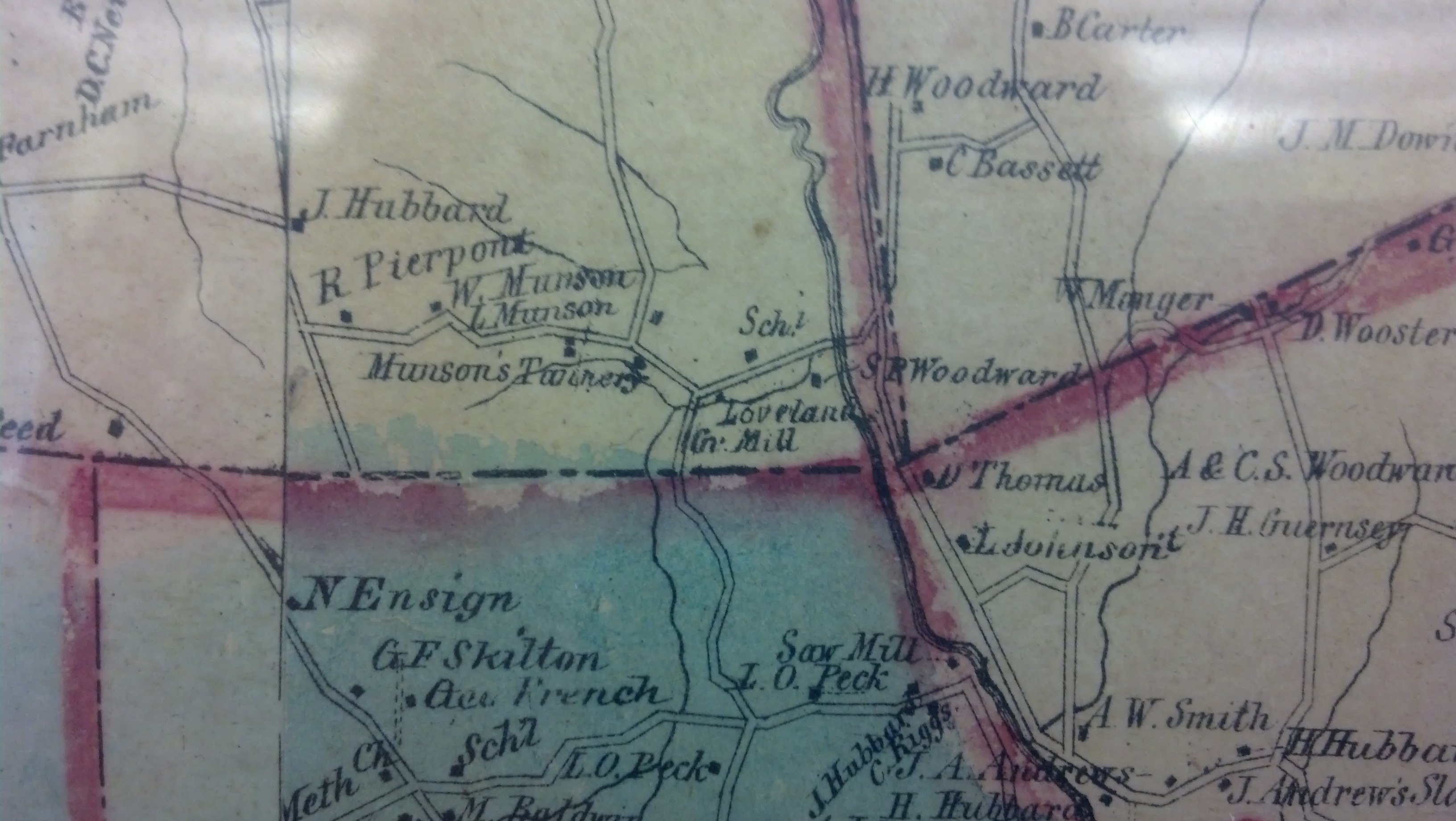
Update:  Below are two maps depicting the mill.  The first is Clark’s 1859 map designating the mill as Loveland’s mill.  The second is Beers’ 1874 map, showing that King owned the mill at that point.  Note also the numerous structures in the area compared to today.

Morris Detail

Clark’s 1859 map

MorrisDetail_Beers

Beers’ 1874 map. Thanks to Linda Hocking of the Litchfield Historical Society for supplying the images of these maps!

Much of this information came from Marilyn Nichols’ lecture, available at:  “Old Grist Mills Cease” (2010-367-0) Litchfield Historical Society, Helga J. Ingraham Memorial Library, P.O. Box 385, 7 South Street, Litchfield, Connecticut, 06759

Revolutionary War Soldiers’ Tree

Rev war Tree 2

This small marker stands at the southeast corner of the eastern section of the Litchfield Green.

The first Arbor Day was held on April 10, 1872 and became an international event eleven years later when Birdsley Northrup of Kent, Connecticut, introduced the event to Japan.  However, Theodore Roosevelt’s ascendency to the presidency in 1901 and his emphasis on conservation issues sparked a nationwide surge of interest in Arbor Day.

In 1902 the Mary Floyd Tallmadge Chapter of the Daughters of the American Revolution celebrated the first Arbor Day of Roosevelt’s presidency by planting a tree on the Litchfield Green to commemorate the services of the town’s Revolutionary War soldiers.

Revolutionary War Soldiers

In all, 507 men from Litchfield served the Patriot cause between 1775 and 1783.  The first to serve were the men of the company led by David Welch of Milton, who were called up soon after news of Lexington and Concord arrived.  A second company enlisted in January 1776 to serve for the defense of New York City.  They drafted a contract specifying the terms of their service under Major General Charles Lee, stating that they were convinced of “the Necessity of a body of Forces to defend against certain Wicked Purposes formed by the instruments of Ministerial Tyranny.”  They specified, however, that they would not serve for more than eight weeks, and stated that General Lee had “given his Word and Honor” to uphold these terms.

fort washington

The Battle of Fort Washington

In November 1776 another company of Litchfield men under Captain Bezaleel Beebe set off for New York.  Thirty-six handpicked men of the company under Captain Beebe were sent to reinforce the American garrison at Fort Washington (today the Manhattan end of the George Washington Bridge).  The men marched into a trap, and were forced to surrender with the entire 2,600 man garrison of the fort.  Although the men were exchanged about a month later, only 11 of these men made it home to Litchfield.

In March 1777 a new call for troops went out, and Litchfield was tasked with enlisting 92 of its men.  The town voted to pay 12 pounds per year to each soldier and to supply “necessaries” to each soldier’s family.  A final call for troops reached town in 1781, and a “selective draft” took place, in which the town was divided into three classes and each class was expected to raise a certain number of men.

Interior of the Old Jersey Prison Ship

Interior of a British prison ship

In addition to those men who were killed and wounded in battle, twenty Litchfield men died while on the dreaded British prison ships.

Rev War Tree

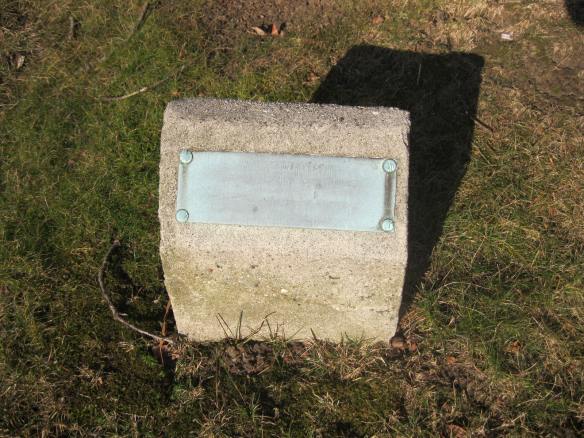
Today, a small stone marker stands at the foot of the tree dedicated to these soldiers.  Its faded inscription reads:

Planted in Memory of

Litchfield’s Revolutionary Soldiers

by the

Mary Floyd Tallmadge Chapter

DAR

Arbor Day 1902

Hidden Nearby: Goshen’s Animal Pound

Pound1

The History of Litchfield County, published in 1881 by the J.W. Lewis Company in Philadelphia, suggests that North Goshen was once a thriving community.  The book offers a house-by-house guide of the area, describing the residents and their commercial and religious activities.

Pound sign

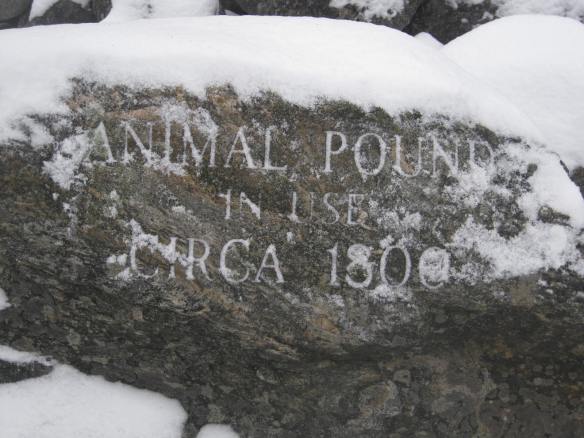
Today, nearly all vestiges of the community are gone, the land owned by the Torrington Water Company.  There are a few hints remaining, however, to the history of this area.  Along East Street North stands an animal pound, a sign suggesting that it was built “circa 1800.”

cattle

Animal pounds were a common sight in early America, as livestock often roamed free.  In fact, at the meetings that established the town of Goshen in 1739, the residents appointed three horse branders whose task was to apply a distinctive mark to each resident’s animals.  That year, 66 distinct marks were recorded in Goshen.

At that same meeting, two men were given permission to build town pounds.  Livestock, by town ordinance, could roam free from March to November.  However, those not in their owner’s barns by November would be impounded and cared for by the town’s pound keeper.  When the owner arrived at the pound to claim his animal, he would pay a fee to the keeper.  Town records in Goshen also indicate that those delinquent in paying their taxes could work off their debt by supervising the town pounds.

Pound 2

The walls of the pound had to be wide enough so that an animal couldn’t step over them.

As part of Goshen’s 250th anniversary in 1989, the Torrington Water Company restored this pound.  Its walls are 35 feet long and 25 feet wide, and stand 4 feet high.

Structures like the Goshen animal pound offer the 21st century explorer a glimpse of life nearly three centuries ago, and remind us of the centrality of livestock to the daily existence of those who inhabited Litchfield County.

The Windmill Hill Windmill

Cistern and Windmill

We take to the woods for many reasons.  Thoreau famously wrote, “I went to the woods because I wished to live deliberately, to front only the essential facts of life, and see if I could not learn what it had to teach, and not, when I came to die, discover that I had not lived.”  Most of us take to the woods for less philosophical reasons – to hike, run, snowshoe, mountain bike, or bird watch.  Hidden amongst the Litchfield woods, however, are reminders of the way the land was used in the past.

There is little old growth forest left in Litchfield County.  In the southern environs of the county the land was cleared for farms.  In its northern reaches, Litchfield County’s woods were utilized for the charcoal needed to power iron furnaces.  When these industries began to transform or fade away, the forests reclaimed their original territory, engulfing many man-made objects and alterations to the landscape.

Perhaps this is most true of the White Memorial Foundation, which owns approximately 5,000 acres in Litchfield and Morris.  In these woods remain many implements of the county’s agricultural and industrial past.

bw windmill

The windmill and cistern on Windmill Hill, White Memorial. From Rachel Carley, Litchfield, pg. 212.

One fascinating example is the base on which the White family’s windmill once stood.  The explorer can find it on the appropriately named Windmill Hill, very near the White Memorial visitor center and museum.  The proximity is no coincidence.

John Jay White, whose children established the foundation in the early 1900s, was a New York real estate magnate who moved from 5th Avenue to Litchfield in 1863.  The home he built, Whitehall, in many ways epitomized the Victorian architectural fashion popular at the time.

View of Whitehall

The view toward Whitehall from the site of the windmill.

On the top of a nearby hill White had a cistern built.  A nearby windmill pumped water into the covered cistern.  Pipes then brought the water more than a quarter mile to the house, which thus enjoyed natural water pressure.

windmill

This structure stands on the approximate site of the windmill.

Today, a concrete slab marks the site of the cistern.  A concrete structure stands nearby; it was built to house the electric pump that replaced the windmill but was rendered obsolete a number of years ago when a new well was dug.

carriage house

White Memorial’s carriage house.

Whitehall still stands, albeit in modified form, as the visitor center and museum of the White Memorial Foundation.  Its top floor was removed and modifications made that erased the structure’s Victorian elements.  Only in the carriage house are glimpses of the Victorian splendor that once marked the estate evident.