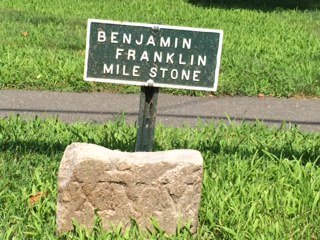
Hidden Nearby: Woodbury’s “Benjamin Franklin Mile Stone”

BF1

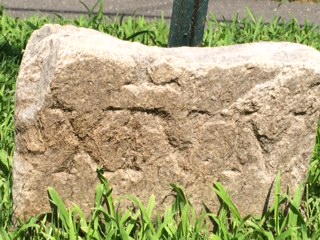
Some legends become carved in stone, or, in the case of Woodbury’s milestone, cast in iron.  The small plaque accompanying a milestone along Main Street in Woodbury states, “Benjamin Franklin Mile Stone.” The milestone itself reads “XIV M,” or fourteen miles. While there is a long-standing tradition that Franklin had these markers laid out – sometimes the legend even states that Franklin himself was involved in the placement of the stones – he was almost certainly not involved.

benjamin-franklin-520

Certain facts about the legend are true. Franklin did serve as one of two deputy postmasters general for the British colonies from 1753 to 1774. Franklin did oversee the modernization of postal roads during his tenure. And, the cost postage in that era was calculated by distance. However, there is no evidence in Franklin’s papers to corroborate the story, and while Franklin did serve as deputy postmaster general for 21 years, he was actually in the American colonies for only 6 years. The rest of the time he was in England on business representing the Pennsylvania colony.
Boston_Post_Road_map

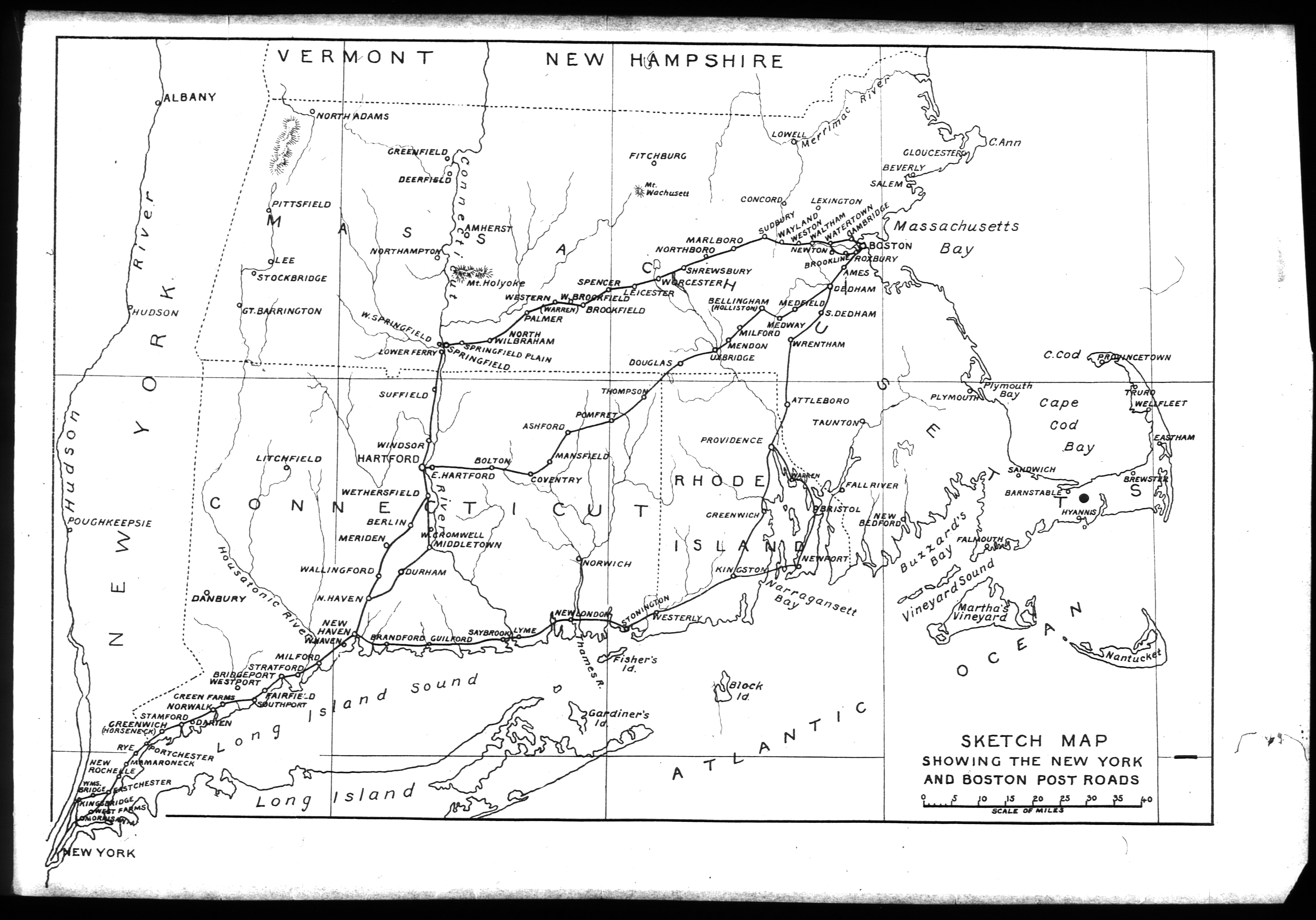
Colonial post roads.

 A specific aspect of the legend claims that Franklin erected a series of milestones between Woodbury and Litchfield while on a trip to New England from June to November 1763. However, Franklin not only didn’t set foot in Connecticut on that trip, but neither Woodbury nor Litchfield had a post office at the time.
 BF2

Milestones had little to do with postal operations, being mostly “embellishments” set up in towns to aid passersby. Post riders were quite familiar with their routes, well aware of the mileages between different points. Still, there are mysteries surrounding the milestones. If it wasn’t Franklin, who did put them up? The series of milestones seems to be the work of different people, done at different times. And what does the distance relate to? Along modern Route 6, it is thirteen miles from Woodbury to both Thomaston and Newtown. Perhaps further study will reveal who constructed the milestone, and for what destination.
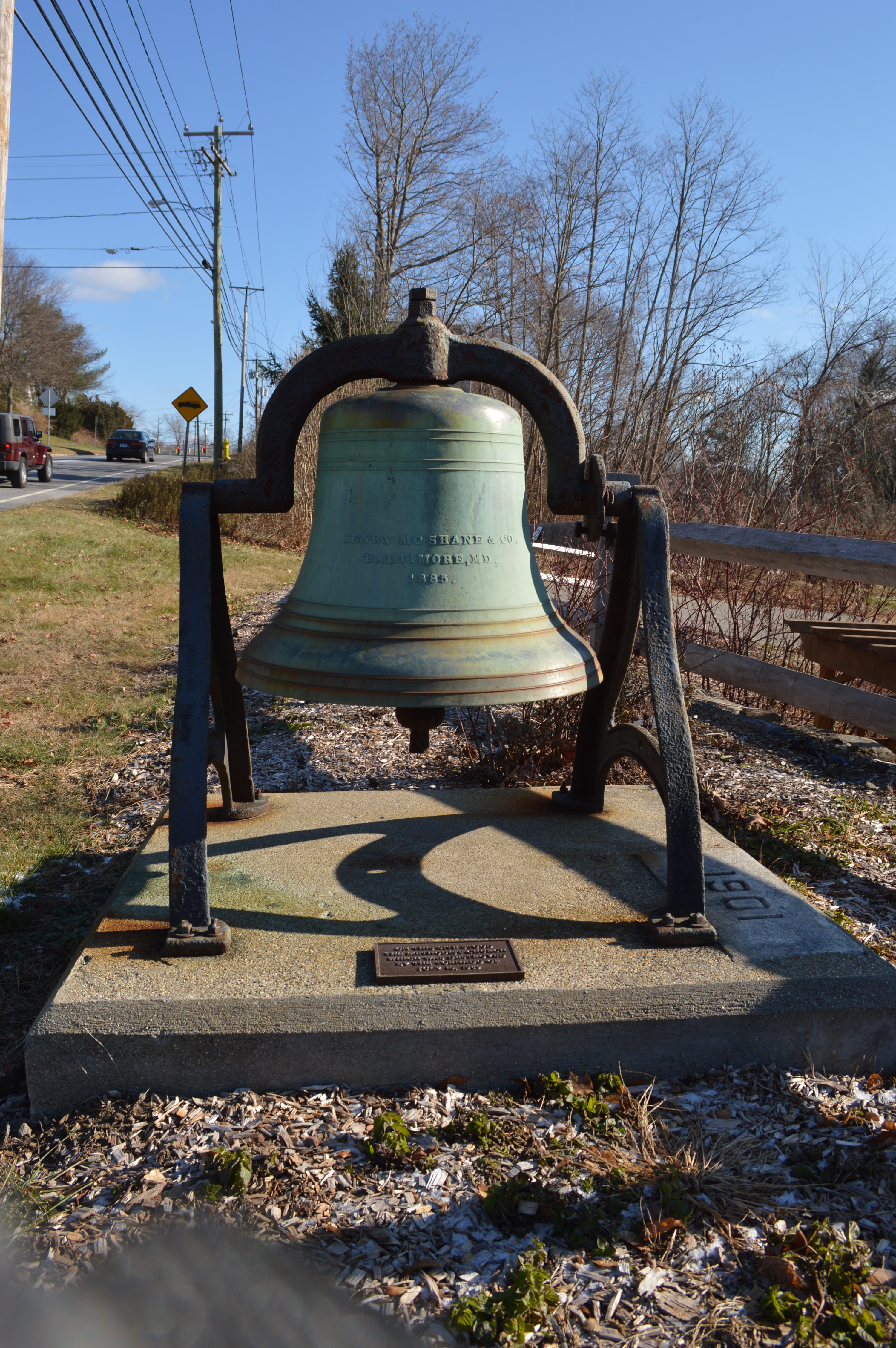
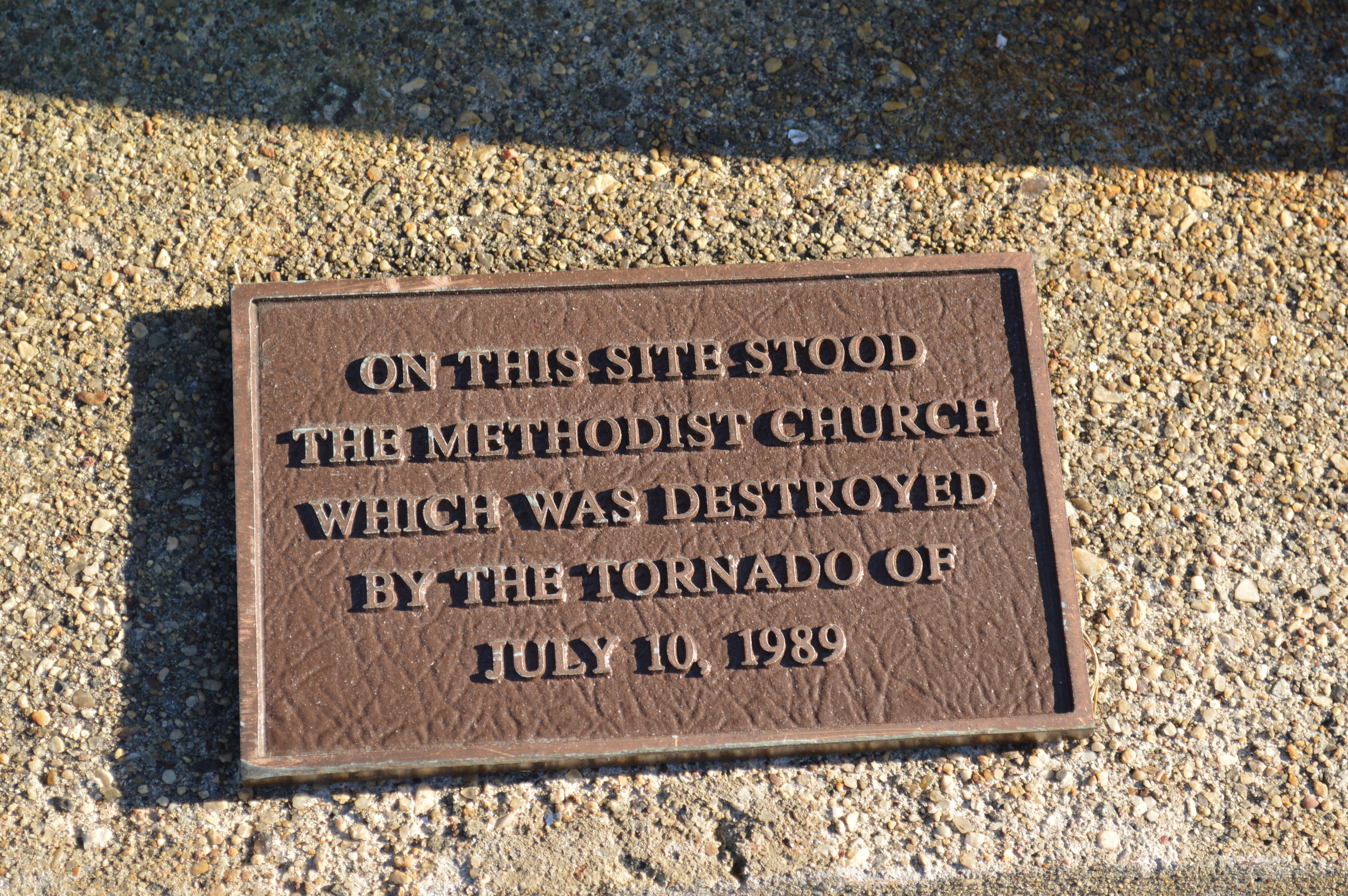
July 1989 Tornado

2013-11-29 11.55.40

This bell and plaque commemorate the United Methodist Church of Bantam, destroyed 25 years ago today by a tornado.

2013-11-29 11.55.21

On Monday, July 10th, 1989, a powerful family of tornados came out of New York State and ripped apart Cornwall’s Mohawk Ski Area, damaging every ski lift and carrying some of their chairs miles away.

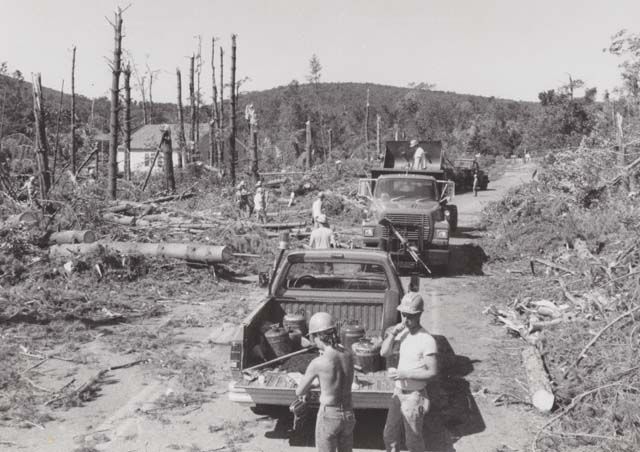
Workers cleaning up the Cathedral Pines area after the tornado.  ctvisit.com

Workers cleaning up the Cathedral Pines area after the tornado. ctvisit.com

Atop any list of Litchfield County’s ecological treasures would have been Cornwall’s Cathedral Pines, at42-acres one of the largest stands of white pines and hemlocks (some reaching 120 feet high) east of the Mississippi. In one of the county’s first acts of ecological awareness, the Calhoun family purchased the land in 1883 to protect it from logging. The family donated Cathedral Pines to the Nature Conservancy in 1967. The tornado destroyed ninety percent of the trees in Cathedral Pines.

An early view of the Methodist Church in Bantam, destroyed by the tornado.  Bantam Historical Society.

An early view of the Methodist Church in Bantam, destroyed by the tornado. Bantam Historical Society.

Winds in excess of 150 miles per hour blew through Milton and Bantam, destroying homes, churches and stores.

Another tornado hit Watertown, and 12-year-old Jennifer Bike was killed when a tree fell on her tent in Black Rock State Park in Thomaston.

2013-11-29 11.53.35

2013-11-29 11.55.09

Today, a small park at the site of the Methodist Church – built in 1901 – in Bantam commemorates tornado. Within the foundation of the church are benches are gardens, a far cry from the fury unleashed on Litchfield County 25 years ago.

I was sixteen years old, working at Lake Waramaug Country Club in New Preston that afternoon. I vividly remember the sky turning a greenish color and a vicious thunderstorm rolling through. Please use the comments area on this blog to share your memories of the tornado.

Sandy Beach Memorial

2013-08-06 15.06.02

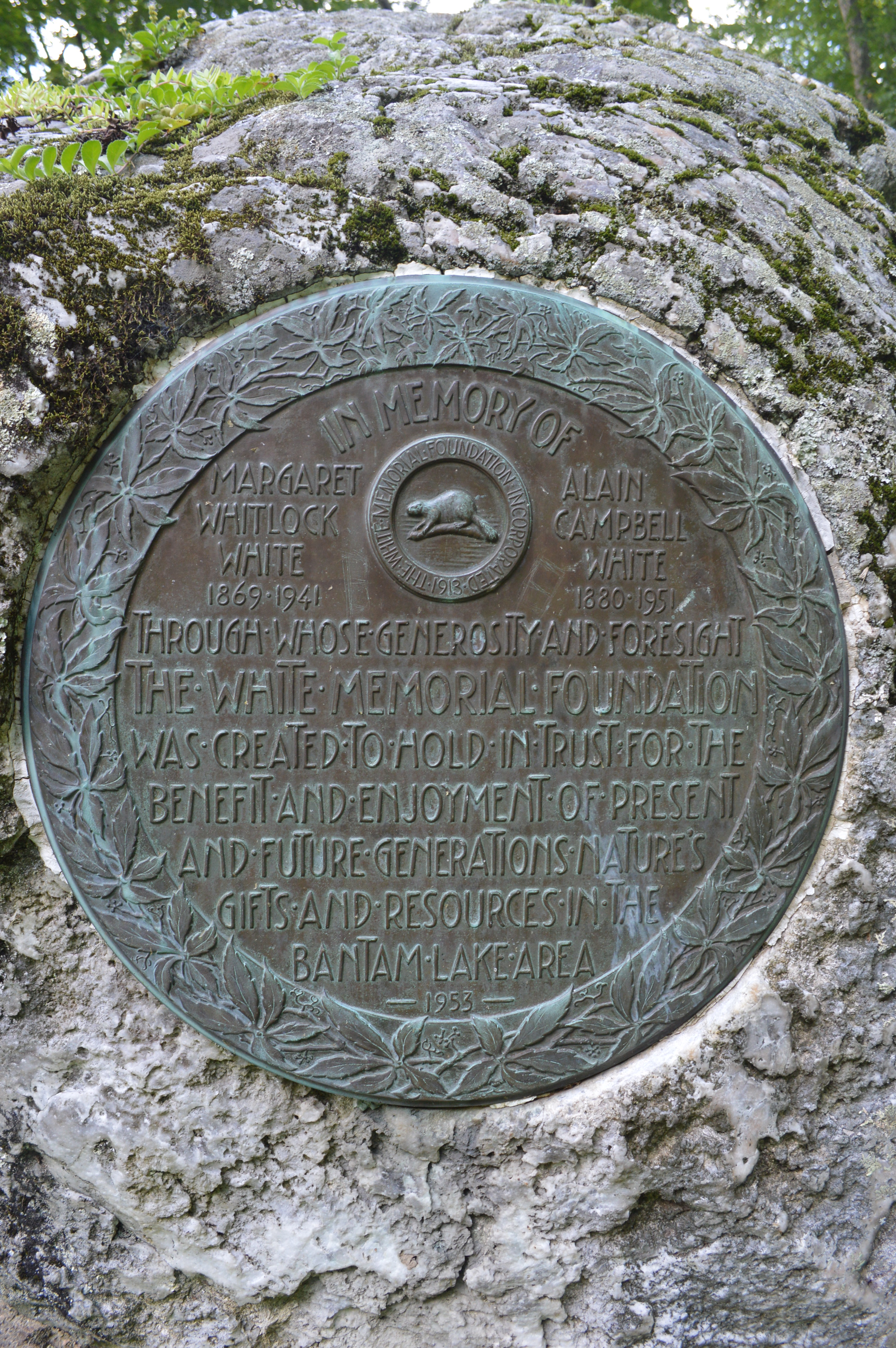
An earlier post examined the memorial to Alain and May White that stands near the Plunge Pool.  That monument, an inscribed boulder in the woods, was erected in 1980.  An earlier monument to these great conservationists stands at the entrance to Sandy Beach.

2013-08-06 15.06.24

In 1953, the White Memorial Foundation dedicated this monument.  It was designed by James Kip Finch, who served on the Foundation’s board of trustees from 1925 to 1966.

Sandy Beach, c. 1930.  (Courtesy Litchfield Historical Society)

Sandy Beach, c. 1930. (Courtesy Litchfield Historical Society)


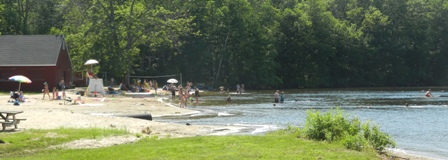
Sandy Beach is an appropriate place for such a memorial, as one of the goals of the Whites was to make Bantam Lake’s shoreline available to local residents.  The Whites purchased the land in the 1920s from the Wadhams family, who farmed the area.  By 1929 Sandy Beach sported 30 bathhouses as well as a concession stand and a float in the lake.  Sandy Beach was widely popular from its inception.  It hosted nearly 650 visitors on a single day in 1929, and 30,000 people utilized the beach in 1930.  The beach offered cheap entertainment to a region facing the Great Depression.

Photo courtesy of litchfield.bz

Photo courtesy of litchfield.bz

The Whites established the Sandy Beach commission in 1928, which worked with the  Foundation to manage the site.  In 1976 stewardship of the beach passed to the towns of Litchfield and Morris.  After more than 80 years, however, Sandy Beach continues to serve its original purposes of offering local residents a refuge from the summer heat.

The Sign-Post Elm

DSC_0548

This is among the most hidden in plain sight of Litchfield markers.

DSC_0547

Today, Litchfield residents who wish to spread news of an event hang flyers at Stop and Shop, the Oliver Wolcott Library, or the Post Office, or information posted on Litchfield.bz. In an earlier day, Litchfield’s residents hung notices on the Sign-Post Elm.


The Whipping Post Elm (White, The History of the Town of Litchfield)

The Whipping Post Elm (White, The History of the Town of Litchfield)

Litchfield had many distinguished elm trees. Brothers Oliver Wolcott Jr. and Frederick Wolcott planted many elms along North and South Streets. John C. Calhoun planted elms at the corner of West Street and Spencer Street and also on Prospect Street when he was a student at the Litchfield Law School. The ominously-named Whipping Post Elm stood in front of the jail at the corner of West and North Streets.; at 150 inches he reportedly had the greatest diameter of any elm in town. Second was the Beecher Elm at 146 ½ inches, at the site of the family home on the corner of North and Prospect Streets.

The Sign Post Elm, with notices visible, at left.  (White, The History of Litchfield)

The Sign Post Elm, with notices visible, at left. (White, The History of Litchfield)


The Sign-Post Elm was not as big, but was, perhaps, of greater importance. For many years it stood at the corner of South and East Streets, in front of what is now the Litchfield Historical Society. It displayed the legal notices of the town, informed residents of town meetings, and hosted, under its branches, auctions and sheriff sales.

DSC_0550

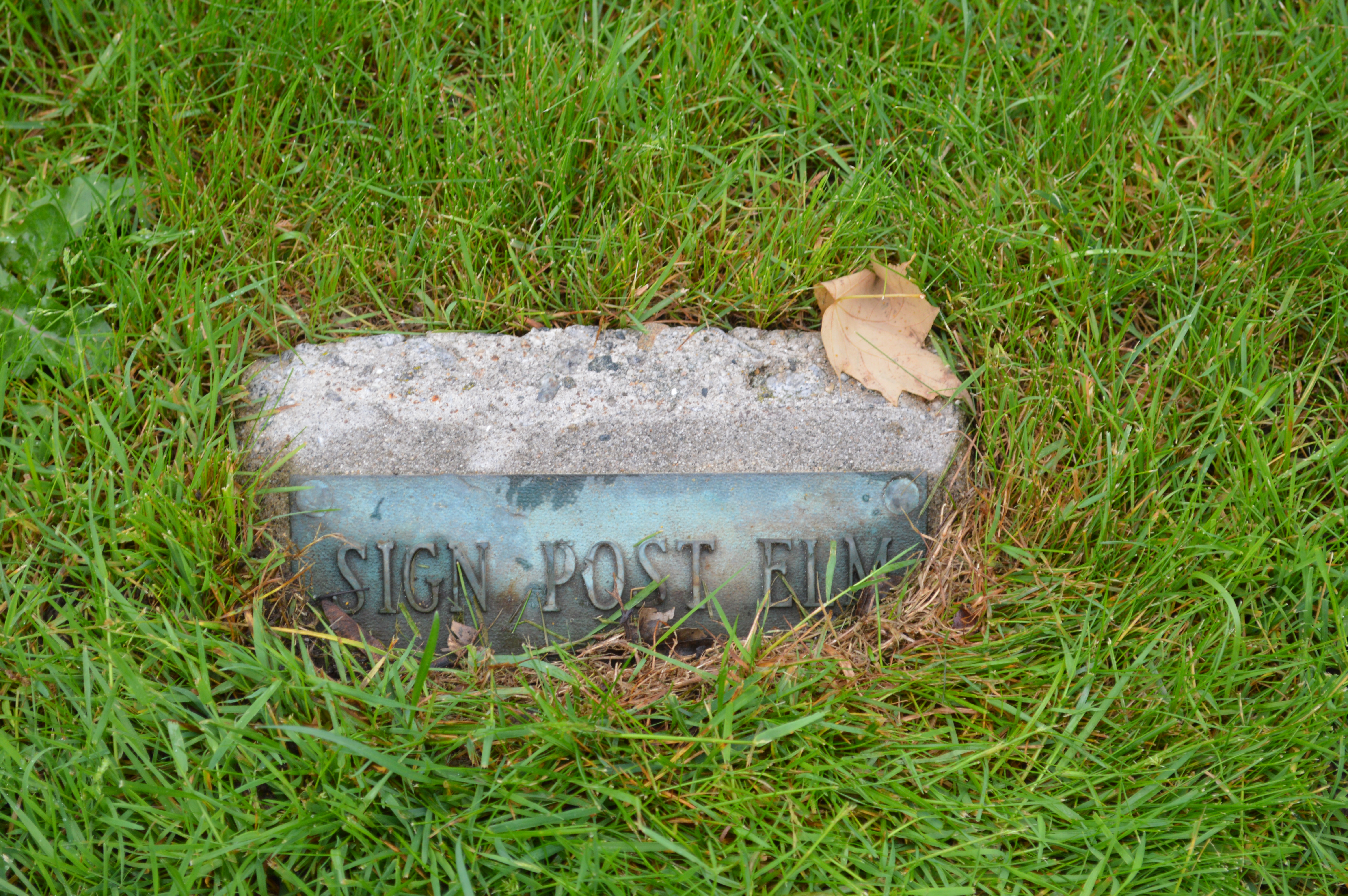
The marker for the sign-post elm is visible as the small stone-like object to the left of the telephone pole in this photograph.

Henry_Ward_Beecher_-_Brady-Handy

Henry Ward Beecher

While Dutch Elm Disease, which was first discovered in the 1920s, has devastated the mature elm trees of North America, the value which Americans of an earlier ascribed to the elm is indisputable. Litchfield native Henry Ward Beecher, in an 1856 account about returning to his hometown, wrote: “There were the old trees, but looking not so large as to our young eyes. The stately road had, however, been bereaved of the buttonball trees, which had been crippled by disease. But the old elms retained a habit particular to Litchfield. There seemed to be a current of wind which at times passes high up in the air over the town, and which moves the tops of the trees, while on the ground there is no movement of wind period. How vividly did that sound from above bring back early days, when for hours we lay upon the windless grass and watched the top leaves flutter and marked how still were the under leaves of the same tree!”

Hidden Nearby: Terryville’s Dorence Atwater Monument

2014-04-27 15.22.21

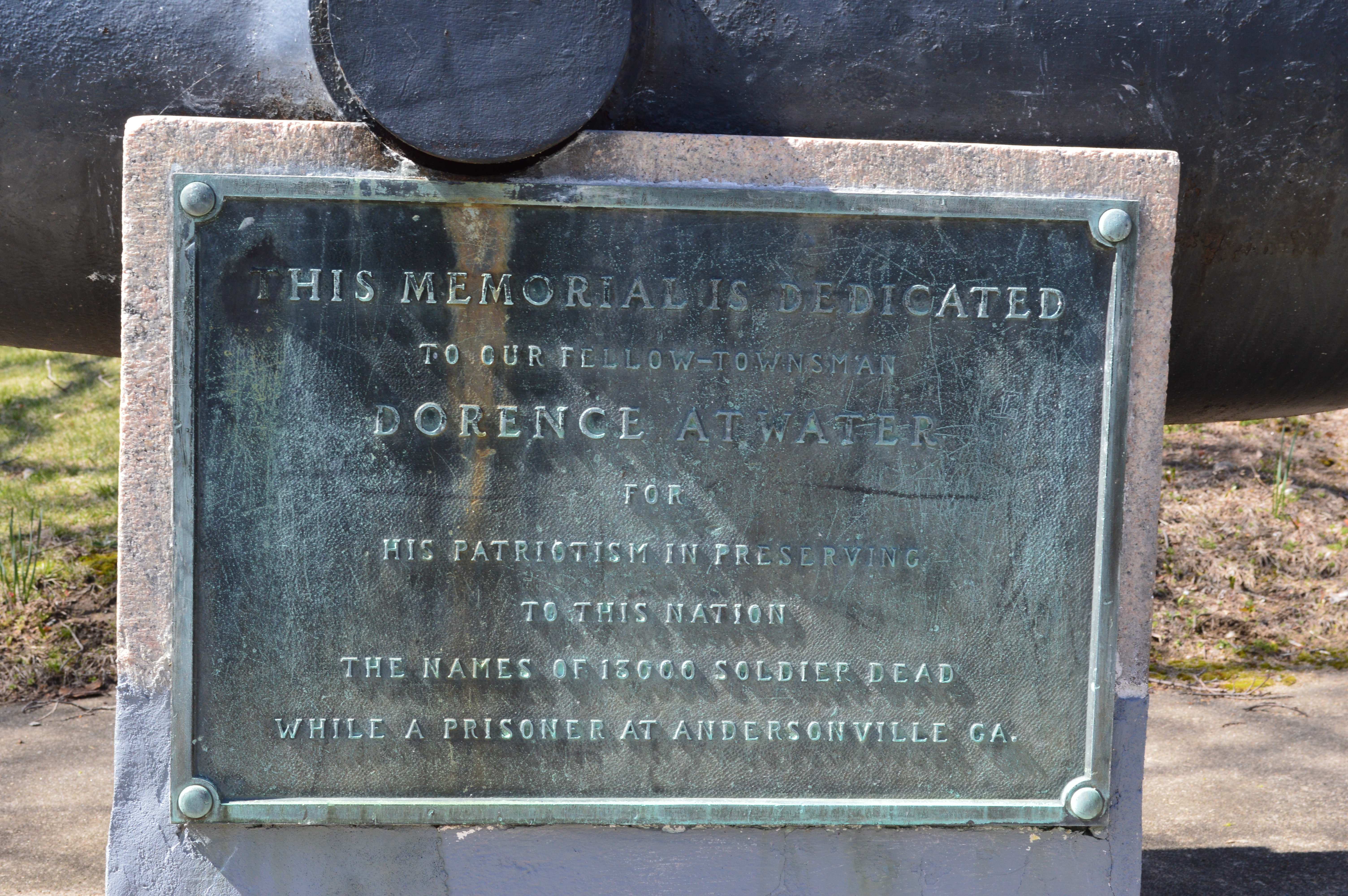
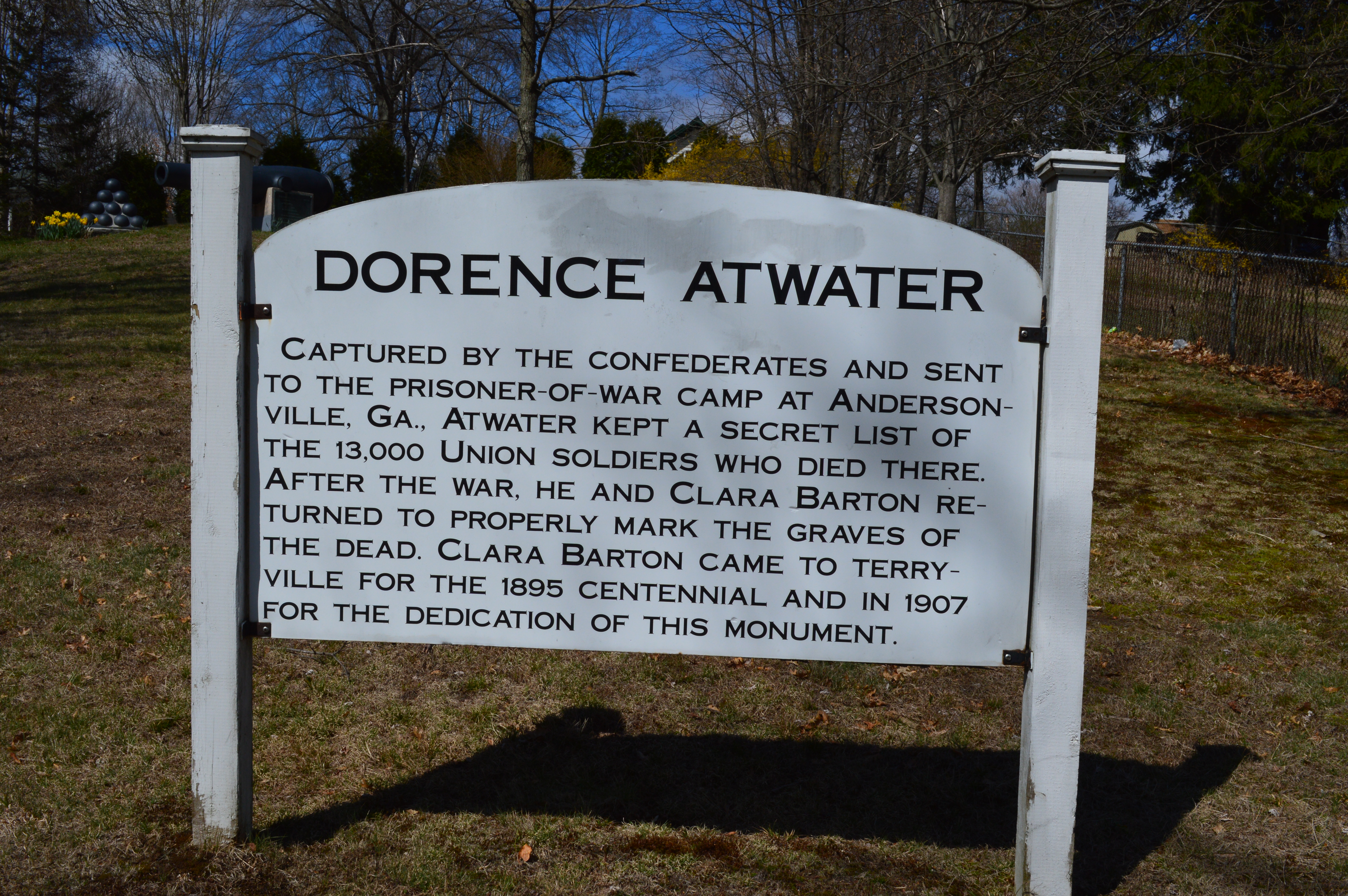
This monument in Terryville’s Baldwin Park offers testimony to one of the great episodes in Litchfield County’s Civil War history.

atwater2

Dorence Atwater

Dorence Atwater was only 16 when he enlisted – lying about his age – in the Union army. He was serving as a courier, running messages for a cavalry unit, when he was captured during the Gettysburg Campaign in July 1863.

WER1676

Camp Sumter, Andersonville, Georgia

Initially imprisoned at Belle Island in Richmond, Atwater was soon transferred to the notorious Camp Sumter – better known as Andersonville.   He fell ill in March 1864, but recovered to become a record keeper. While this removed him from the regular prison population, Atwater’s task was a morbid one, recording the names of the men who died.   The young man from Terryville, still only 19 years old, was consumed with ensuring that, in the words of a Hartford Courant article, “family members would know the fate and final resting spot of their loved ones.”

wcbbrady

Clara Barton

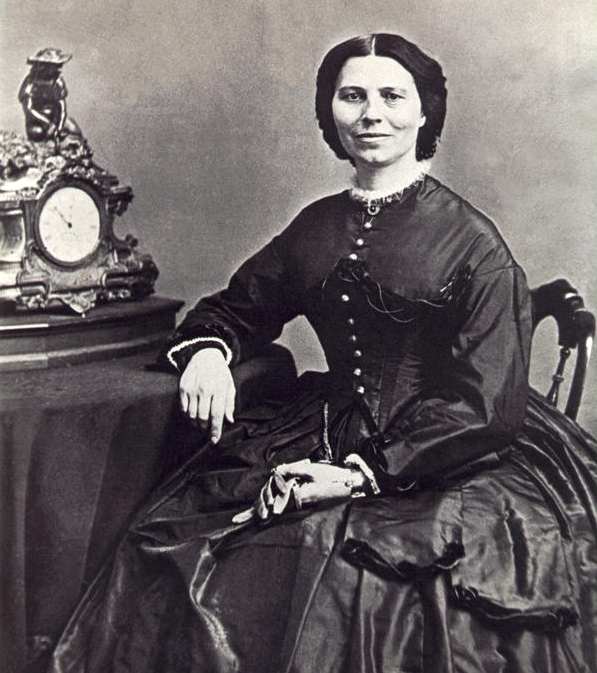
Atwater was paroled from Andersonville in March 1865 and upon leaving, smuggled the camp’s roll out in a bag. The punishment, had he been caught, would have been extreme. After the war, Atwater returned to Andersonville with Clara Barton to locate and mark the graves.  In all, approximately 13,000 Union prisoners died at the prison camp. For his actions, Barton reported to family members, “for the record of your dead you are indebted to the forethought, courage, and perseverance of a 19-year-old soldier named Dorence Atwater.”

dorence-atwater_wife

Princess Moeta Salmon Atwater

Atwater’s continued efforts on behalf of the victims of Andersonville – in this case protecting the list of names from those who wished to use it for commercial purposes – resulted in his court martial. Barton, however, took Atwater’s case directly to President Andrew Johnson, who not only pardoned Atwater but appointed him US consul to the Seychelle Islands. He followed this by serving as US consul to Tahiti, where he met and married his wife, an island princess. He also engaged in several highly successful business enterprises, including establishing a shipping line.

2014-04-27 15.22.33

Atwater and his wife returned to Terryville in 1908 to view the monument the town had erected in his honor in Baldwin Park. The monument had been dedicated one year earlier, with his great friend Clara Barton in attendance.

2014-04-27 15.21.57

Sarah Pierce’s Litchfield Female Academy

DSC_1453

The years following the American Revolution were noted for a national impulse to establish grammar schools for young children, and academies for those considering college.  While there were several academies for girls operating in the county, none was more influential or noted than Sarah Pierce’s Litchfield Female Academy.

1941-02-2_sarah_pierce_-_resize

Sarah Pierce (Courtesy of National Endowment for the Humanities)

      Pierce was born in Litchfield in 1767.  She never married and instead dedicated her life to educating young women.  Pierce’s father died when Sarah was 16, and her brother, John Pierce, Jr., invested in an education for her sister in the hopes that she would become a teacher and support herself.  The first classes were held in the dining room of the Pierce home.

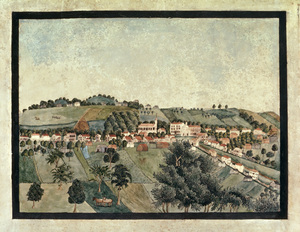
Rebecca Couch Denison - View of Litchfield

            By 1798, Pierce had termed her school the Female Academy and began a subscription list to build a structure, which by 1803 was erected at a site on North Street indicated today by a stone marker.  Here young women were introduced to Pierce’s revolutionary ideas about education – namely, that girls should be taught what boys were, including geography and history.  Pierce went so far as to write her own histories when she couldn’t find suitable texts.

Litchfield Female Seminary in Connecticut

Litchfield Female Academy

            At the turn of the 19th century, so many students were coming in such large numbers – 130 in one year along – that Pierce needed to hire additional teachers.  The subjects they were responsible for grew to include chemistry, astronomy, and botany.  Academic pursuits were balanced with artistic endeavors including music, dancing, singing, embroidery, drawing, and painting.

John Pierce Brace

John Pierce Brace (Courtesy of Litchfield Historical Society)

     Pierce brought in her nephew John Pierce Brace, a graduate of Williams College, as a teacher and her ultimate successor as head of the school.  Pierce was noted for his hands-on approach to education, as noted by Mary Wilbor in 1822:  “Mr. Brace had all his bugs to school this P.M.  He has a great variety, two were from China, which were very handsome, all the rest were of Litchfield descent, and he can trace their pedigree as far back as when Noah entered the ark.”

Needlepoint by Sally Miller, Litchfield Female Academy student, 1811

Needlepoint by Sally Miller, Litchfield Female Academy student, 1811

Pierce’s students boarded with Litchfield families.  The town was home to several large boarding houses, including Aunt Bull’s on Prospect Street, and may homes took in students from the Female Academy and the Litchfield Law School (see below).  Pierce was also committed to teaching her students proper etiquette, as evidenced by the following rule:  “You are expected to rise early, be dressed early, be dressed neatly, and to exercise before breakfast.  You are to retire to rest when the family in which you reside request you.  You must consider it a breach of politeness to be requested a second time to rise in the morning or retire of an evening.”

Connecticut tercentennial sign on North Street.

Connecticut tercentennial sign on North Street.

Mary Ann Bacon attended Pierce’s academy in 1802, and boarded with the Andrew Adams family on North Street.  Her diary entry for June 14th, 1802 provides an insight into a typical student experience:

Arose about half past five, took a walk with Miss Adams to Mr. Smith’s to speak          for an embroidering frame.  After breakfast went to school.  I heard the Ladies read      history, studied a Geography lesson and recited it.  In the afternoon I drew read and      spelt.  After my return home my employment was writing and studying I spent the        evening with Mrs. Adams and retired to rest about half past nine o’Clock.

Over 3,000 young women – and about 120 young men – were educated at Pierce’s school before it closed in 1833.  Their intellectual, social, and artistic abilities helped make Litchfield one of early 19th century America’s most cosmopolitan towns.

Carriage Steps

A prominent carriage step along North Street.

A prominent carriage step along North Street.

An earlier post examined the history of Litchfield’s hitching posts.   A similar reminder of Litchfield’s transportation history are the carriage steps (or mounting blocks) that dot North and South Streets.

2013-08-06 12.06.38

Mounting blocks were simple stone blocks – often granite – that allowed passengers and easier way of climbing on board a carriage or stagecoach.  Carriage steps were a fancier alternative, with two steps often carved into the stone.

2013-08-06 11.47.23

A remnant of a mounting block along South Street.

While they were often found outside the homes of the town’s wealthier residents, they speak to the importance of carriages and stages and means of transportation.  These conveyances brought students to the Tapping Reeve Law School and Sarah Pierce’s female academy.  The wealth and cultural refinement of these students helped establish the cosmopolitan atmosphere of Litchfield in the early 19th century.
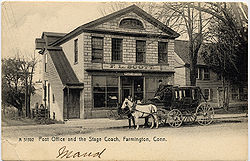
A stagecoach in Farmington; it was perhaps bound for Litchfield.

A stagecoach in Farmington; it was perhaps bound for Litchfield.

Historian Lynn Brickley has written that while stagecoaches were forbidden from traveling at night, advertisements stated that the stage would leave Litchfield at 3 a.m.  A stage could travel 4-5 miles per hour, with stops every ten miles to change horses.  Still, rugged roads could slow the process, and the stage took 14 hours to travel 24 miles.

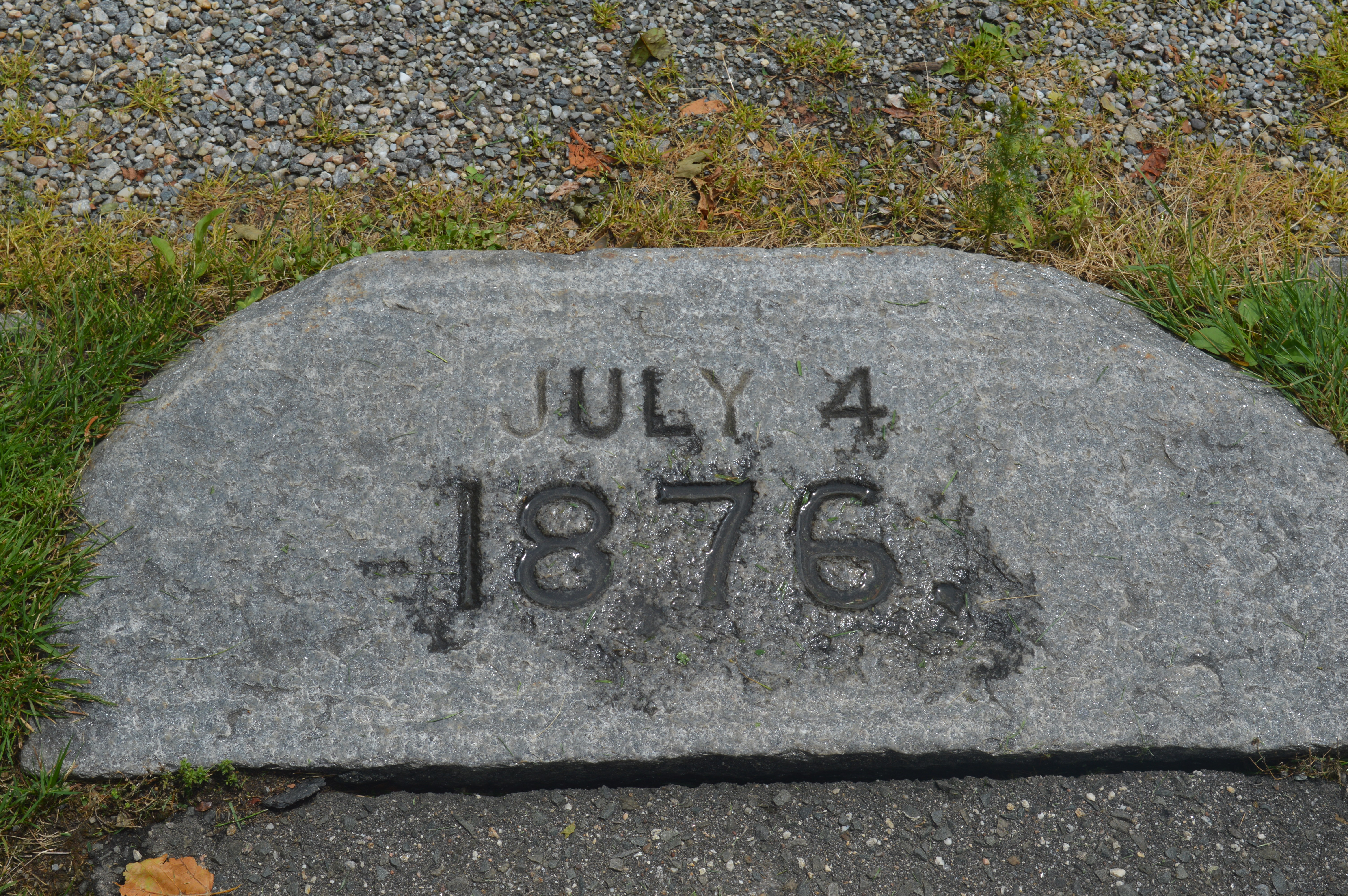
George Woodruff's centennial inscription may have served as a mounting block.

George Woodruff’s centennial inscription may have served as a mounting block.

Ultimately the arrival of the railroad would make stagecoaches no longer economically viable, and automobiles would do the same to carriages.  The implements of horse-drawn travel – hitching posts and carriage steps – remain as testimony to their importance in an earlier age.

Hidden Nearby: Sharon’s Moravian Monument

Jan_Hus_2

Jan Hus

The Unity of Brethren, better known as the Moravians, also played an important role in the early religious history of the county.  The group’s nickname stems from the refugees from Moravia, an area of the present day Czech Republic.  The Moravians were essentially followers of the Catholic revolutionary Jan Hus, who advocated for giving lay people a more prominent role in the church and having masses said in vernacular languages.  Hus was burned at the stake in 1415.

Nikolaus_Ludwig_von_Zinzendorf_(portrait_by_Balthasar_Denner)

Nicolaus von Zinzendorf

One of the principal tenets of the Moravian church is the “ideal of service,” which emphasizes the importance of educational and missionary work.  At the forefront of these ideals was Count Nicolaus von Zinzendorf, a German social reformer and Moravian bishop who led efforts to spread Christianity through the Native Americans of the Northeast.  Around 1740, von Zinzendorf himself came to America, and preached to Indians in New Milford.  He was so successful in igniting the fire of Moravianism that the natives agreed to move with Zinzendorf to Bethlem (today Bethlehem), Pennsylvania.  Harsh conditions and illness, however, soon led the Native Americans to return.

V05-26

Monument to Rauch in Pine Plains, NY. Courtesy of Ancestry.com

Around the same time, a second Moravian mission was established in Sharon to minister to the settlements at Shekomeko (Pine Plains, NY), Wequagnock (near Sharon), and the Schaghticokes in Kent.  The mission was founded by the Reverend Christian Henry Rauch, who presided for two years before turning the work over to 26 year-old Reverend Gotlieb Buetner, who died two years later, and was buried at the site of the mission.

DSC_0656

New York State chased the Moravians out of their borders in 1745, fearing that the missionaries were secret emissaries of the Catholic Church.  This led numerous Christian Indians to settle around Sharon, where the Moravian mission continued under the leadership of David Bruce, a Moravian teacher from Edinburgh, Scotland.  In 1789, George Loskiel wrote of Bruce’s activities in his History of the Moravian Missioners Among the North American Indians:

Bruce … resided chiefly in a house at Wequagnock … but sometimes resided at         Schaticook, whence he paid visits to Westenhunk, by invitation of the head chief of the Mohikan nation, soweing the seeds of the gospel wherever he came …. Twenty Indians were added to the church by baptism.  Brother Bruce  remained in his station till his happy departure out of time …. He was remarkably cheerful during his illness, and his conversation edified all who saw him.  Perceiving that his end approached, he called his Indian brethren present to his bedside, and, pressing their hands to his breast, besought them fervently to remain faithful unto the end, and immediately fell asleep in the Lord.

DSC_0658

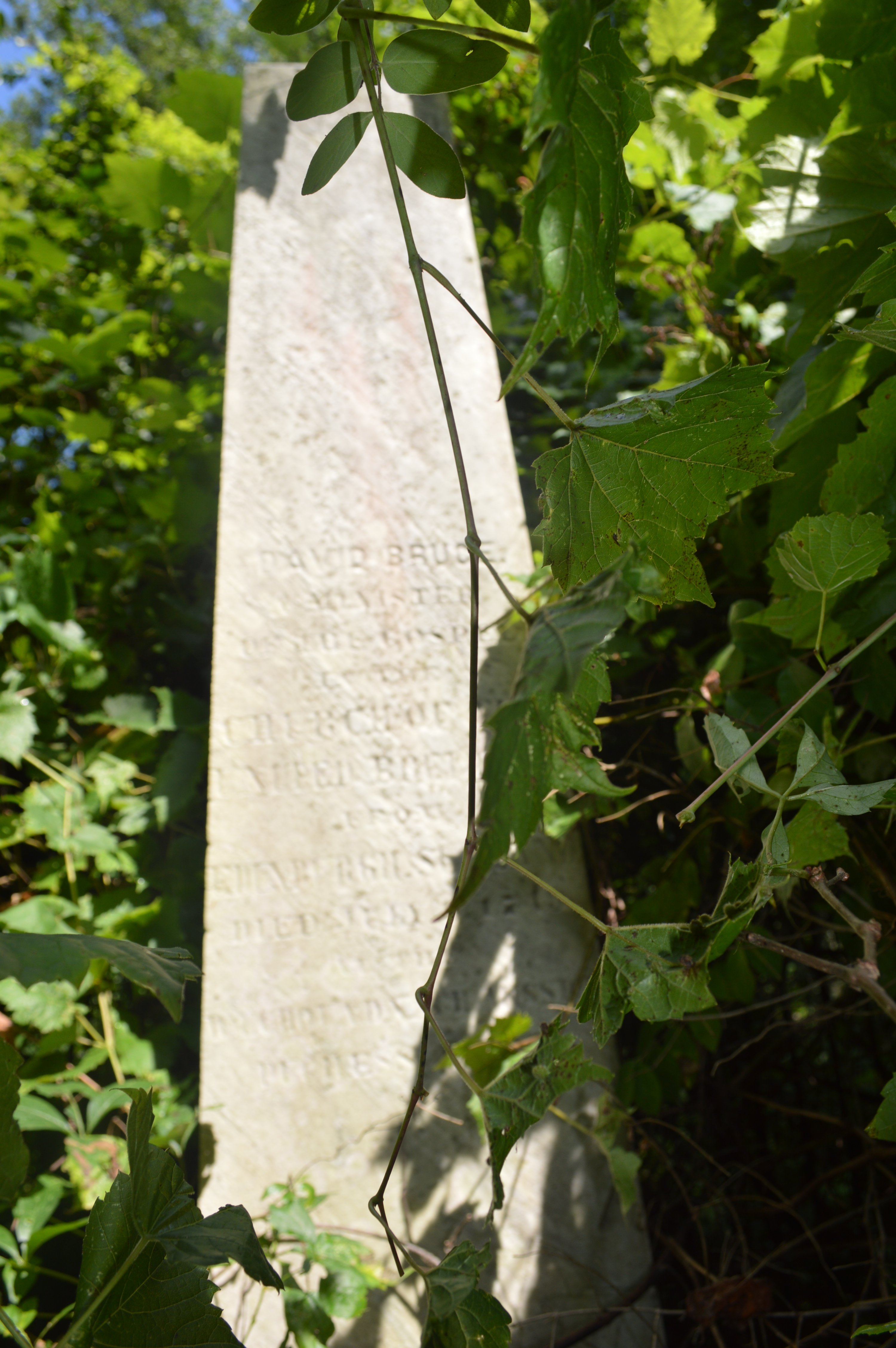
That was July 9, 1749.  A monument to Bruce and Joseph Powel, a later Moravian missionary, was erected in Sharon in October 1859, 110 years after Bruce’s death.  The monument still stands, hidden deep within the woods along Route 361.  On its east face is the following passage from Isaiah:

How beautiful upon the mountains

Are the feet of him that bringeth

Good tidings, that publisheth peace,

That bringeth good tidings of good,

That publisheth salvation.
Special thanks to my friend and colleague Warren Prindle of Sharon for not only bringing this monument to my attention, but also hacking through the woods with me to find it!

Hidden Nearby: The Harwinton Sign Post

DSC_0298

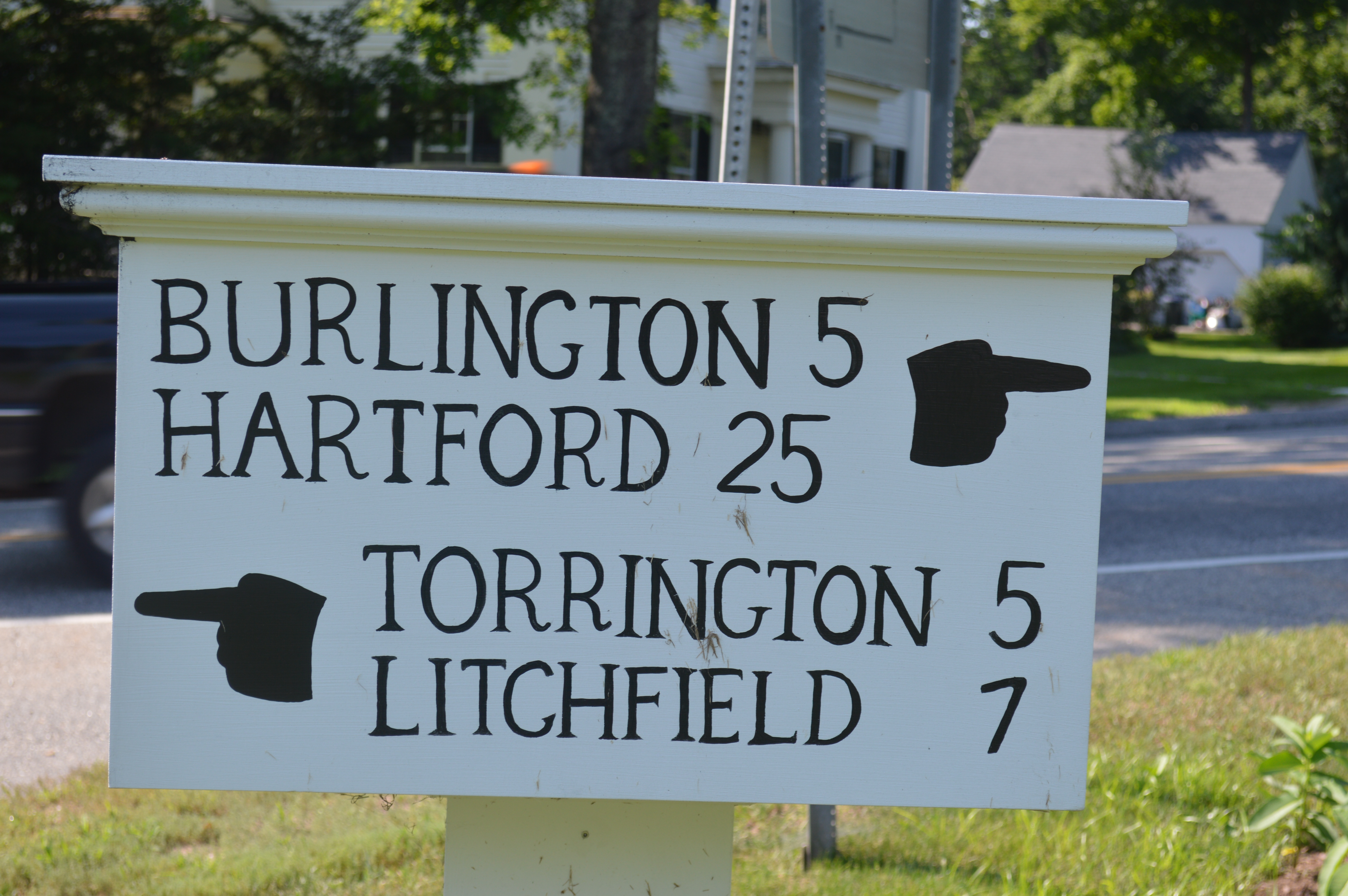
Harwinton derives its name from the fact that it was settled in 1726 by emigrants from Hartford and Windsor, and it was originally called “Hartford and Windsdor’s Town..”  Those settlers from Hartford were given land rights in the eastern part of town, while those from Windsor were given the west side of town.  A post was put on the dividing line, and that post evolved into the Harwinton’s well-known Sign Box.

greencoverreduced

An old image of the Harwinton green, courtesy of the Harwinton Historical Society.

The sign box was designed by Lewis Smith, who served as the town’s probate judge from 1844 to 1860.  In addition to providing directions and distances to nearby towns, the sign box also provided residents a means of posting notices to their fellow townspeople in the days before other forms of communication.

DSC_0300

In 2006 a wayward motorist destroyed the sign box, which was soon replaced.  In May 2013, Larry Connors, a woodworker in town, constructed a more permanent structure and Amanda Surveski, a student at Lewis S. Mills High School, painted the letters, distances and directions.

DSC_0299

While thousands of drivers pass it every day without noticing it, the Harwinton sign box is one of those landmarks that give our New England towns their character.

The Beecher Monument

2013-06-28 11.30.30

The monument sits prominently on the eastern end of where Route 63 passes through the Litchfield green, a fitting location for the monument to Litchfield’s most prominent family.

Lyman_Beecher_-_Brady-Handy

Lyman Beecher (1775-1863)

Lyman Beecher was born in New Haven in 1775 and graduated from Yale in 1797.  The following year he became the pastor of the East Hampton (Long Island) Congregational Church at an annual salary of $300.  He remained there for twelve years before he was hired by the Litchfield Congregational Church, where he remained for sixteen years. (It is interesting to note that the monument sits at the site of Beecher’s church; the current Congregational Church was moved to its site in 1929).

DSC_0028

Beecher remembered his time in Litchfield as the most “active and laborious” of his life.  In his autobiography he wrote that he “found the people of Litchfield impatient for my arrival and determined to be pleased, if possible, but somewhat fearful that they should not be able to persuade me to stay.  The house yesterday was full, and the conference in the evening, and so far as I have heard, the people felt as I have told you they intended to.  Had the people in New York been thus predisposed I think I should not have failed to give them my satisfaction.  My health is good and I enjoy good spirits, some time past, am treated with great attention and politeness and am become acquainted with agreeable people.”

S4859-lgTimothy Dwight, the president of Yale University, preached the sermon at Beecher’s installment service.  Beecher very quickly established himself as one of the nation’s most important religious leaders.  He was central to the establishment of the Litchfield County Foreign Mission Society, and from the pulpit at the Congregational Church gave the Six Sermons on Intermperance, that when published in book form in 1826 were widely circulated on both sides of the Atlantic and were “among the earliest and most effective” statements on behalf of the temperance movement.

stowe-crop

Harriet Beecher Stowe

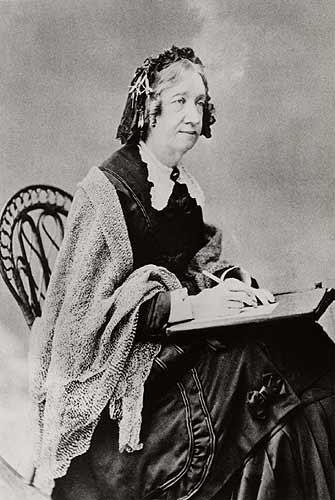
Lyman Beecher’s achievements have largely been eclipsed by those of his children; in fact, Theodore Parker, the noted writer and abolitionist said that Lyman was the father “of more brains than any other man in America.”  Harriet Beecher was born in Litchfield the year after Lyman was installed as pastor.  One townsperson shared a recollection of Lyman Beecher serving as the judge of an essay contest among the students of Sarah Pierce’s academy.  Upon hearing one essay he immediately brightened and asked who had written it.  He beamed when he learned it was his daughter’s work.

230px-Henry_Ward_Beecher_-_Brady-Handy

Henry Ward Beecher

Henry Ward Beecher, soon to surpass his father’s fame as a minister, was born in Litchfield in 1813.  He was  remembered by his classmates for building a pulpit out of hay and impersonating the elder Beecher’s sermons.

beecher_008

Catharine Beecher

Catharine Beecher, Lyman’s oldest child, would become a reformer and leading proponent of the cult of domesticity.  While not born in Litchfield, she had fond memories of the annual “minister’s wood sled” when members of the congregation would bring Beecher wood for the winter and in return the Beecher children would serve them cider, hot cakes and doughnuts.

DSC_0030

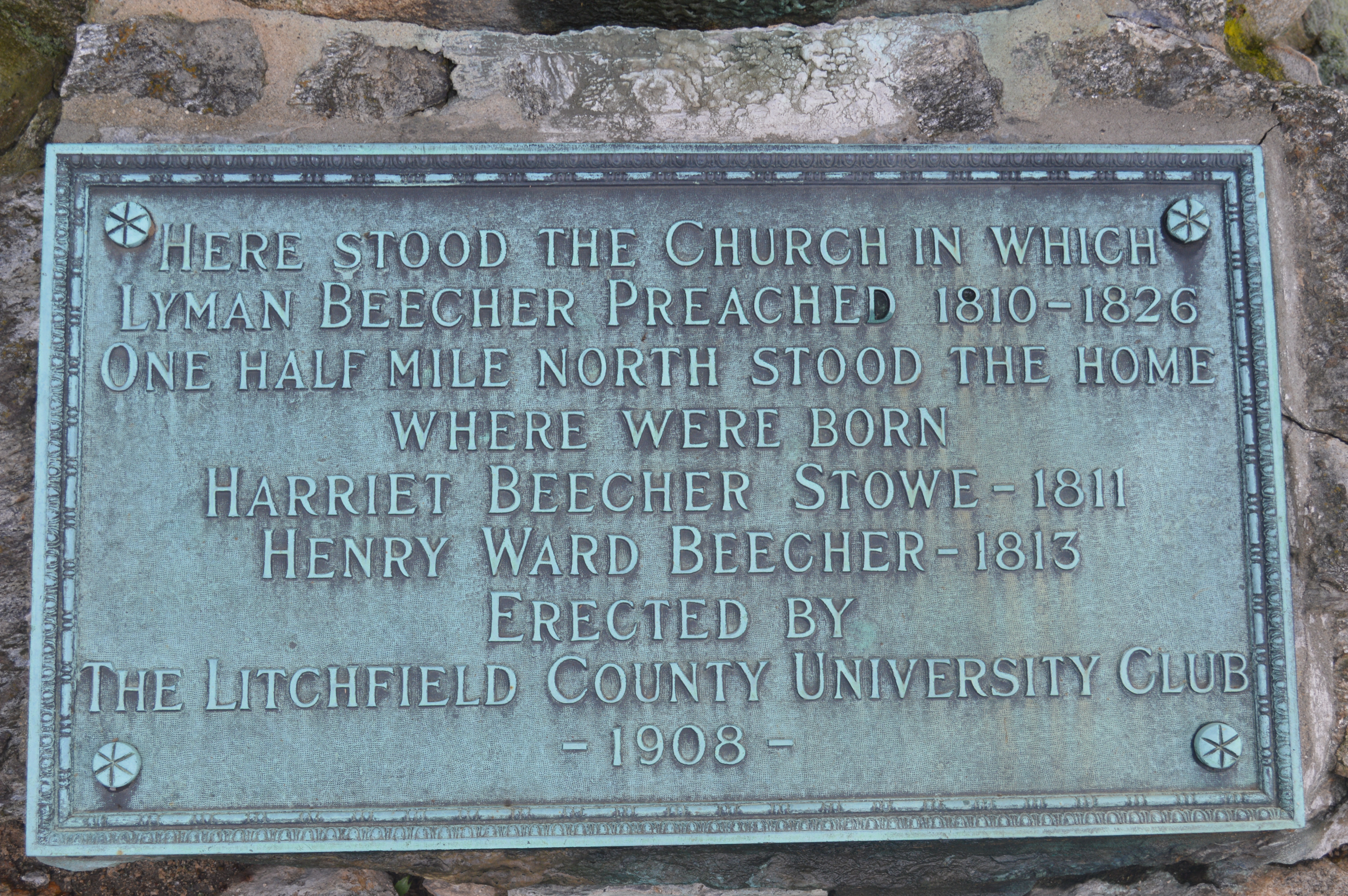
The Beechers’ time in Litchfield ended in 1826 when Lyman moved to a congregation in Boston.  Harriet achieved her fame in Cincinnati and Maine, Henry Ward headed the Plymouth Church in Brooklyn, and Catharine opened a school for girls in Hartford.  Still, they had a great impact on Litchfield, as remembered by this monument which was erected by the University Club in 1908.