The Windmill Hill Windmill

Cistern and Windmill

We take to the woods for many reasons.  Thoreau famously wrote, “I went to the woods because I wished to live deliberately, to front only the essential facts of life, and see if I could not learn what it had to teach, and not, when I came to die, discover that I had not lived.”  Most of us take to the woods for less philosophical reasons – to hike, run, snowshoe, mountain bike, or bird watch.  Hidden amongst the Litchfield woods, however, are reminders of the way the land was used in the past.

There is little old growth forest left in Litchfield County.  In the southern environs of the county the land was cleared for farms.  In its northern reaches, Litchfield County’s woods were utilized for the charcoal needed to power iron furnaces.  When these industries began to transform or fade away, the forests reclaimed their original territory, engulfing many man-made objects and alterations to the landscape.

Perhaps this is most true of the White Memorial Foundation, which owns approximately 5,000 acres in Litchfield and Morris.  In these woods remain many implements of the county’s agricultural and industrial past.

bw windmill

The windmill and cistern on Windmill Hill, White Memorial. From Rachel Carley, Litchfield, pg. 212.

One fascinating example is the base on which the White family’s windmill once stood.  The explorer can find it on the appropriately named Windmill Hill, very near the White Memorial visitor center and museum.  The proximity is no coincidence.

John Jay White, whose children established the foundation in the early 1900s, was a New York real estate magnate who moved from 5th Avenue to Litchfield in 1863.  The home he built, Whitehall, in many ways epitomized the Victorian architectural fashion popular at the time.

View of Whitehall

The view toward Whitehall from the site of the windmill.

On the top of a nearby hill White had a cistern built.  A nearby windmill pumped water into the covered cistern.  Pipes then brought the water more than a quarter mile to the house, which thus enjoyed natural water pressure.

windmill

This structure stands on the approximate site of the windmill.

Today, a concrete slab marks the site of the cistern.  A concrete structure stands nearby; it was built to house the electric pump that replaced the windmill but was rendered obsolete a number of years ago when a new well was dug.

carriage house

White Memorial’s carriage house.

Whitehall still stands, albeit in modified form, as the visitor center and museum of the White Memorial Foundation.  Its top floor was removed and modifications made that erased the structure’s Victorian elements.  Only in the carriage house are glimpses of the Victorian splendor that once marked the estate evident.
Hidden Nearby: The Morris Academy

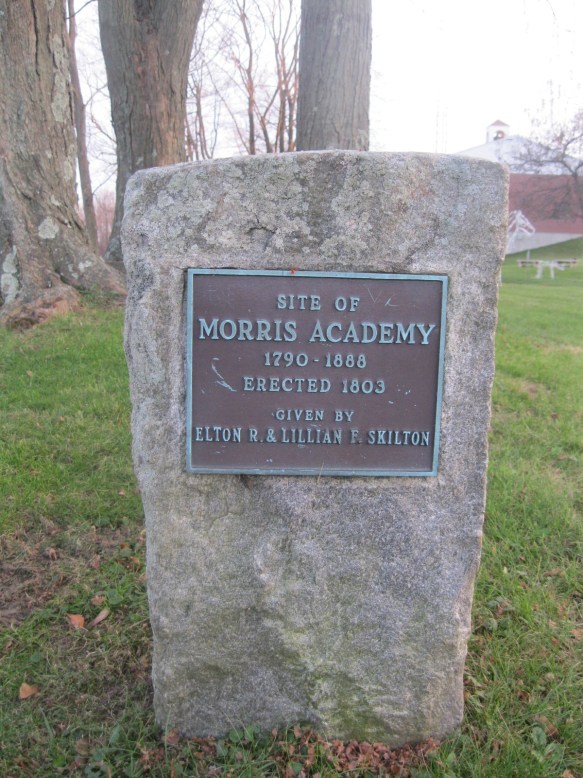
Morris monument

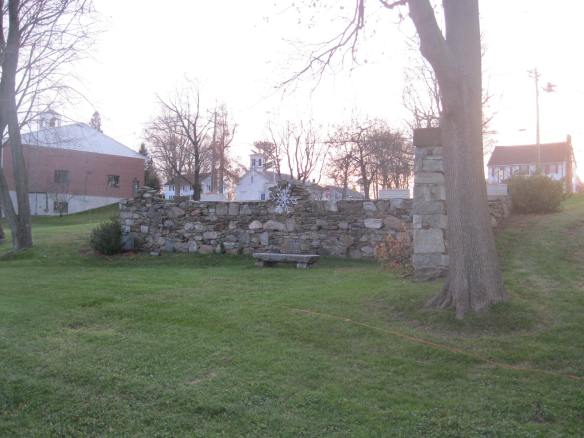
This small marker and the remnants of the foundation mark the location of the Morris Academy, a landmark co-educational institution.

James Morris

The Academy was the brainchild of James Morris III, who was born on January 19, 1752 in South Farms (which, in 1859 was renamed Morris in his honor).  Morris’ father James was a deacon, and the son harbored hopes of entering the ministry.  An enthusiastic reader, young James routinely traveled to Bethlehem to borrow books from that town’s library.  His education, which began with these library books, was guided by three remarkable teachers.

Nathan Hale

At eighteen, Morris began studies under Bethlehem’s Dr. Joseph Bellamy, one of the leading theologians of the late 18th century.  It is reported that Morris also studied under Nathan Hale, before enrolling at Yale.  While at Yale, Timothy Dwight, later president of the university and one of the leading figures in American educational history, served as Morris’ tutor.

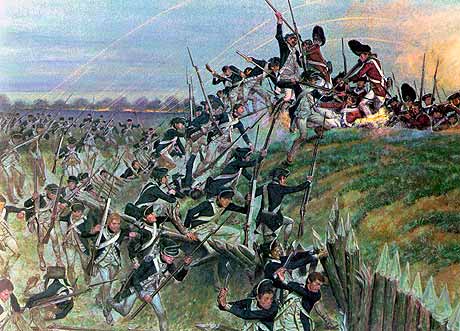
The Battle of Yorktown

Following his graduation, Morris returned home to help on the family farm, teach students in Litchfield, and ponder a future in the ministry.  The Revolutionary War, however, got in the way.  He served first in the Connecticut Militia, then in the Continental Army, fighting on Long Island, at White Plains, and at Germantown, Pennsylvania, where he was captured.  Upon receiving parole, he hurried to Yorktown, Virginia, where he served Alexander Hamilton during that climactic battle of the Revolution.

After the war he returned home and married Elizabeth Hubbard, with whom he raised five children.  His fellow townspeople elected him both justice of the peace and a selectman.  By 1790, however, when children began regularly showing up at his door, Morris put aside his ideas about the ministry and looked instead for a career in education.

A typical scene in an early co-educational school

Rare for his time, Morris accepted both boys and girls as students.  This sparked significant discussion, as many believed that education would cause women to lose sight of their more traditional roles.  In 1794, a town hearing was held about the situation, and any charges against Morris were dismissed.

The foundation of the Morris Academy

The foundation of the Morris Academy

By 1800, Morris’ school had grown so large that a formal structure was needed.  Wealthy subscribers were enlisted from the area to subsidize the $1,200 cost of the building, which opened on November 28, 1803.  (The building stood on the property where the James Morris School stands today)  By that time, Morris had educated students from all of the New England states except Rhode Island, as well as New York, New Jersey, Pennsylvania, Maryland, Virginia, South Carolina, Georgia and the West Indies.  He averaged between 50 and 75 students a year.

While Morris died in Goshen in 1820 (he is buried in East Morris), the school remained open until 1888.  As Barbara Nolen Strong wrote in her 1976 book on the Morris Academy, “The Morris Academy is entitled to be called a pioneer institution because of its ‘open door’ policy in coeducation. It was not the first in the United States, not even in Connecticut, but none of the other early academies opened their doors as wide and kept them open as long. No other coeducational academy spread its influence so far.” In a fitting gesture to the impact of James Morris on the community, the town of South Farms changed its name to Morris in 1859.

Hidden Nearby: Bethlehem’s War of 1812 Monument

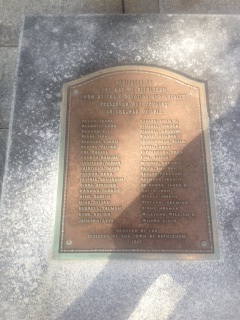
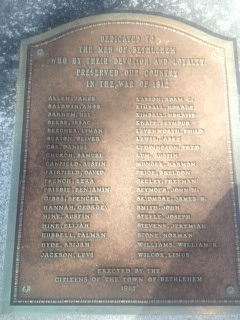
Most New England towns have a monument to their Civil War veterans.  Many also honor their sons who fought in World War I, World War II, Korea and Vietnam.  Bethlehem, Connecticut, is one of the few towns to honor its War or 1812 veterans.

This year marks the bicentennial of the War of 1812.  While the anniversary has been largely overshadowed by the Civil War sesquicentennial, the War of 1812 was an important event in the history of the young American republic.  For the second time in 35 years Americans had stood up to the British, the world’s great power, and had held their own.  The end of the war, followed by the American success at the Battle of New Orleans (word of the treaty reached Louisiana too late to prevent the battle) led to a surge in American nationalism and a spirit of political unity known as the Era of Good Feelings.

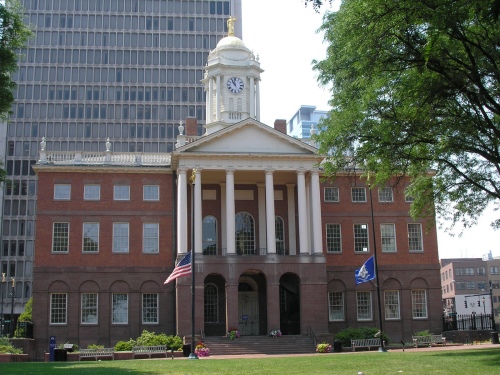
The Old State House, site of the Hartford Convention, 1814-15

Still, the war was quite unpopular in Connecticut.  As much of the state’s economy was tied to trade with Great Britain, the state suffered financially from the decision to go to war.  Connecticut’s entire Congressional delegation voted against the war.  Many of Connecticut’s Federalist politicians supported the call for the Hartford Convention, an assembly of leading New Englanders concerned, among other things, with ending the war.  Seven Connecticut representatives, including Nathaniel Smith of nearby Woodbury, attended the Convention, where calls were made for the secession of New England states from the Union.  The end of the war and the results from New Orleans made fools of these men, most of whom saw their political careers ruined.

Residents of Stonington work on fortifications for their town, 1814.

Connecticut’s opposition to the war was manifested in other ways, as well.  While some 10,000 Connecticut men turned out for the war, the state government refused to allow the members of the Connecticut militia to leave the state.  There was little military action in the state.  An contingent of ships was trapped by the British at New London, but the appearance of a large group of state militia allowed the American sailors to escape.  In 1814, a British fleet bombarded Stonington for three days, while $200,000 worth of damage was done to shipping concerns at Essex.

With hindsight, we know that the war had a minimal impact on Litchfield County.  Statewide, there were 233 casualties as a result of the war.  Few families of Litchfield would have felt the effects of the war.  Still, the men of Bethlehem who enlisted to serve knew none of this.  They joined the war effort with the belief that they would be thrust into action against the British, and were willing to make this sacrifice.  It is this patriotic spirit that the town of Bethlehem commemorated with this monument.

Some thoughts on Litchfield’s clocks

While driving along West Street in Litchfield one may catch a glimpse of the time from the clock of the Congregational Church, or in the tower of the Litchfield County Court House.  Subconsciously, the driver is forced to think back to his or her student days to convert the Roman numerals on the face of the clock to Arabic numerals.  This is all done very quickly, and without much thought.

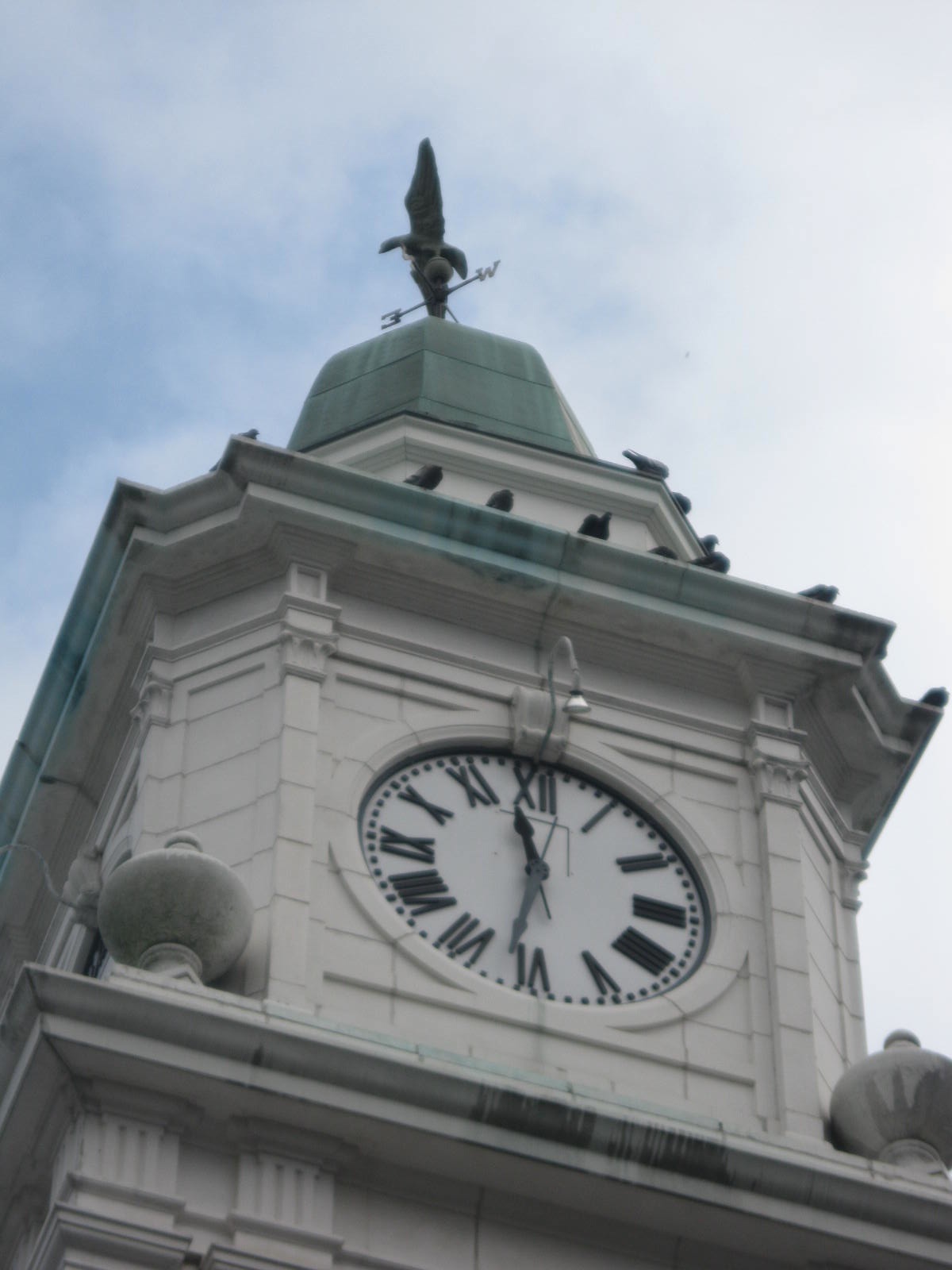
Out on foot to explore his surroundings, however, one may recognize that the faces of these two clocks do not properly correspond to traditional Roman numerals.  Instead of using “IV” for four o’clock, both of these clocks use “IIII.”

London’s Big Ben

They are not alone.  It is customary for clockmakers to substitute “IIII” for “IV” on their works.  There are notable exceptions – Big Ben, the famed London clock whose tower was renamed for Elizabeth II this year in honor of her diamond jubilee, sports the numeral “IV.”  As with so many traditions, there are conjectures as to their origin, but no definitive explanations.

Some speculate that the use of “IIII” provides symmetry to the clock face.  One through four o’clock, only make use of the numeral “I” while the next four hours utilize “V” and “I” and the final four use “X” and “I”.

Does this clock face demonstrate a lack of balance or symmetry?

Others say that the explanation is that the numeral “IIII” provides a better balance to its counterpart “VIII” than “IV” would.  Don’t tell Big Ben.

Jupiter (IVPITER), also known as Jove (IOVI)

Still others hold that the tradition dates back to the Romans, who never used “IV” on their clocks because the letters “IV” were the first two letters of their spelling of the god Jupiter (IVPITER), and they didn’t wish to tempt fate.  This explanation would make for a good story if the Romans actually used clocks.  Does the numeral “IV” appear on sundials?

Those pessimistic about the nature of mankind argue that it is easier to count by adding I’s than it is to subtract I from V, an argument that does not take into account that 9 is “IX” and not VIIII.

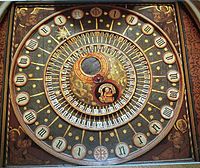
The Wells Cathedral Clock

As this blog celebrates history, let’s accept that the tradition follows the lead of the oldest extant public clock, the Wells Cathedral Clock.  This clock, found in the west of England, proudly displays four o’clock as “IIII”, and has since its installation, which was – at the latest – in 1392.

The present Litchfield Congregational Church was built in 1829; however, when a new church was built in 1873, the structure was used for a variety of purposes, including as a movie theater and roller skating rink.  It was restored to its original use in 1930, as part of the town’s Colonial Revival makeover.  The clock would have served important purposes, not only calling residents to worship, but also pealing to announce important news or of fire.

The Litchfield County Court House boasts a Seth Thomas clock tower.  This was installed in 1890 as part of the rebuilding of the court house following an 1886 fire.  When the court house was remodeled in 1913-14 – again, to make the structure fit with its Colonial Revival surroundings – the clock tower was retained.

These two clocks don’t display the exact same time, and as such are vestiges of a bygone era, when passersby didn’t need a digital device connected to satellites to provide them with the precise time.  Most still relied upon sundials and hour glasses to tell time; perhaps in a rapidly changing world, the numeral “IIII” grounded them in ancient traditions.

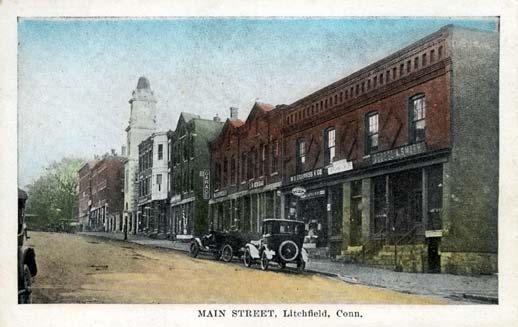
West Street – Then and Now

Return visitors will recognize the above image as the banner used on this blog.  It depicts Litchfield’s West Street, likely at some point in the late 1920s or early 1930s.  Shot in black and white, it was later colorized for use on a post card.

Here is the same view on sunny fall morning in 2012:

A later post will explore the history of Litchfield’s Historic District.  But the juxtaposition of these two images is testimony to the remarkable job of preservation done in the center of town.  The most striking difference is that the street has been paved; also, it appears that West Street once featured parallel parking.  The right side of the building on the extreme right of the image is now red instead of gray.  The stores in the center of the 2012 view have painted their fronts white, which accentuates the colonnade.  Note that the signs on the building have changed over time.  In the top image, one business has a marquee-style sign, with the other businesses have prominent signage above their store fronts.  Today’s stores have less prominent signs.

Otherwise, the appearance of the street is virtually identical.  The notable architectural features – the bricks in the shapes of diamonds, peaks along the roofs, the patterns along the tops of the facades – all remain.

The historic district was created to protect the town’s colonial character.  Along West Street, however, it has been remarkably successful in preserving the character of the early 20th century.

One Hundred Fifty Years Ago This Month …

Marker identifying the location of the recruiting tent for the 19th Connecticut Infantry on the Litchfield Green.

On April 15, 1861 – within days of learning of the Confederate firing on Fort Sumter – President Abraham Lincoln issued issued a call for 75,000 volunteers to serve for 90 days in order to put down the rebellion.  Much has been made of this as evidence that Lincoln perhaps had his head in the sand or was ignorant about the realities of the manpower needed to win the Civil War; however, under the existing Militia Act, the 75,000 men were all that Lincoln was legally allowed to call out.  Regardless of the technicalities of the law, Northern enlistment offices were overrun by volunteers – in fact, some men were actually sent home.

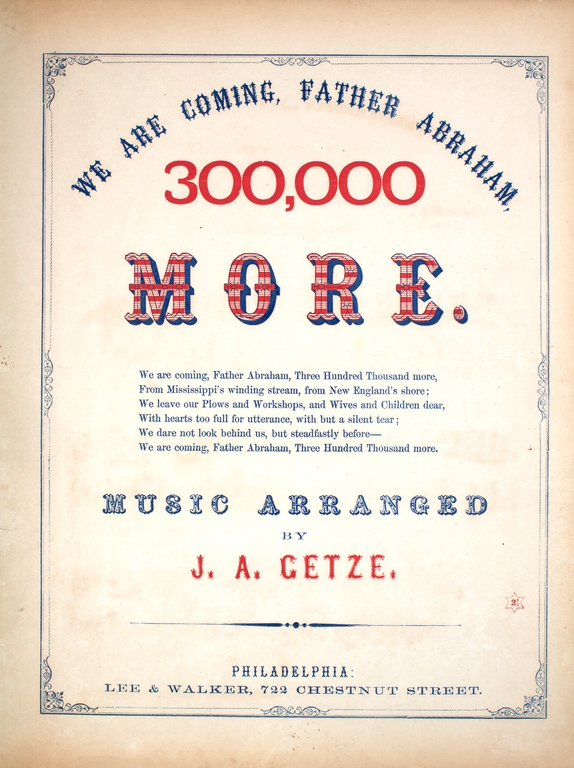
The battles at Bull Run, Shiloh, and on the Virginia peninsula made it clear that significantly more Union troops would be necessary to vanquish the Confederacy.  Therefore, in July 1862, Lincoln issued a call for 300,000 additional volunteers to serve for three years.


Lincoln’s call inspired James Sloan Gibbons to write the war hymn, “We are Coming, Father Abraham”:

We are coming, Father Abraham, 300,000 more

From Mississippi’s winding stream and from New England’s shore.

We leave our plows and workshops, our wives and children dear,

With hearts too full for utterance, with but a silent tear,

We dare not look behind us but steadfastly before.

We are coming, Father Abraham, 300,000 more!


We are coming, we are coming, our Union to restore,

We are coming Father Abraham, 300,000 more!

As patriotic songs alone did not ensure the volunteers the Union army needed, the Lincoln Administration assigned each state a quota for the number of volunteers to be raised.   Connecticut was thus required to raise 7,153 men for the Union cause.  The state in turn assigned quotas to each town based upon population and number of men already in the service; if these quotas weren’t met, a state draft would follow.  Based upon the calculations, Litchfield needed to raise 48 men in August 1862.

A “grand convention” of citizens from all over Litchfield County met on July 22nd at the Litchfield court house to discuss how to best meet the quotas, at which it was decided to raise a County Regiment comprised of volunteers from across Litchfield County.  Leverett Wessels, “one of the best and most popular men of the county”, was selected to be the colonel of the regiment.  The convention also recommended that each town offer its volunteers a bounty of $100 for enlisting, a sizeable increase over the $7 bounty that 1861 volunteers received! A town meeting in Litchfield ratified this recommendation on July 25th, and it was reported that “the utmost enthusiasm and good feeling prevailed.”  (All told, the town of Litchfield would award more than $50,000 in bounties over the course of the war; a dollar in 1860 would be worth more than $25 today. And these bounties were in addition to bounties offered by the state and federal governments.)

A recruiting tent in New York’s City Hall Park.

Almost immediately, a recruiting tent appeared on the Litchfield green, with A. B. Shumway supervising the operation from an office at the Litchfield Enquirer.  By July 25th, Shumway could state that he had “already enlisted several men, and expects to enlist many more before the regiment goes into camp.”  The newspaper reported on August 7th that “Litchfield will fill up its quota during this week.  The work goes bravely on, and the Regiment will be full, we trust, before the 20th of August.”  Another article stated that “recruiting is going on briskly in Litchfield.  Our people are becoming aroused to the true appreciation of their duty in these times.  The prospect of an early draft creates excitement.  (Draftees received no bonus)  We shall take our full town quota in the regiment into camp as soon as it is formed.”  The paper went a step further, predicting that Litchfield and Goshen alone would fill an entire company of 100 men.

The enlistees from Litchfield and across the county reported to Camp Dutton on Litchfield’s Chestnut Hill (a site that will be explored in a later post).  Whether its citizens were motivated by patriotism, financial incentive, or fear of being drafted, Litchfield exceeded its quota, sending nearly 70 men off to war in the summer of 1862, nearly all of them in the 19th Connecticut Infantry, which would gain fame on fields including Cold Harbor as the Second Connecticut Heavy Artillery.

Questions remain about this marker.  It appears that at one time something was attached to the top of this marker.  What was it?  When was this marker erected?  Who put it up – the Village Improvement Society?  The 2nd Connecticut Heavy Artillery Veterans’ Association?  More research is needed/  Stay tuned!

Litchfield’s Water Monument

Litchfield enjoyed a so-called “Golden Age” from 1784 to 1834.  In these fifty years the small town was a center of education -with both Tapping Reeve’s law school and the Sarah Pierce Academy bringing young, intelligent and often well-to-do men and women to town – and of commerce.  In 1810, the population of the town was approximately 4,600, making it, according to the Litchfield Historical Society (http://litchfieldhistoricalsociety.org/history/index.php), the fourth largest settlement in the state.

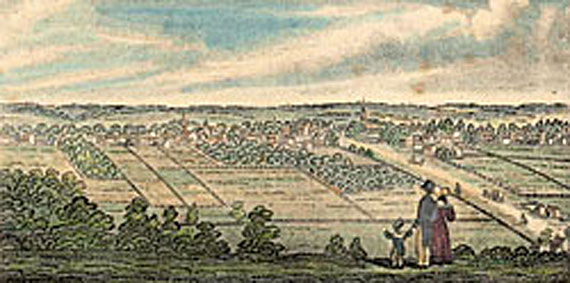
Litchfield, 1836

However, beginning with the United States’ Fourth Census in 1820, the number of residents in Litchfield began a steady decline, with the overall population dropping in nine of the next ten censuses.  By 1910, the town’s population stood at 3,005, a staggering drop of 35%.  There were many reasons for the exodus of Litchfield residents.  Across New England, populations fell in the aftermath of the American Revolution as farmers gave up their rocky lands for the promise of new lands in the west; the migration was so severe that editorials appeared in the Hartford Courant asking who would tend to the graveyards of Litchfield County in the aftermath of the departure of so many residents.  The drop in Litchfield’s population was due to perhaps a simpler cause – it was very difficult for those who lived in town to obtain an adequate supply of water.

Litchfield was first laid out along elevated lands, initially along the ridge marked by present-day North and South Streets, then spreading to the Chestnut Hill area. While this allowed for plots away from swamps and wetlands, it made for great difficulty in digging wells.  A solution to the town’s water problem would be arrived at only with great difficulty and after decades of planning and work.

Fox Brook, Goshen

After discussions of how to solve the water crisis – and the continued decline in the town’s population – the Litchfield Water Company was established in 1891.  The company proposed damming Fox Brook in Goshen to create a reservoir.  While water was brought to Litchfield in 1891, within a few years the source was proven to be inadequate, for it was later written that Fox Brook “could not properly be called a brook, as it practically dried up soon after a rainfall.”

Professor Henry S. Munroe, of Columbia University’s Department of Mining was brought in to solve the problem.  Munroe, whose other contributions to the Litchfield County landscape included the tower on Mount Tom, oversaw the construction of a new pumping plan in the valley below the reservoir, with wells 90 feet deep.  These wells, as Alain White wrote in his history of Litchfield,

“have provided an unfailing supply of pure water ever since, so that however dry the season or how near a water famine many of the surrounding towns were, Litchfield people … had no cause for worry.”

The Litchfield Water Company soon after purchased 500 acres of the surrounding watershed of the reservoir, which they allowed to return to a natural forested state – excepting, that is, the fences they erected to keep out cattle.  Filters were added to the pumps in 1914 to help ensure the purity of the water supply.

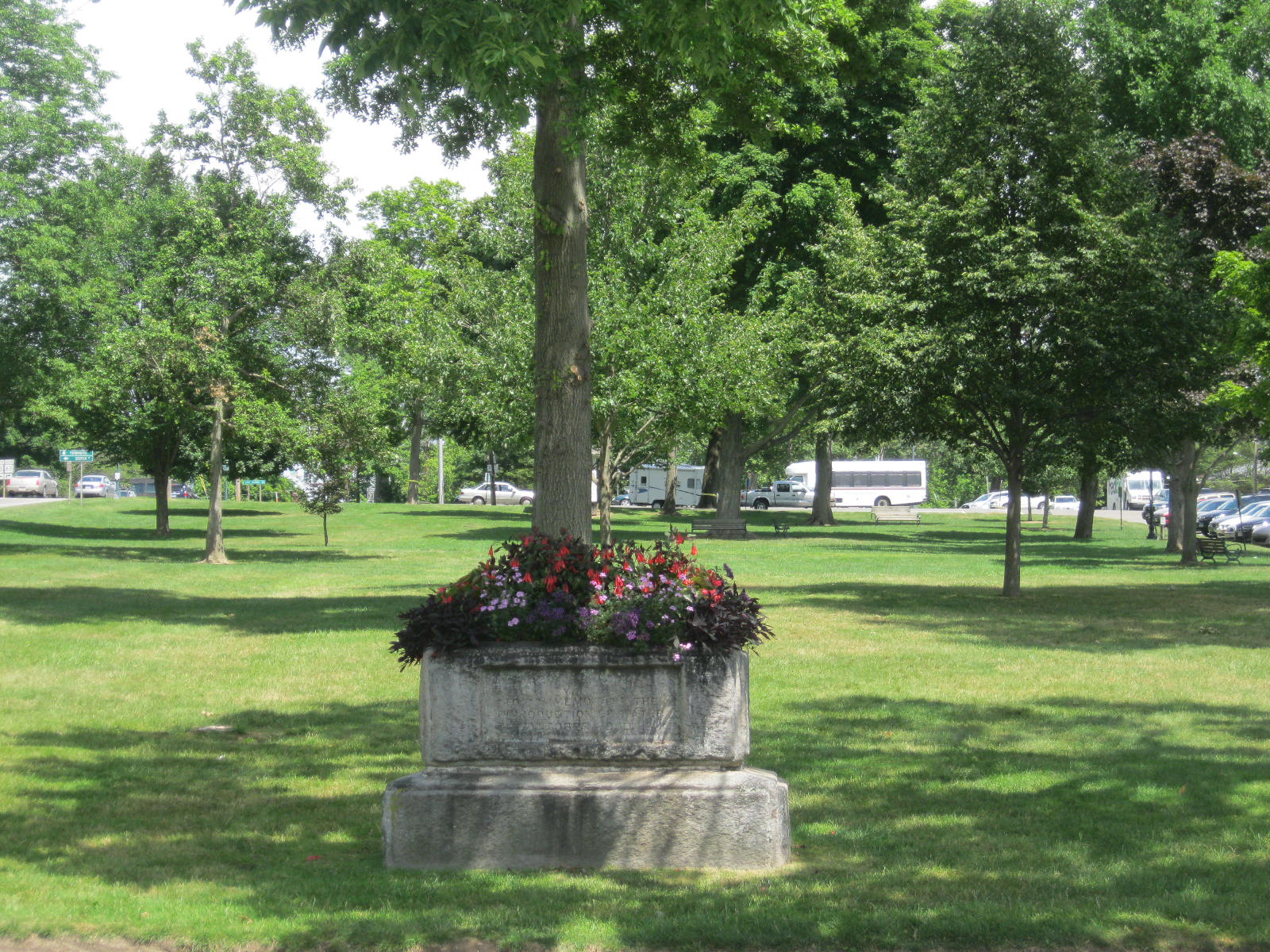
Apparently the mere prospect of a clean and secure source of drinking water excited the commemorative spirit of the town.  In 1890, a year before the water system was activated, a small monument appeared on the western end of the town green bearing the inscription:

Erected by the

VIS

to commemorate the

introduction of water

October 1890.

The Litchfield Village Improvement Company (later the Village Improvement Society, or VIS) was incorporated in 1875 to oversee improvements to the town’s streets, parks, and public structures.  In erecting this particular marker, however, the organization perhaps did more than improve the appearance of their town; they may have commemorated its very survival.