Litchfield Then and Now: The 150th Anniversary of the End of the Civil War

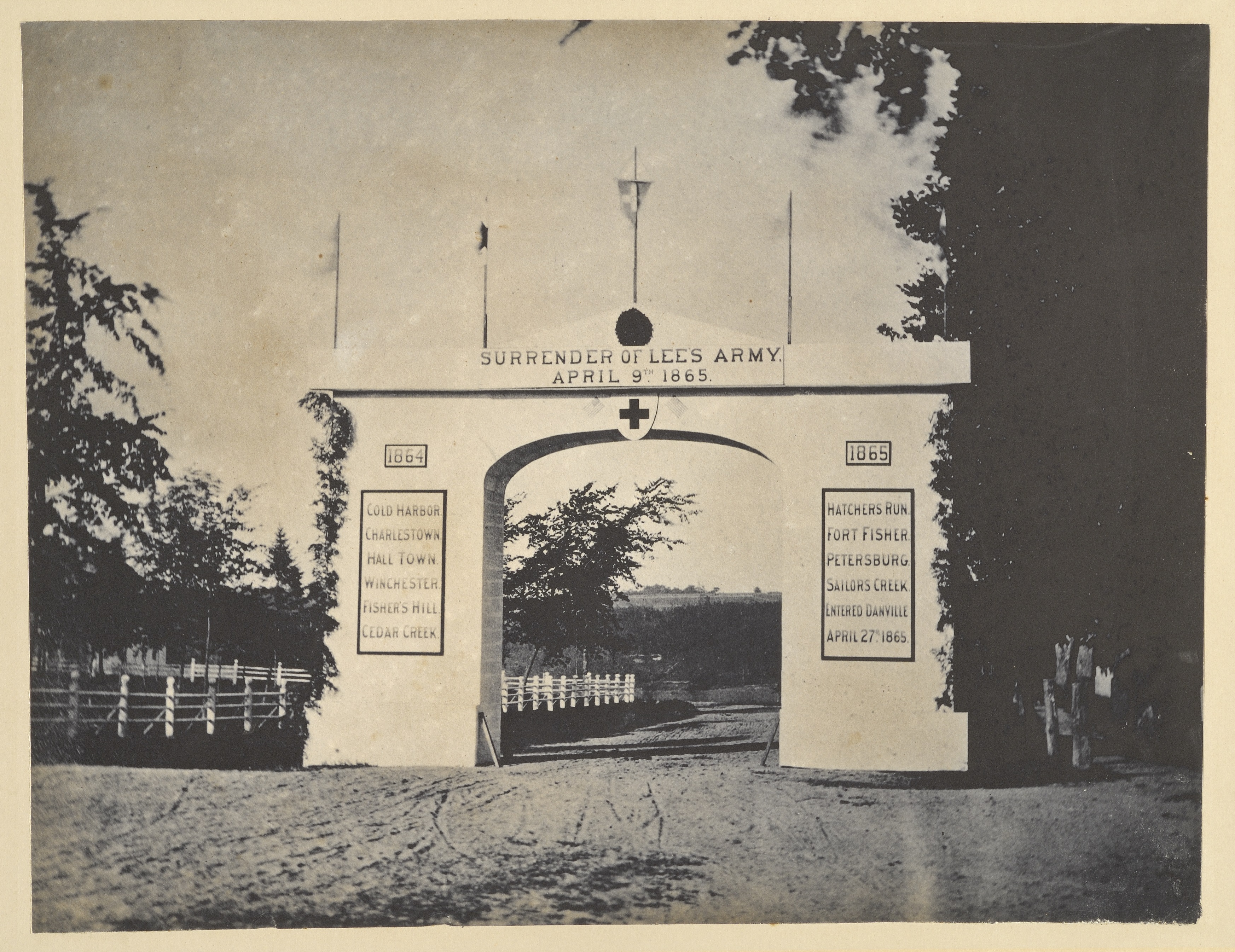
archarchmodernApril 9th, the anniversary of the Lee’s surrender to Grant, marks the culmination of the Civil War sesquicentennial. Litchfield County soldiers served with the 29th Connecticut Infantry, an African American unit that was the first Union regiment to enter the Confederate capital of Richmond, and the 2nd Connecticut Heavy Artillery that pursued Lee’s army to the surrender at Appomattox Court House. While the war ended in the early spring, it was not until August 1865 that many of Litchfield County’s veterans returned home.  That month a great celebration in Litchfield honored returning veterans from the county. The village was decorated with enormous national flags while the smaller flags of a dozen army corps flew from the giant pole on the Green. A triumphal arch, made of papier-mâché, was erected on East Street, near where the Litchfield Historical Society now stands. It had the Sixth Corps flag in the center and two divisional flags on the side, commemorating the army units to which Litchfield’s soldiers belonged.  Below those flags were the names of the battles in which the 2nd Connecticut Heavy Artillery fought.

The returning veterans – 300 to 400 strong – arrived in East Litchfield by rail, marched to the town, and paraded through the arch – soldiers on one side, civilians once again on the other.

Colonel Elisha Kellogg of the 2nd Connecticut Heavy Artillery

Colonel Elisha Kellogg of the 2nd Connecticut Heavy Artillery

The local newspaper reported that “The reception of the 19th in this town on Tuesday was a most gratifying success.”  Residents of neighboring towns began arriving in the early morning.  Reverend Richards gave a benediction, and Lieutenant Colonel Nathaniel Smith of Woodbury gave a welcoming speech:

I will not recount the list of your battles – they are known to all present – from that               first bloody day to the last unparalleled march of over 100 miles in 22 marching                   hours – ending in Lee’s surrender.  These things – memories to you – are glorious             wonders to us!  We look upon you with emotion!  With joy and gratitude, and bid                 you welcome!

Congressman Hubbard, who lived on South Street and was a favorite of Lincoln’s who referred to the representative as “Old Connecticut, also spoke:

Your hard fare, your toilsome marches and constant exposure to wounds                            and death have been crowned by the highest reward ever gained by men at                        arms.  The conspirators against a people’s government are in the dust and                          freedom is triumphant.

Major General John Sedgwick

Major General John Sedgwick

Thousands of people attended the festivities, which consisted of bands, food and drink, and performances.  An exhibit hall was set up with relics from the war, including the coat with the bullet hole that killed General John Sedgwick of Cornwall, captured swords, battlefield artifacts, paintings and photos of Henry Dutton (killed at Cedar Mountain, John Hubbard (the Congressman’s son), the three Wadhams brothers (killed at Fort Darling, the North Anna, and Cold Harbor), and Colonel Elisha Kellogg (killed at Cold Harbor).

At dark, an illumination allowed the festivities to continue until the lights went out at 10 p.m., when the crowd dispersed.

Hidden Nearby: New Milford’s Underground Railroad Monument

UGRR2

Two leading figures of the abolitionist movement, John Brown and Harriet Beecher Stowe, were natives of Litchfield County. As such, they would likely have been pleased by the county’s role in the Underground Railroad.  While much of the history of this secret route by which fugitive slaves were ushered to Canada is clouded in myth and legend, there is substantial documentation for a route that passed from the coast to Waterbury, then to New Milford, Washington, Torrington, Winchester and Winsted before crossing into Massachusetts.

NM Quaker

New Milford’s Quaker Meetinghouse, at 300 Danbury Road (Rt. 7).

Quakers took the lead in operations in New Milford, and the Old Friends’ Meetinghouse, which still stands on Route 7 south of town, was a prominent center of activity. Two Centuries of New Milford, an early 20th century history, documented the role of other locations in town in the Underground Railroad:

In the later days of slavery in the South there were several stations of the Underground      Railroad in this vicinity. Mr. Charles Sabin’s house in Lanesville was one, and the                house of Mr. Augustine Thayer on Grove Street in this village was another. Mr. Thayer      and his good wife devoted their lives to the Abolition cause. They helped many poor            slaves on their way, rising from their beds in the night to feed and minister to them, and      secreting them till they could be taken under cover of darkness to Deacon Gerardus          Roberts’ house on Second Hill, from there to Mr. Daniel Platt’s in Washington, and so        on, by short stages, all the way until the Canadian border was reached.

A second prominent stop in Washington was at the home of Frederick Gunn, who established the Gunnery School in 1849.

As fugitive slaves reached Torrington, they likely sought refuge at the home of Isaiah Tuttle and his son, Uriel, who lived in the Torringford section of town. Uriel was president of the Litchfield County and the Connecticut Anti-Slavery Societies. Of his anti-slavery activities, Deacon Thomas Miller wrote, “His efforts and undying zeal in the cause of emancipation are too well known to the public in this state to need a delineation… His house was literally a place of refuge for the panting fugitive, and his purse and team were often employed to help him forward to a place of safety.”

Isaiah Tuttle House, on Torringford Street, Torrington. Courtesy of Connecticut Freedom Trail

Isaiah Tuttle House, on Torringford Street, Torrington. Courtesy of Connecticut Freedom Trail

Other reported stops on the Underground Railroad include the home of Joshua Bird, a deacon at the Bethlehem Congregational Church who lived on the town Green. Henry Terry, grandson of the clockmaker, lived on North Street in Plymouth. An ardent abolitionist, he allegedly had tunnels running from his cellar to an outbuilding to whisk slaves to safety. The presence of tunnels like these fed Southern fears about Northern complicity in helping slaves escape, and the belief that the election of Lincoln in 1860 would lead to legalization of the Underground Railroad were major factors in the decision of southern states to secede from the Union in the winter of 1860-61. Interestingly, when the Emancipation Proclamation was issued almost two years into the war, the number of fugitive slaves making their way to the north dropped precipitously, as they only needed to reach Union lines, not Canada, to achieve freedom.

UGRR1

Looking to commemorate her town’s role in the Underground Railroad, New Milford resident Frances Smith conceived the idea of a monument at the head of the town green, in the shadow of the Civil War monument. Sculptor Ray Crawford provided the design, which depicts a broken chain, symbolizing the end of slavery. The monument was dedicated on November 17, 2013.

East Cemetery: Floral Symbolism

Photojournalist Douglas Keister has written that “Plants, especially flowers, remind us of the beauty and brevity of life.” As such, they have been used to remember the dead since the time of the Egyptians. Aristotle even went so far as to state that plants had a soul. The use of the language of flowers as symbolism on gravestones peaked during the Victorian Era, which also marked the heyday of the use of cemeteries as gardens. Vestiges of this era of floral symbolism are common in Litchfield’s East Cemetery.

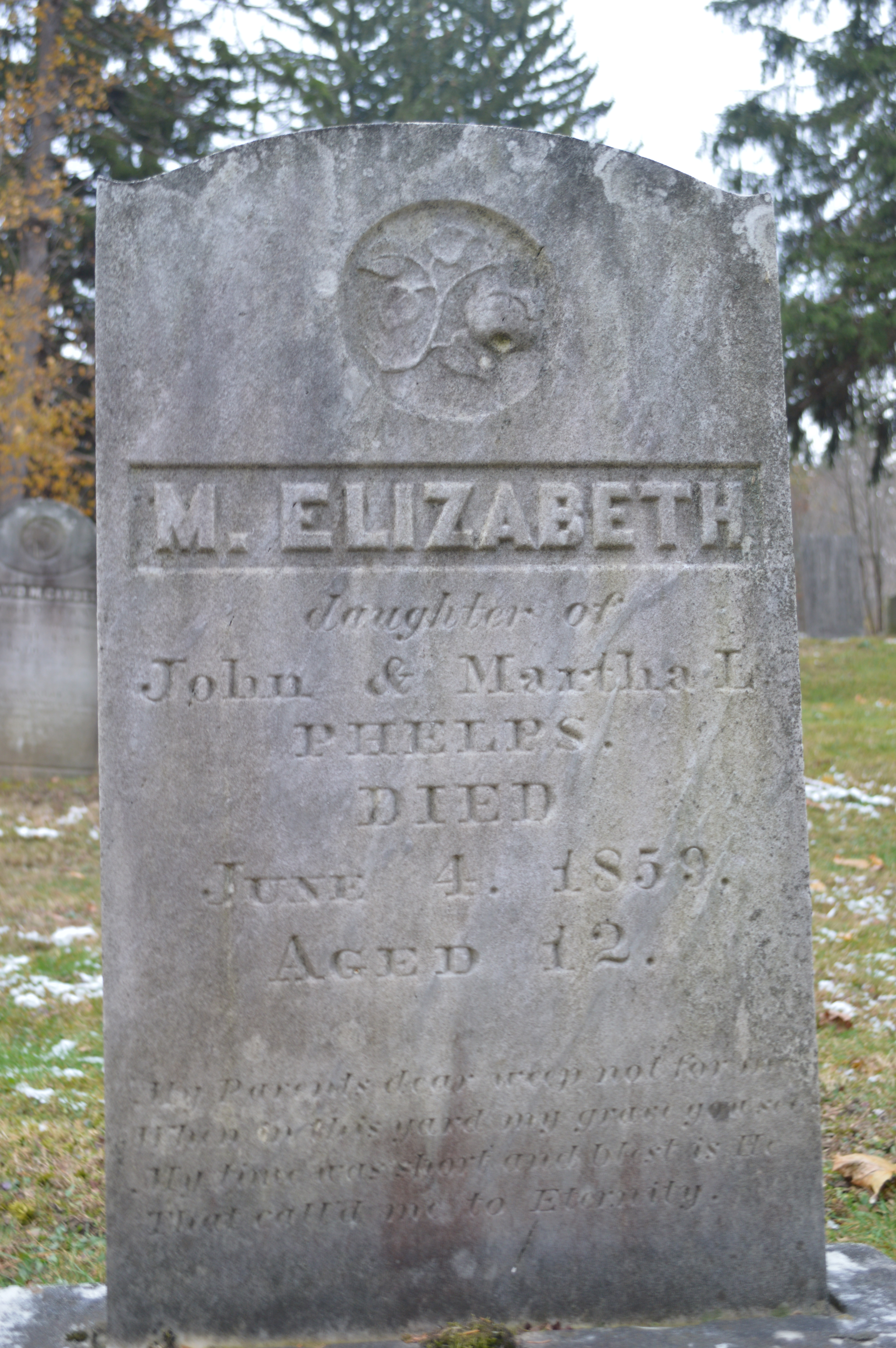
Rose

Elizabeth Phelps died at only twelve years of age in 1859.  Her gravestone included a rose, a flower rich in symbolism to the Victorians.  Since Elizabeth was so young, we are led to believe that this depicts a white rose, a symbol of purity. The fragrance and beauty of a rose was a reminder to visitors to the cemetery of the Paradise that awaited good Christians.

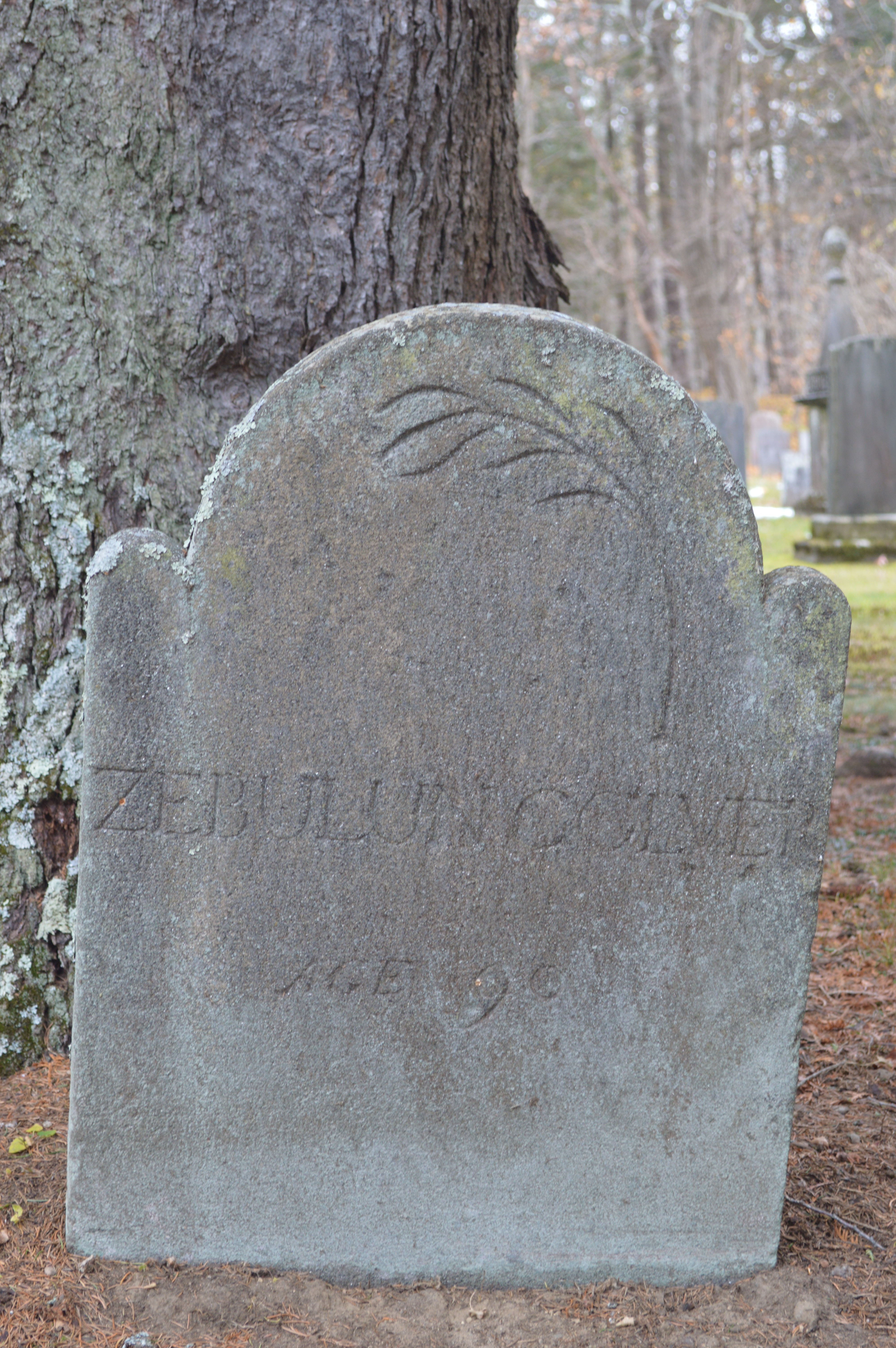
Palm

Zebulon Colmer, who lived to be 90, had his gravestone marked with a palm tree.  The story of Christ’s procession into Jerusalem on Palm Sunday is, of course, well known to Christians.  In the Roman era, the palm was a symbol of victory, and Christians adapted this imagery to symbolize Christ’s victory over death, and thus, by extension, the afterlife achieved by good Christians.

Lily

Julia Henrietta Jones, who died in 1851 at the age of 46, was commemorated with a lily.  Lilies were symbols of chastity, but were also strongly associated with funerals, as their strong scent covered the foul smells associated with death.

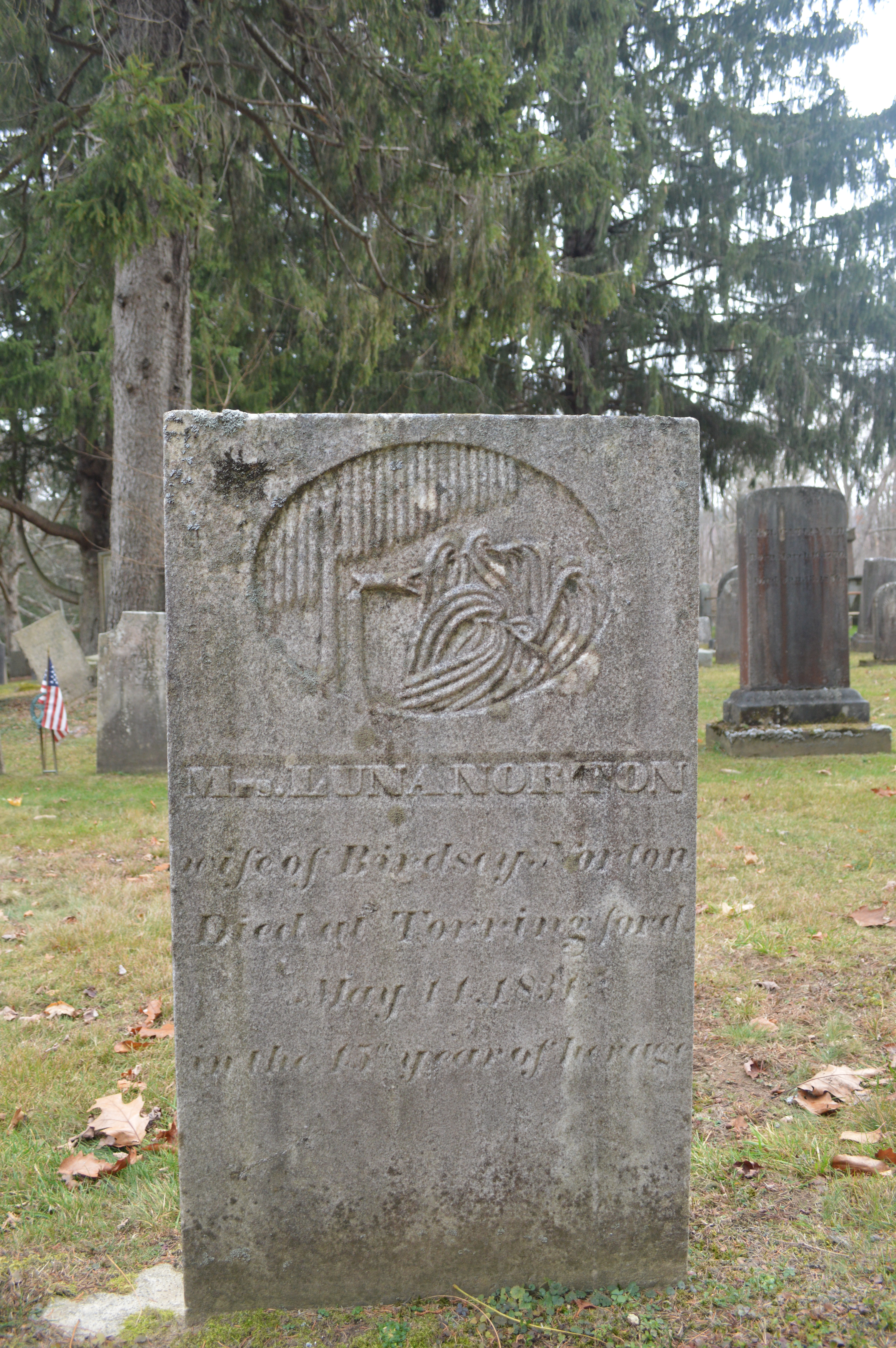
Broken willow

The gravestone of Luna Norton depicts a broken willow tree, incorporating two Victorian symbols of death.  Weeping willows are symbolic of grief, but also of immortality, as the tree will continue to live despite having its branches cut off.  This was an exceedingly popular cemetery image in the early 1800s, and several willow trees can be found on graves in the East Cemetery.  Norton’s grave, however, depicts a broken willow, which seems to counteract the notion of immortality.  Broken trees symbolized lives that were cut short.

For more information on the symbolism of gravestones, see Stories in Stone by Douglas Keister.

For additional posts on the East Cemetery, see here, here and here.

The Blizzard of 1888

With Litchfield stuck in a weather pattern that seems to bring more snow every day, perhaps a look back at the great Blizzard of 1888 is in order.

Drifted snow at Dr. Buel's house on North Street, Litchfield, 1888.  Courtesy of Litchfield Historical Society.

Drifted snow at Dr. Buel’s house on North Street, Litchfield, 1888. Courtesy of Litchfield Historical Society.

With little in the way of accurate meteorological predictions, the blizzard came as a surprise to the Northeast on Sunday, March 11, 1888.  It had been an unusually warm winter, and that day dawned with rain.  It soon turned to hail, then sleet, then ultimately snow.  Bitter cold and high winds set in, and the snow continued for three days.  When it all stopped, between 20 and 50 inches of snow had fallen in Connecticut, with drifts of 12 feet not uncommon.  (One drift in New Haven reached 40 feet high!)  The storm resulted in more than 400 deaths and an estimated $20 million worth of damage.

Dr. Buel's house after the snow had melted.  One source says the snow was melted within ten days; another says the last of the drifts didn't melt until June! Courtesy of Litchfield Historical Society.

Dr. Buel’s house after the snow had melted. One source says the snow was melted within ten days; another says the last of the drifts didn’t melt until June! Courtesy of Litchfield Historical Society.

The following are excerpts about the blizzard from the Litchfield Enquirer:

March 12th – “The wind blew a perfect blizzard all day and the drifting and falling snow made even main streets almost impassable Monday night the storm continued with increasing fury and buildings rocked as though in a storm at sea.”

A modern view of Dr. Buel's house.

A modern view of Dr. Buel’s house.

March 13th – “On Tuesday morning the wind had lessened though still blowing a gale with the thermometer at or near zero. The most remarkable drifts are at Dr. [H. W.] Buel‘s. One, a little west of the house, about 20 feet, to a level with the eaves. There is an addition on the west of Dr. Buel‘s house, reaching- about to the eaves, which is almost completely covered by the snow, so that our reporter, walking- along the top of the drift, passed completely over the roof of this part of the house, and down on the northern side. There is a drift on the east which is even higher, shutting up one of the library windows completely, and reaching nearly to the top of one of the large firs which form a hedge on that side of the house.

March 14th – “The wind is northeast and considerable snow is still falling. People are about on snow shoes skees (sic) and snow shoes extemporized out of boards some carrying groceries to those in great want. Little business is doing. Most of the stores are closed. A few are open with people standing about comparing notes about tunneling to their woodsheds drifts over second story windows and other marvels of the great storm.”

The Lake Station, Bantam.  Courtesy of White Memorial Foundation.

The Lake Station, Bantam. Courtesy of White Memorial Foundation.

The Shepaug Railroad was out of service until March 16th. A railroad cut near the Lake Station (today the Cove in Bantam) was filled with a drift 22 feet deep!

And all this snow needed to be removed from the transportation network without the benefit of modern plows!

Topsmead State Forest

DSC_1320

A modern visitor to the Topsmead State Forest may think he or she has stepped into a Harry Potter novel.  The English cottage at the hilltop – the name means “top of the meadow” – is reminiscent of the Weasley clan’s home in J.K. Rowling’s novels.  The home and grounds, however, are reminders of an important era of the region’s history. Topsmead was the summer home of Edith Morton Chase and her companions, Mary and Lucy Burrall.

OLYMPUS DIGITAL CAMERA

The former headquarters of Chase Brass and Copper, designed by Cass Gilbert who also designed the Woolworth Building in New York and the Supreme Court building in Washington, DC.

Ms. Chase was the daughter of Henry Sabin Chase, the first president of Chase Brass and Copper Company, founded in Waterbury in 1876. The company became one of the most profitable businesses in the city, and Chase hired the noted architect Cass Gilbert to design the corporate headquarters across the street from Waterbury’s City Hall. Shortly before his death in 1917, Chase purchased 16 acres on East Litchfield’s Jefferson Hill as a gift for his daughter, who built a small cottage on the grounds.  Over the next 55 years, Edith Chase made twenty-four additional land purchases, enlarging the estate to 511 acres. Ms. Chase hired architect Richard Henry Dana, Jr.  (who designed the main building of St. Margaret McTernan’s school, established by Henry Chase and now called Chase Collegiate) to create a grander house.  Dana designed a structure in the English Tudor style, with brick and stucco walls, and a slate roof.  The interior walls are oak and stucco, and the house was decorated with 17th century antiques.

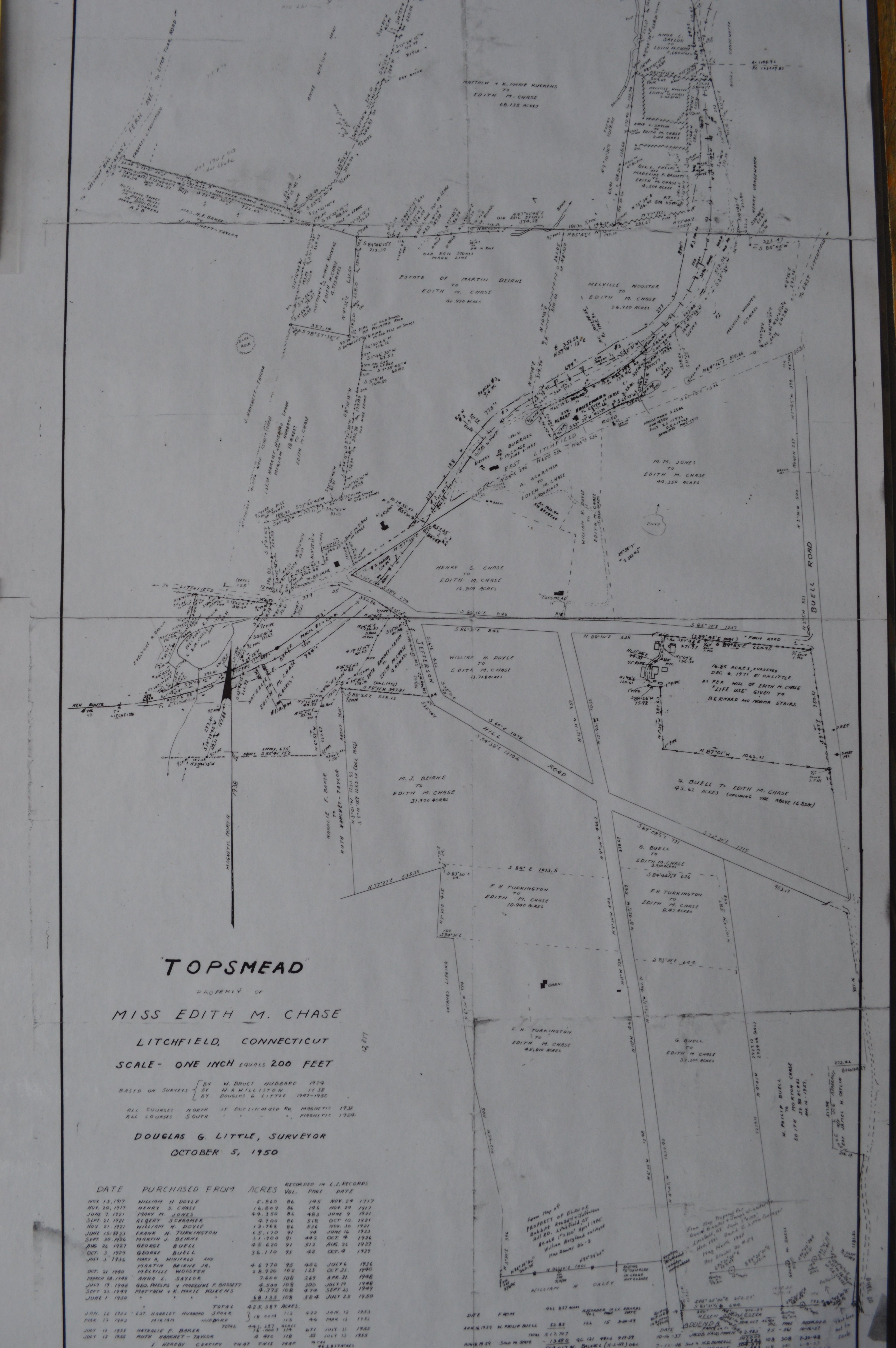
Property map of Topsmead, displayed at the site.

Property map of Topsmead, displayed at the site.

Edith Chase was a lover of the outdoors and she paid great attention to the landscaping.  Formal gardens surround the house, apple trees line the driveway, and holly and lilac grow against the house. In 1927, Ms. Chase purchased the adjoining Buell Farm, which was used to produce the estate’s food, with vegetable gardens, dairy operations, and beef, hogs, sheep, and poultry.

The Topsmead meadow in winter, a wonderful spot for snowshoeing or cross-country skiing.

The Topsmead meadow in winter, a wonderful spot for snowshoeing or cross-country skiing.

Edith Morton Chase died in 1972 and willed her estate to the people of Connecticut.  It was renamed Topsmead State Forest, and thanks to an endowment left by Chase it preserves much of the estate as it appeared at her death.  Particularly significant is the meadow, which preserves a landscape that has been lost in much of Connecticut.

Hidden Nearby: Seth Thomas Clock Factory

2013-11-29 16.41.15

Seth Thomas was born in Wolcott, Connecticut, in 1785.  His education reportedly consisted of only a few weeks in grammar school before he began work on the family farm.  When Seth was 12, his father died and his mother sent him off to be an apprentice to Daniel Tuttle, a neighboring carpenter.  Tuttle taught Thomas arithmetic, the use of tools, and the principles of running a business.  At the age of 21, Seth Thomas struck out on his own to be a carpenter.

This Connecticut tercentenary sign on Main Street in Thomaston commemorates the region's clockmaking history.

This Connecticut tercentenary sign on Main Street in Thomaston commemorates the region’s clockmaking history.

Around 1806, Thomas went to work for Eli Terry, the nation’s leading clockmaker.  Using his carpenter skills, Thomas outfitted Terry’s Plymouth factory with stools and benches, then made the various gears in the internal mechanism of Terry’s clocks.  In 1810, Terry sold his business to Thomas and Silas Hoadley, who formed the Thomas and Hoadley Mechanics and Company and continued making the grandfather clocks that Terry had popularized. The partnership was short-lived however, and by 1813, Thomas had struck out on his own.

A Seth Thomas shelf clock, c. 1820.  Courtesy Metropolitan Museum of Art.

A Seth Thomas shelf clock, c. 1820. Courtesy Metropolitan Museum of Art.

In looking for a location for his own factory, Thomas found a site on the Naugatuck River in what was then known as Plymouth Hollow, which would be renamed Thomaston.  (This is the site where the Seth Thomas Clock Factory still stands.) Plymouth Hollow was a community of only 20 houses at the time, but Thomas’s factory would soon bring excitement to the town.  Operations began early in the morning, and workers put in twelve hour days for a daily wage of between 75 cents and $1.25. Thomas ran a company store for his employees and occasionally sponsored dances. Initially his factory produced the same type of grandfather clock he made with Hoadley. However, when Thomas’s mentor Eli Terry developed a cheaper shelf clock, the market for the “tall clock” nearly dried up.  Fortunately for Seth Thomas, Terry was overwhelmed with orders and sold the rights to the patent to Thomas for $1000.  Clocks were sent by ox cart to New Haven for shipment to New York.  Business was so brisk that by 1825, both Terry and Thomas had made $100,000 in profit, and Thomas spawned cottage industries across the town in making cases and transporting supplies and products.

Seth Thomas

Seth Thomas

In later years, Thomas diversified his business holdings, opening a cotton mill in town, sponsoring railroads, and dabbling in real estate development.  In 1853, he incorporated his business as the Seth Thomas Clock Company, so that operations could continue after his death, which came in 1859, when Thomas was 74.  His clocks lived on, incorporating new brass parts, expanding into watch, alarm clock, and marine clock production, and made the famous tower clock in Grand Central Station.  The Seth Thomas Clock Factory building that stands on Main Street in Thomaston was built around 1915, and was severely damaged in the Flood of 1955. Eventually the company was bought by the General Time Corporation, which itself was bought by a series of other corporations. Operations ceased around 1980, but the name Seth Thomas lives on in the quality of his clocks, and in the name of the community, which separated from Plymouth in 1875.

Hidden Nearby: New Milford Public Library’s Memorial Hall

2013-11-29 12.46.47New Milford’s first library was established in 1796.  Housed in the homes of five different “public spirited citizens” it was ironically known as the Union Library.  The library was open only five days a year, and consisted of 350 books.  A century later, the New Milford Library Association was founded and the collection was relocated to the town hall.

Public_Library,_New_Milford,_CT

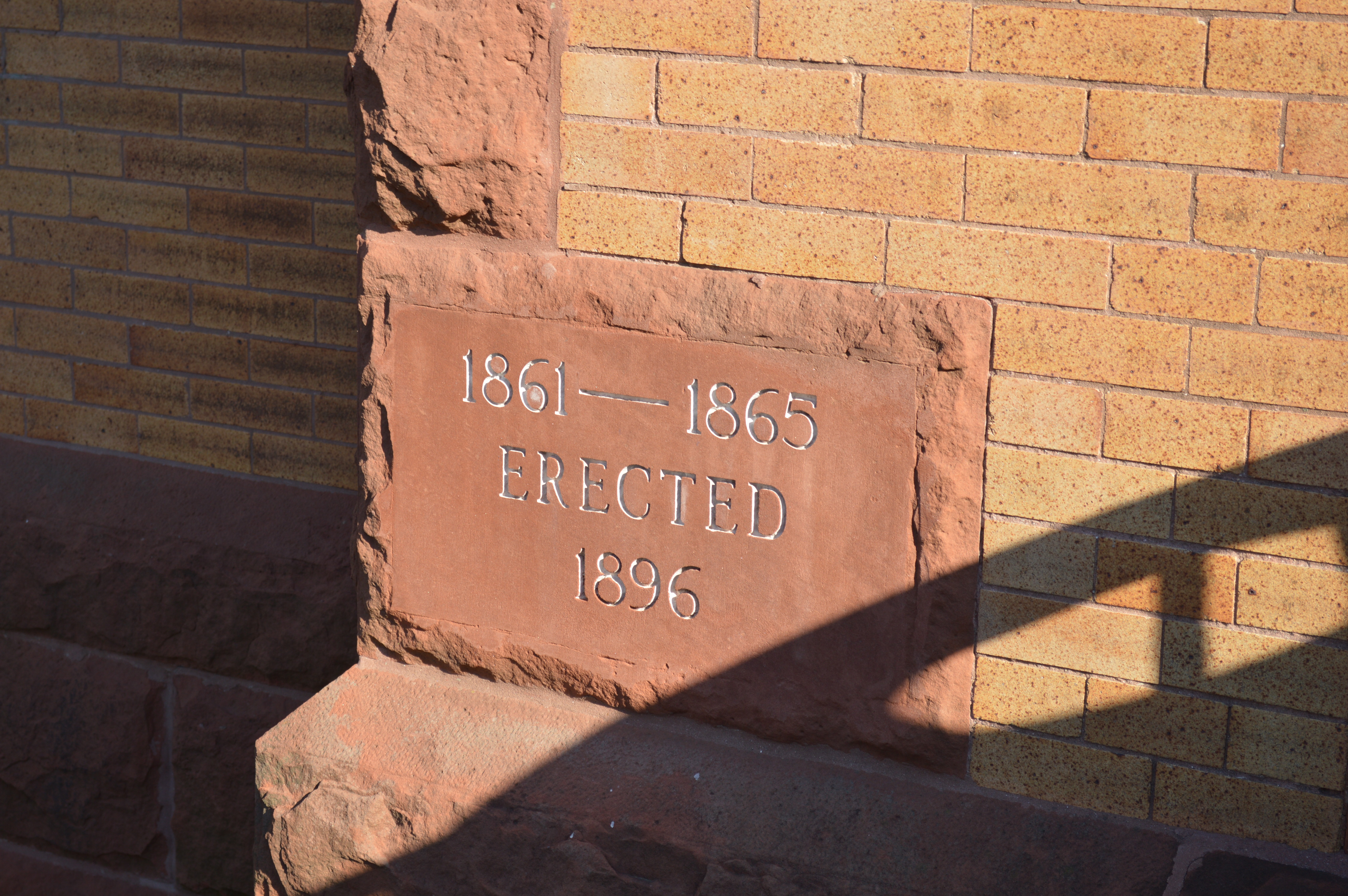
In 1893, the General Assembly of Connecticut passed a bill “authorizing the Town of New Milford to erect a library building and memorial hall,” honoring the 267 soldiers and sailors from New Milford who served in the Civil War. The legislation further specified that the structure was “also to contain the tablets, emblems, and inscriptions commemorative of those soldiers who enlisted from said New Milford, and for meetings of the Grand Army and for other literary, patriotic, and historical purposes such as the town may prescribe.”

gravemarkers-gar (1)

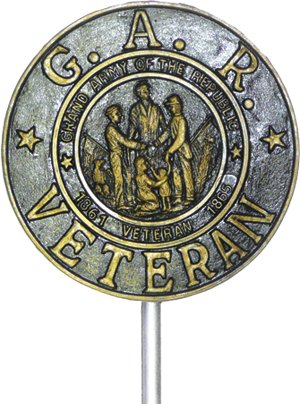
The “Grand Army” was the Grand Army of the Republic, a fraternal organization comprised of veterans of the Union Army.  Founded in Decatur, Illinois in 1866, the GAR became among the first – and arguably one of the most successful – lobbying organizations.  At its peak it consisted of 490,000 Civil War veterans.  The GAR supported voting rights for African American veterans, furthered the careers of Republican politicians, and pushed for Congress to establish veterans pensions. (The GAR was so successful in this last endeavor that as of 2013, one pension is still being paid – $876 a year to the daughter of a Civil War veteran born around 1930!)

General Emory Upton, for whom New Milford's GAR post was named.

General Emory Upton, for whom New Milford’s GAR post was named.

Egbert Marsh, a prominent citizen, offered the town a lot on Main Street and $10,000 toward the construction of a new building, with individuals contributing the balance. Marsh donated additional money to purchase books for the collection. The library building was erected in 1897.  The reading room opened in January 1898, and the circulation of books began two months later. The second story of the building served sat the headquarters of the GAR’s Upton Post, which was organized in 1882 with 26 charter members.

8c08bd76-434c-4813-8680-788a89403dd8

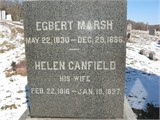
Egbert Marsh’s grave, Center Cemetery, New Milford

Egbert Marsh died in 1896 and never saw the completed structure.  The second story of the library, devoted to public lectures and meetings, is still called Memorial Hall, however, and its walls are decorated with prominent images and documents from the Civil War.

Hidden Nearby: Torrington’s Carl Bozenski’s Christmas Village

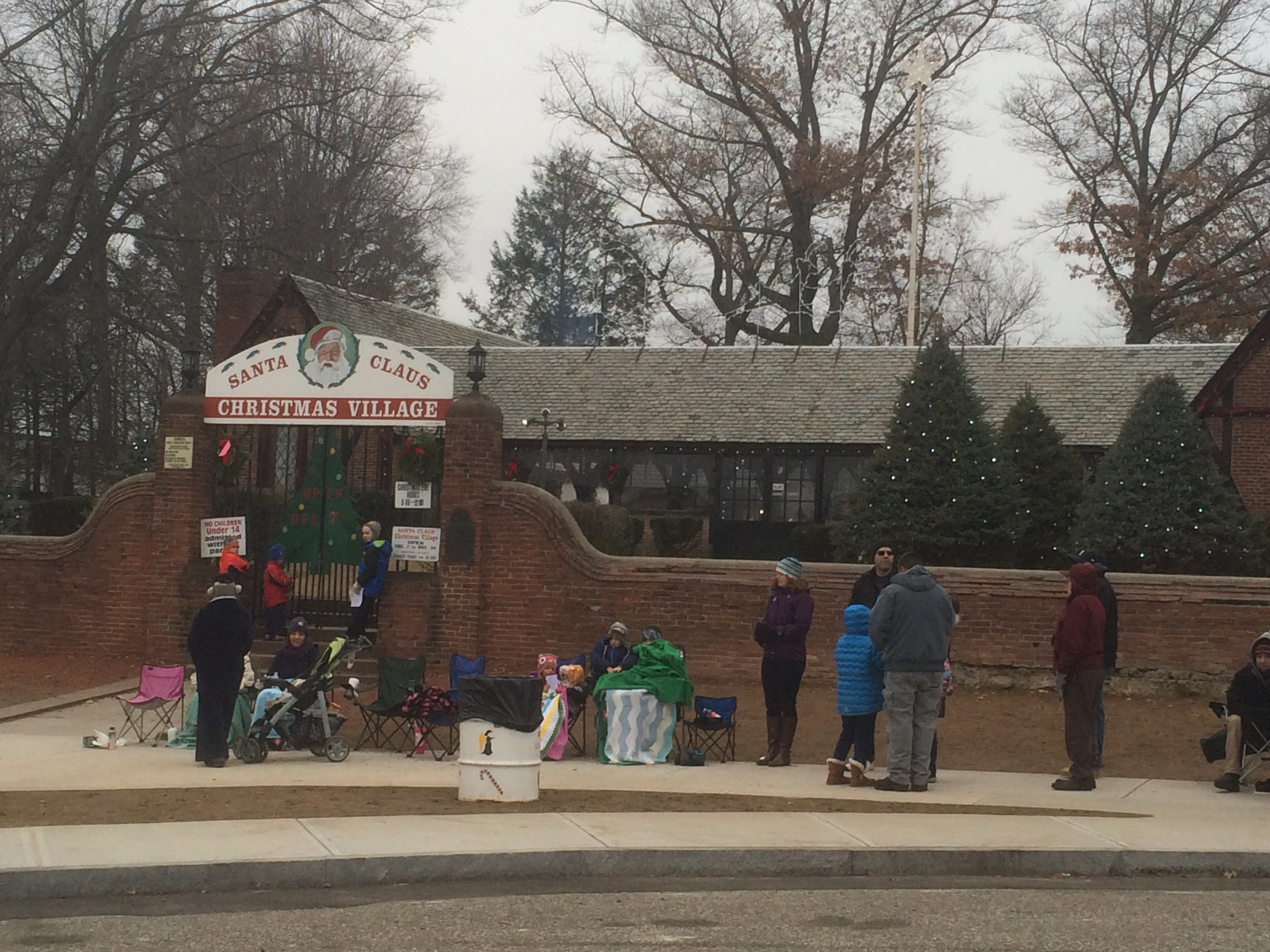
IMG_1407A site for which people stand in line for hours is hardly hidden.  Carl Bozenski’s Christmas Village has been a fixture of Litchfield County’s celebration of Christmas since 1947.

IMG_1409

Bozenski was Torrington’s Parks and Recreation Supervisor who, frustrated with the commercialization of Christmas, opened his own Yuletide attraction to spread holiday spirit.  (The site was also once used for summer camps.) Nearly seventy years later, crowds continue to pour into the village.  The Christmas Village opens with a parade through town in early December.  Visitors stand in line – often for hours – to see the toy workshop and Santa’s house, to meet Santa himself and receive a small toy.  (Toys are collected through a community toy shower.)  In 2013, more than 20,000 people visited the Christmas Village, keeping alive the dream of Carl Bozenski and securing its place as a centerpiece of a Litchfield County Christmas.

A very merry holiday season to everyone who takes the time to check out this blog!

East Cemetery: The Death’s Head Tombstone

2014-11-16 15.25.09

Prior to the sixteenth century’s Protestant Reformation there were few formal burying grounds for those who were not nobles.  The remains of royalty, nobility, and high-ranking clergy members were often entombed in the walls of churches and cathedrals, with the areas closest to the altar being reserved for the most important members of society.

2014-11-16 15.22.02

The social changes spurred on by the Reformation – and the necessity of finding new spaces with the walls of churches nearing their capacity – led to the dead being interred in burial grounds, often known as God’s Acres. The emergence of these cemeteries opened up the possibility of a tombstone for members of the middle class, which meant an opportunity to be remembered.

2014-11-16 15.28.34

Much of New England’s tombstone art followed the lead of the Puritans, who were particularly macabre in their engravings.  Puritan theology held that only the “Elect” would make it to heaven; the rest of mankind just died, were buried, and rotted in the ground. These beliefs are reflected in Puritan gravestone art, with the classic words, “Here lies of the body of …” engraved below a skull or skull and crossbones.

2014-11-16 15.23.07

However, a loosening of the grip of conservative Puritanism led to more optimistic gravestones, with skulls being swapped for human faces, and crossbones giving way to angels’ wings.  Equally telling is a subtle change in the wording, with “Here lies the body of …” often giving way to “Here lies the mortal remains,” language that allowed for the possibility of a human soul.

For more information on cemetery art, see Douglas Keister’s excellent Stories in Stone.

The Grave of Willis Carter

DSC_1097

The grave of Jeph Africa, a Revolutionary War veteran, in the East Cemetery.

In the southeast corner of Litchfield’s East Cemetery is a section of graves of African Americans who lived in the 19th century.  Several government-issued graves mark the final resting places of men who served in the 29th Connecticut Infantry, the state’s African American regiment.

DSC_1096

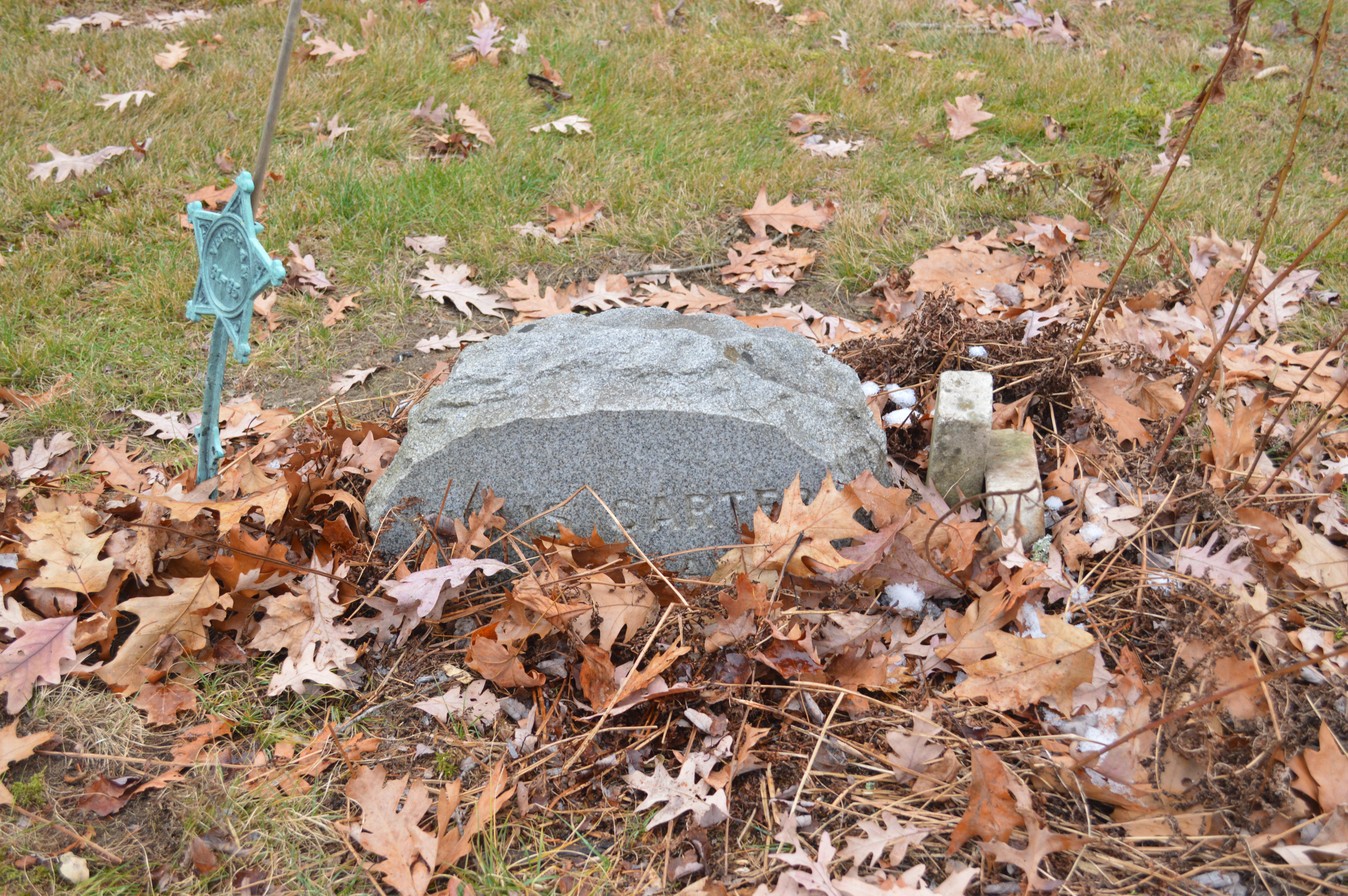
Less noticeable is a simple white grave, half buried.  Was it originally installed like this, or has it slowly sunk into the ground over the decades?  When the leaves are removed, the words jump out at the explorer:

WILLIS CARTER

BORN A SLAVE IN

TENNESSEE

A Civil War veteran’s marker stands next to Carter’s grave but no other immediate information is available.  Does his gravestone contain information about what unit he served in, when he was born, or when he died?  To find out would require disturbing the soil containing his remains.

DSC_1095

Some information is available in Census reports.  The 1870 census identifies Willis Carter as a Torrington resident, born in Tennessee around 1847. The 1880 census provides slightly more information.  We learn that Carter was then living in Litchfield, and was married to Ellen.  His birth year was then estimated to be 1848; both his parents were born in Tennessee.

The 29th Connecticut Infantry

The 29th Connecticut Infantry

Willis Carter’s name does not appear on the roster of men in the 29th Connecticut Infantry.  The records of this unit, however, are hardly definitive.  Still, it is perhaps more likely that he joined a unit of the United States Colored Troops forming in his native Tennessee, and found his way north after the war.  Either way, Willis Carter’s sunken gravestone provides testimony to a remarkable period in American history, when one born a slave in Tennessee became personally involved in a war that secured his freedom, and who afterward found himself living and working in a small New England town.