Hidden Nearby: Camp Columbia State Park in Morris

DSC_0194This post is the third in a partnership with the Litchfield.bz website.  Litchfield.bz is posting video tours of some of the sites visited by this blog.  To see our video tour of Camp Columbia, click here:  http://www.youtube.com/watch?v=65RY3vqdJ4Q

Camp Columbia State Forest stands as something as a ghost town along Route 109 in Morris.  For nearly 100 years – from 1885 to 1983 – Columbia University held engineering and surveying classes on the more than 500 acre campus, which at its peak occupied nearly one square mile from the shores of Bantam Lake to the Morris/Bethlehem town line.  Here, engineering breakthroughs such as the concrete roof that would later top Madison Square Garden were pioneered.

A 1934 aerial view of Camp Columbia.  Courtesy of the State of Connecticut.

A 1934 aerial view of Camp Columbia. Courtesy of the State of Connecticut.

Land purchases began in 1903.  Prior to this the university had rented land from Mrs. Everett Waugh.  Mrs. Waugh’s farm would become the heart of the property, which soon would feature dormitories, a YMCA building with billiards and ping pong tables, a mess hall, and an astronomical observatory.   Columbia paid $10,000 for the 1903 purchases.
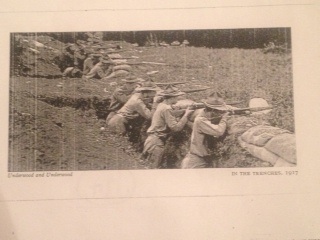
trench

Officer candidates participating in a World War I training program held at Camp Columbia. Photo courtesy of Columbia University.

In the years prior to World War I, a boathouse was built on Bantam Lake.  Future expansion was halted by the coming of war, and in 1917, officers’ training for the United States Army took place on the property.  Trenches were dug near Munger Lane, and mock infantry assaults swept the camp.  In 1918, the university issued an informational packet for those interested in a second round of training at the camp, which stated that the purpose was to offer “an officers’ training course for men who may be called to the National Army and desire to fit themselves for officers of noncommissioned officers in Government Service.”  The packet stated that the program was conducted by the university, not the Army, but that  it had “the approval and endorsement of the Secretary of War, and the record of the men who attended last summer shows that the course has been effective in preparing men for officers’ rank, real usefulness, and rapid advancement.”
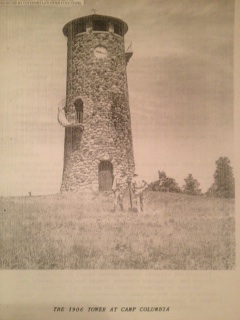
tower

A 1940s image of the Camp Columbia tower; the tower is still standing but no longer has the hands on the clock. Photo courtesy of Columbia University.

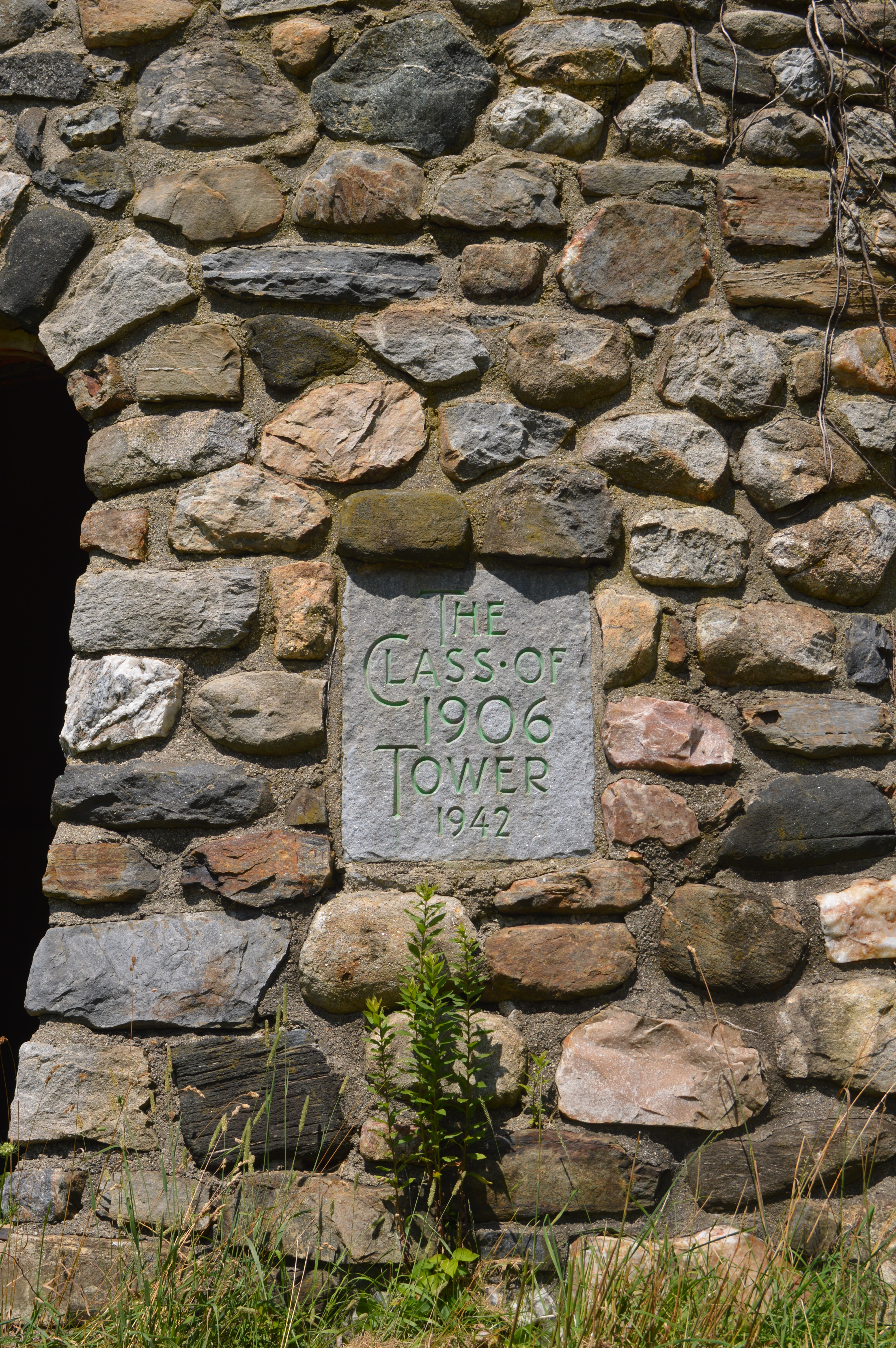
In 1934, a fieldstone dining hall was built and eight years later the central feature of the camp, a 60 foot cylindrical water tower with an observation platform made of local stone was presented to the camp by the Class of 1906.  A 1952 Columbia University press release describes the tower as a “land-locked lighthouse, or the battlement of a feudal castle.”

columbia-university-dwight-eisenhower-1948

Dwight Eisenhower as president of Columbia University.

 Columbia engineering students blasted and leveled the hilly terrain to create a softball field and football field.  In the late 1940s, the Columbia Lions football team held their early season practices here under Coach Lou Little, who paced the sidelines at the school for 26 seasons and was inducted into the College Football Hall of Fame in 1960.  Little was supported in his efforts by the then president of Columbia, Dwight D. Eisenhower.  Ike is reported to have spent time at the camp watching practices and hunting on the grounds.
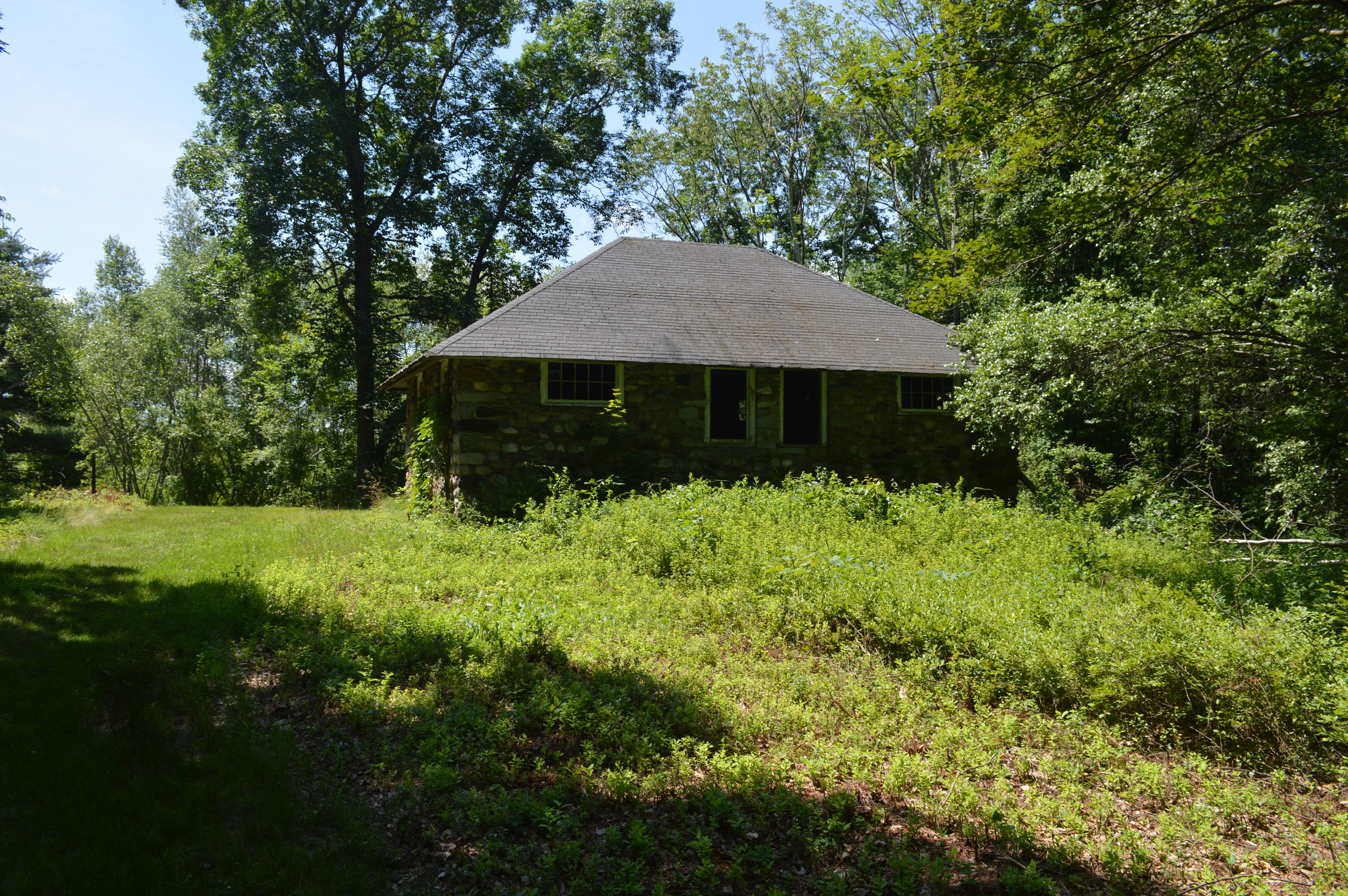
DSC_0192

The Instrument House, one of two surviving structures.

Still, the primary purpose of the camp was as a field school for engineering students, and by the early 1950s the summer program was mandatory for these students.  Courses taught at the camp included Chemical Engineering, Civil Engineering, and Technology & International Affairs.  Additionally, the Columbia University American Language Center offered classes for those international students who wished to apply to American colleges.  The presence of the 60 or so international students in 1952 – from Korea, China, Japan, Malaya, Norway, Sweden, Colombia, Greece, Canada, Brazil, Engalnd and Italy – allowed the university to declare that the camp was “a veritable United Nations in microscosm, the youngsters live together and work together with no more friction than one would find in any other college class.”

Remains of the old flag circle at Camp Columbia.

Remains of the old flag circle at Camp Columbia.

By the mid-1960s, declining student interest in the camp experience and changes to the engineering curriculum brought an end to the Engineering Department’s use of Camp Columbia.  The university maintained the grounds for special programming until 1983 when it was closed.  While the university struggled to find a buyer for the property, the buildings slowly deteriorated.  In 1989, the Town of Morris declared several buildings to be a public hazard and they were utilized in a controlled burning training exercise.

DSC_0196

Remains of an old fountain at Camp Columbia.

In 2000, the State of Connecticut agreed to purchase the grounds for $2.1 million and began to remove most of the buildings.  Today, only the boathouse, tower and instrument house still stand.  Still, for the explorer willing to walk the grounds, hints of foundations and clearings in the forest provide a glimpse into what was once a thriving intellectual community.

The Original Site of St. Michael’s Church

2013-08-06 11.34.16

This small, difficult to find marker stands along Route 202 between the ABC Music Shop and the Tapping Reeve Condominiums.  It marks the first location of St. Michael’s Episcopal Church.

peppercorn_black

Peppercorns

The church was founded in November 1745 at a meeting of the heads of thirteen Litchfield families.  While the numbers of Episcopalians in colonial Connecticut paled in comparison to the number of Congregationalists, Litchfield’s families were fortunate to have a strong leader in John Davies.  Davies, who had been born in England, donated money to build the church and leased the land on which the first church stood.  The terms of the lease between Davies and the Society of the Propagation of the Gospel in Foreign Parts called for the parish to pay Davies one peppercorn annually on the feast of St. Michael the Archangel.  Thus, the parish got its name.

GeorgeWashington

The Revolutionary War was a particularly trying time for the church, as parishioners took an oath of loyalty to both the King of England and the Archbishop of Canterbury.  The church closed completely between 1777 and 1780, and American soldiers allegedly threw stones at the structure as they passed through Litchfield until they were stopped by George Washington, himself an Episcopalian.  Approximately 20% of Connecticut’s Episcopalians fled to Canada as a result of the war.

In 1784, the Connecticut General Assembly officially recognized the Episcopal Church and the Episcopal Society of Litchfield was organized.  Further stability came the following year when Rev. Ashbel Baldwin was installed at the pulpit in Litchfield.

St.Mich.Litchfield

St. Michael’s Church today

These developments, coupled with the cessation of Episcopalian loyalty to the King, led to the need for a larger church. This resulted in the parish’s move to South Street, the site where the current church built between 1918 and 1920 still stands.

Hidden Nearby: Two Monuments to Sportsmen at Housatonic Meadows State Park

flyfish

This blog has typically focused on the history of Litchfield County.  While the region certainly has a rich history, it has an equally rich tradition as a place for outdoorsmen.  These characteristics intersect at Housatonic Meadows State Park.

DSC_0210

Franklin Delano Roosevelt signed the legislation establishing the Civilian Conservation Corps on March 31, 1933.  Over the next eight years , millions of men would serve in the CCC, providing income for their families ravaged by the Great Depression.

One of the first camps was Camp Cross in West Cornwall, Connecticut.  Named for Connecticut governor Wilbur Cross, it opened on June 20, 1933 and was one of the original 13 camps in the state.  Commanded by Thomas C. Hood, the camp housed the 182nd Civilian Conservation Corps, which was trained in fighting forest fires, chopping and sawing wood, and identifying trees.

DSC_0211

For their first task, the 182nd cleared 45 acres in the Housatonic Meadows State Park, which had been established in 1927.  (As the park is one the west side of the Housatonic, it is technically in the town of Sharon.) Here they also planted 45,000 red pine trees in 1933, and another 28,500 trees (red and Scotch pine, European larch, hemlock and white spruce) in 1936.  The corps also repaired and maintained roads and constructed stone walls in the park.  By 1936, the 182nd was working 6,800 acres and had mapped topographic and recreational features and catalogued trees on the property.  Their works was not without danger, however, as one corpsman was reportedly injured by a deer, two others killed a nine-foot rattlesnake, and many reported seeing “wild cats.”  The attack on Pearl Harbor eliminated the needs for the camps, but not before the CCC allowed millions of men an opportunity to help provide for their families.

DSC_0213

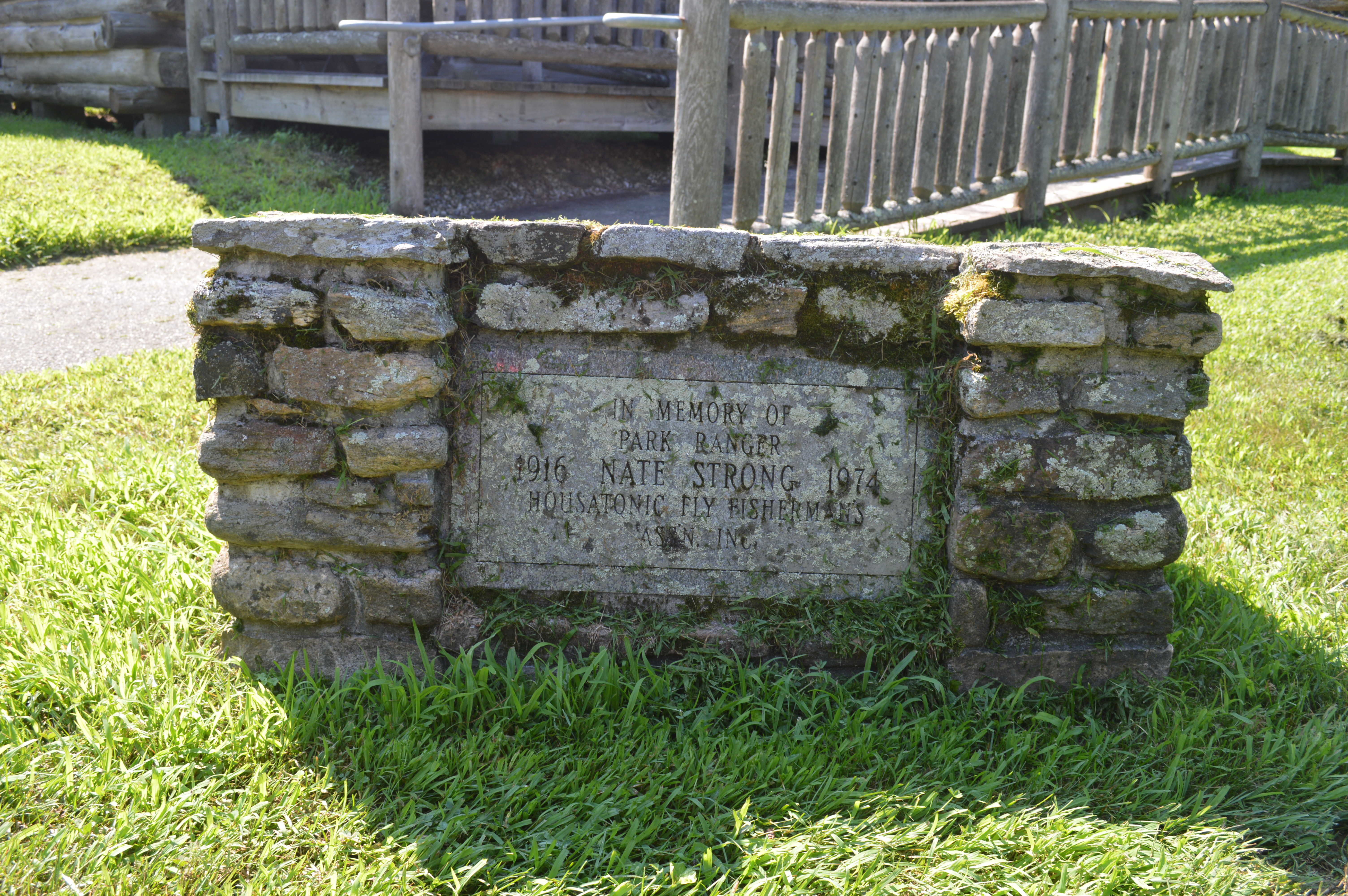
Housatonic Meadows State Park also contains two monuments that denote the area’s reputation as one of the finest fly fishing locales in the northeast.  In front of the campground office is a monument honoring Ranger Nate Strong that was erected by the Housatonic Fly Fisherman’s Association.

DSC_0212

Further south, near the intersection of Routes 4 and 7 is a second monument, this one honoring Francis L. Sheane, who was the chairman of the state Board of Fisheries and Game in the 1940s.

The Constitution Oak

2013-06-28 11.18.57

Connecticut, the “Constitution State,” has a unique history of state constitutions.  The “constitution” that is celebrated on our license plates is the Fundamental Orders of 1638.  This document stated that Connecticut held no political allegiance to England, but rather was loyal to its local government.  In 1662 the Fundamental Orders were replaced by a royal charter exerting the King’s authority over the colony.  However, Connecticut residents paid little attention to this document and continued to abide by the provision of the Fundamental Orders.  This continued until 1818, when provisions establishing the Congregational Church as the official religion of Connecticut were deemed incompatible with the relatively recent First Amendment.  A new state constitution followed.

The Civil War monument in front of the state capitol was erected at the time of the convention in 1902.

The Civil War monument in front of the state capitol was erected at the time of the convention in 1902.

By 1901 it was apparent that there were significant flaws in the 1818 constitution.  Senatorial and House districts were set up according to geographic rather than population guidelines.  The end result was that Union, with a population of 1,000, had the same number of representatives as New Haven, with more than 100,000 residents.  In 1901, Connecticut voters called for a constitutional convention by a 2-1 margin.  The convention put forth a proposal that would award towns between one and four representatives based on population.  This was not enough for the cities, but too much for the small towns, and the proposal was voted down by another 2-1 margin.

Charles Andrews

Charles Andrews

That convention would be all but forgotten except that each of the 168 delegates (representing every municipality in the state) was given a pin oak seedling to plant in their town.  Charles Andrews, one-time governor (1879-1881) and then chief justice of the state supreme court was Litchfield’s representative and the presiding officer of the convention.  He planted his at the eastern end of the town green.

2013-06-28 11.19.48

Periodic surveys of these trees have revealed dwindling numbers.  Of the 168 original oaks, 110 were still standing in 1939 and 86 in 1986.  The last survey, conducted in 2002, revealed only 74 remain.  While a new state constitution was finally approved in 1965, Litchfield’s oak – a reminder of a failed constitution – still stands.

Periodic surveys:

1902 168
1937 110
1986 86
2002 74

Hidden Nearby: The Kent Falls CCC Trail

DSC_0234

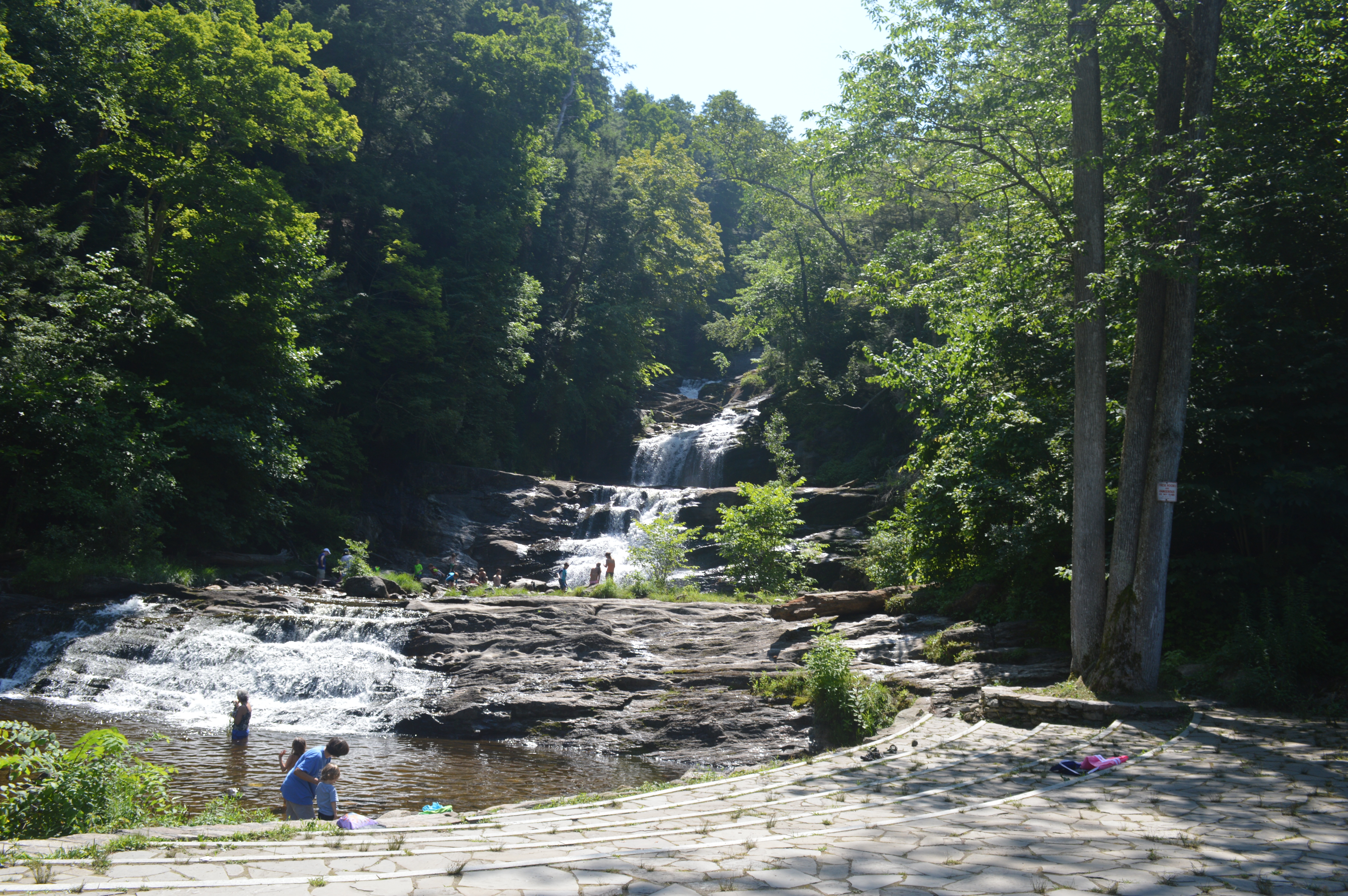
Kent Falls is one of Connecticut’s most popular state parks, with hundreds of thousands of people taking advantage of its picnic area and cooling waters every summer.  There remains at least one part of it, however, that is hidden in plain sight.

DSC_0216

Nearly all visitors who hike to the top of the falls do so via the paved path and steps.  At the northern end of the parking lot, however, is the red blazed trail.  Following this trail for a tenth of a mile brings the explorer to the yellow blazed trail.  The reward for the additional effort is a gradual switch-backed ascent to the top of the falls, with magnificent stone retaining walls supporting the trail (which is an old road bed.)

DSC_0221

The stone walls were built by the men of the Camp Macedonia unit of the Civilian Conservation Corps during the Great Depression.  The camp opened in June 1935 and employed 202 men.  While originally opened to build what would become Macedonia State Park, suitable land for a camp was not available near Macedonia Brook.  (The site of Camp Macedonia has only within the last five years been located; its location is not being shared as means of preserving it are determined.)

DSC_0226

In addition to the stone walls, the CCC also constructed the picnic area and the other trails to the top of the falls.  In exchange for their labor, the men received $30 per month, $25 of which had to be sent home to their families.  They were also provided with food, lodging, medical care and education, a desired commodity as most of the men had only an eighth-grade education.  Responsible men were paid an extra fifty cents a weeks to serve as leaders, helping the two army officers stationed at the camp with its administration.

DSC_0235

Most go to Kent Falls to admire its natural beauty.  It is appropriate, however, to also spend a moment reflecting on the men who made this natural beauty accessible to us.

Hidden Nearby: Harwinton’s Catlin Trough

DSC_0285

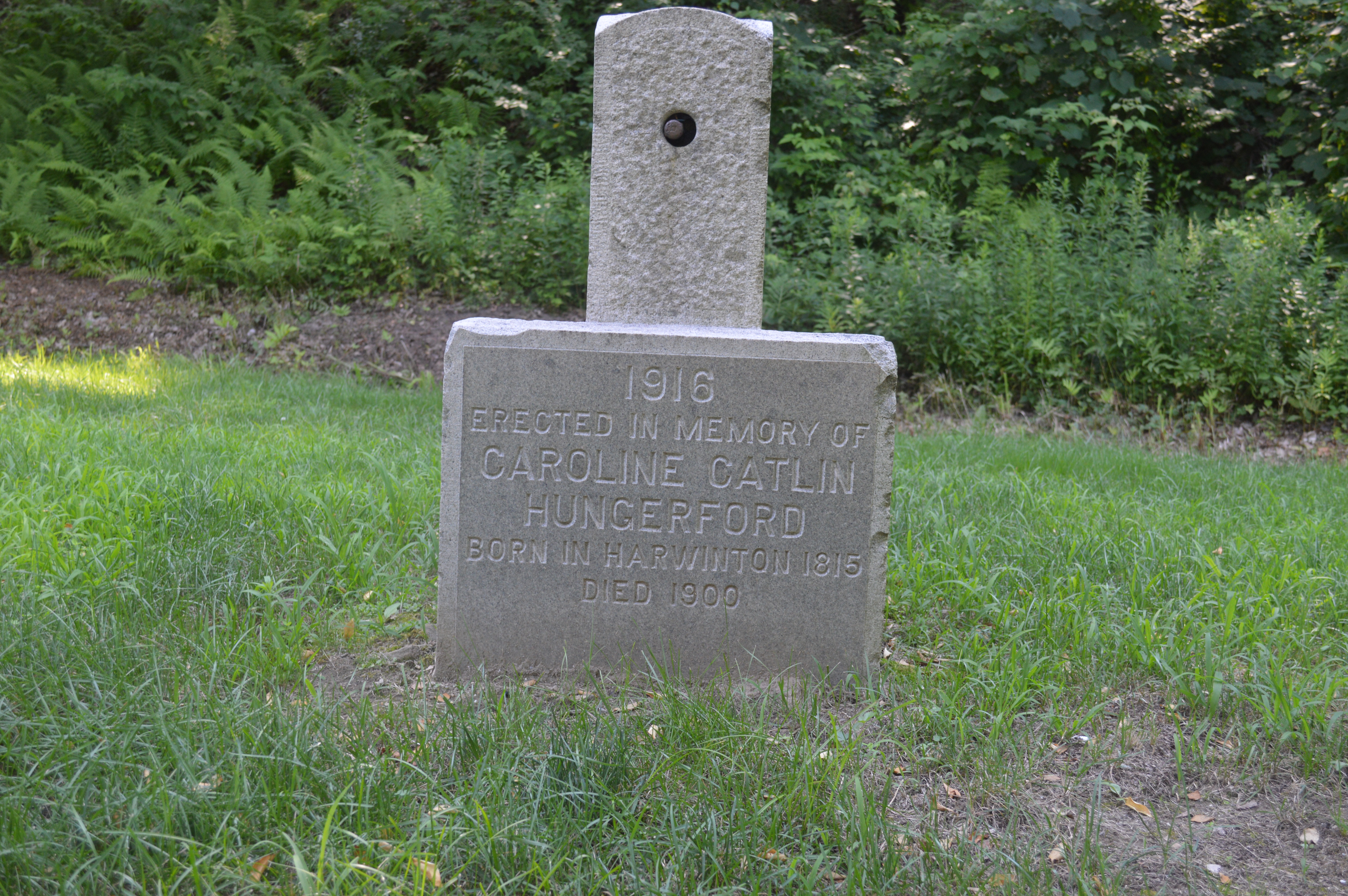
The Harwinton water trough stands a memorial to the original setllers of this part of town, and to the development of the Burlington Road/Harmony Hill Road Historic District area.  Harwinton was originally Hartford and Windsor’s Town, a tribute to the original emigrants who settled it.

DSC_0284

Next to the trough is this granite marker; it was once a drinking fountain.

Among those original settlers was Major Abijah Catlin (1715-1778), who was given a land grant here in 1738.  While there is considerable debate about whether the Abijah ever moved to Harwinton, his family maintained homes and businesses in this area for five generations.  His son, Abijah Jr., operated a store and an inn at the crossroads of Route 4 and Harmony Hill Road.  Here, in 1780, Catlin served refreshments to George Washington, the Marquis de Lafayette, and General Henry Knox.  One of his descendants, George Catlin, was educated at the Litchfield Law School and served in the United States Congress.

DSC_0294

Photo courtesy of Harwinton Historical Society.

The Catlins placed a trough at this location at some point in the 18th century.  It utilized a nearby spring and gravity to provide horses and oxen passing by with a source of drinking water.  It operated until the early 20th century.

DSC_0296

Much like the Goshen animal pound, the trough reminds us of the integral role animals played in the lives of those who lived in this area two centuries ago.

The Center School Inscription

2013-08-06 12.02.13

This post is the second to be accompanied by a video hosted by litchfield.bz. You can access the video here: http://m.youtube.com/watch?v=Tql0h1SAqUE&desktop_uri=%2Fwatch%3Fv%3DTql0h1SAqUE

From the 18th through the early 20th century, public education in American towns was run through small school districts. These districts were organized around one-room schoolhouses and were situated to be within walking distance of homes. For example, when established in 1774 the school in Northfield constituted Litchfield’s 14th school district.

The school for the borough of Litchfield was located on West Street, but Arthur Bostwick who was born in Litchfield in 1860 and became a prominent librarian and author, wrote that “nobody went to it who could afford a term’s tuition at the Institute.” (This institute stood on North Street; the Wolcott Institute on South Street closed the year before Bostwick’s birth). This school was destroyed in the great fire that swept town in 1886.

Litchfield High School, on East Street.

Litchfield High School, on East Street.

Two years later a high school opened at the top of East Street. Students were required to study grammar, literature, arithmetic, United States History and geography.

2013-08-06 12.01.08

“1725 First Public School Appropriation”

2013-08-06 12.01.35

“The Center School Litchfield”

2013-08-06 12.01.42

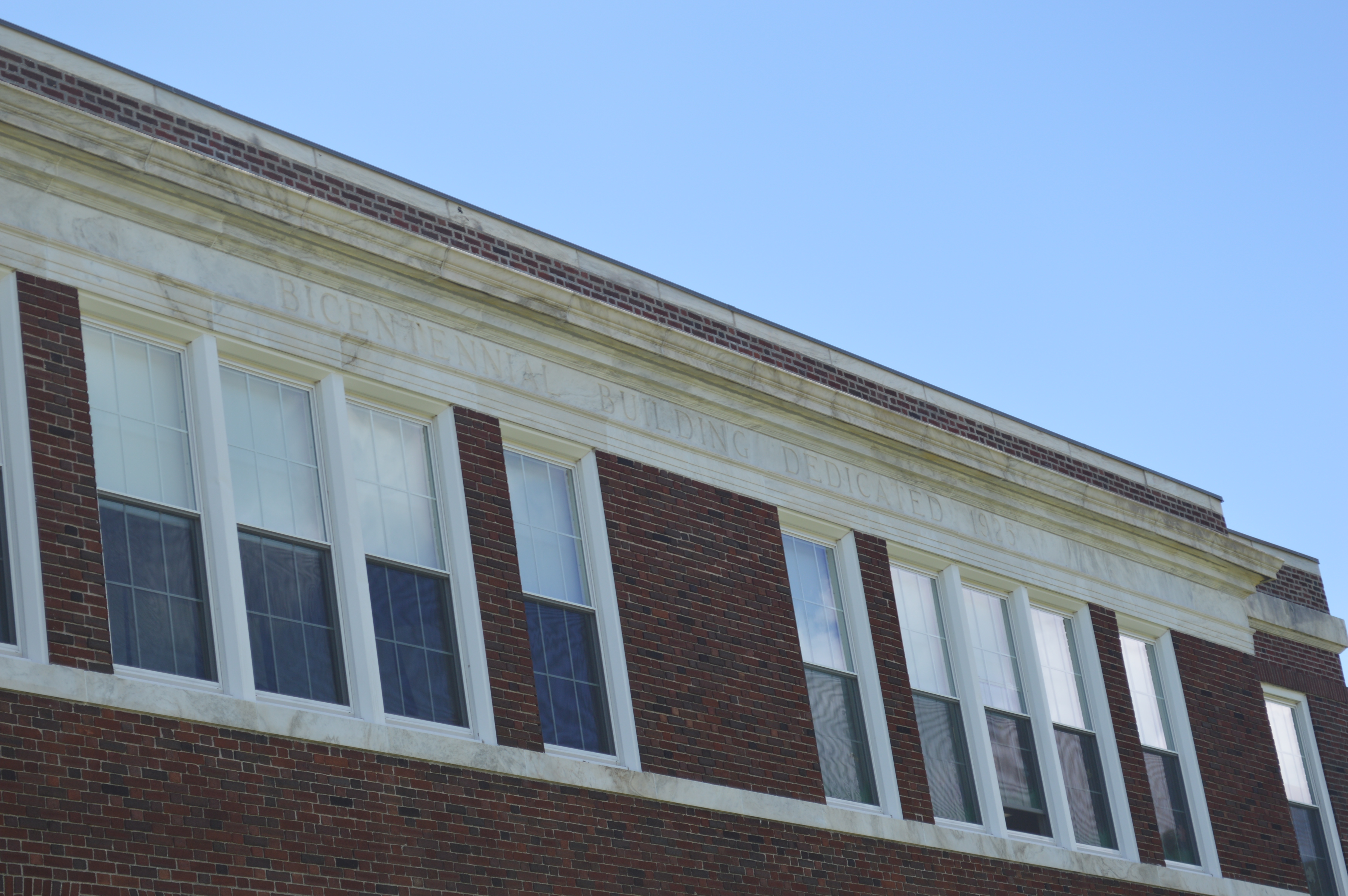
“Bicentennial building dedicated 1925”

There was a movement In the early 20th century to combine the scattered school districts into “consolidated” or “center” schools. It was believed that this would offer students a more specialized education at enhanced economic efficiency to the town. The result for Litchfield was Center School, which opened its doors in 1925, the bicentennial of Litchfield’s first school. This anniversary was commemorated in the inscription at the top of the building. While the building has gone from housing all of Litchfield’s students to only those in grades K-3, the inscription remains as a reminder of the town’s educational history.

The Bantam Lake Ice House

This observation tower along the Lake (Yellow) Trail at White Memorial sits at the point where ice was taken out of the lake and sent to the ice house.

This observation tower along the Lake (Yellow) Trail at White Memorial sits at the point where ice was taken out of the lake and sent to the ice house.

This post marks a new partnership between Hiddeninplainsightblog.com and Litchfield.bz.  Litchfield.bz will occasionally be providing videos showing some of the sites discussed on this blog.

In the days before refrigerators foods either needed to be preserved (through canning, smoking, or salting) or kept fresh through the use of ice boxes.  Ice boxes were dependent upon a steady supply of fresh ice, no easy proposition in the summer months.  To satisfy the demand for blocks of ice, ice was harvested from New England ponds and lakes in the winter (usually in January and February when temperatures were the coldest).

Forty acres of Bantam Lake had to be harvested to fill the ice house.

Forty acres of Bantam Lake had to be harvested to fill the ice house.

The earliest ice harvests were done in the same manner as harvesting crops, with neighbors and friends pitching in and being compensated with a share of the crop.  Specialty tools, including gang saws, chisels and saw plows, were used to cut the ice into blocks which were then transported to ice houses for keeping.  Ice houses were designed with the floor one foot off the ground to allow for the passage of air under the ice.  They featured double walls, one foot apart and packed with shavings or saw dust for insulation.  The floors of these ice houses were pitched to allow for drainage.

DSC_0276

The former machine shop at the ice house complex.

The largest ice harvesting operation in Connecticut was the Berkshire Ice Company (later part of the Southern New England Ice Company) on Bantam Lake.  Their facility stood near the present Litchfield Town Beach on North Shore Road in Bantam.  Here the foreman’s house and machine shop still stand, and the remains of workers’ dormitories and, most impressively, the 700 foot by 125 foot ice house are visible.

The ice house had fourteen  30-foot high storage sections that each held 4,000 tons of ice for a total of 56,000 tons of ice.  It would take 40 harvested acres of ice to fill the warehouse.  The particular challenge the workers faced was getting the ice into the storage house.  This was especially difficult as the ice was cut into the 300-pound blocks preferred for wholesale purposes.  (Retail ice was cut into 25, 50, or 100 pound blocks).

DSC_0248

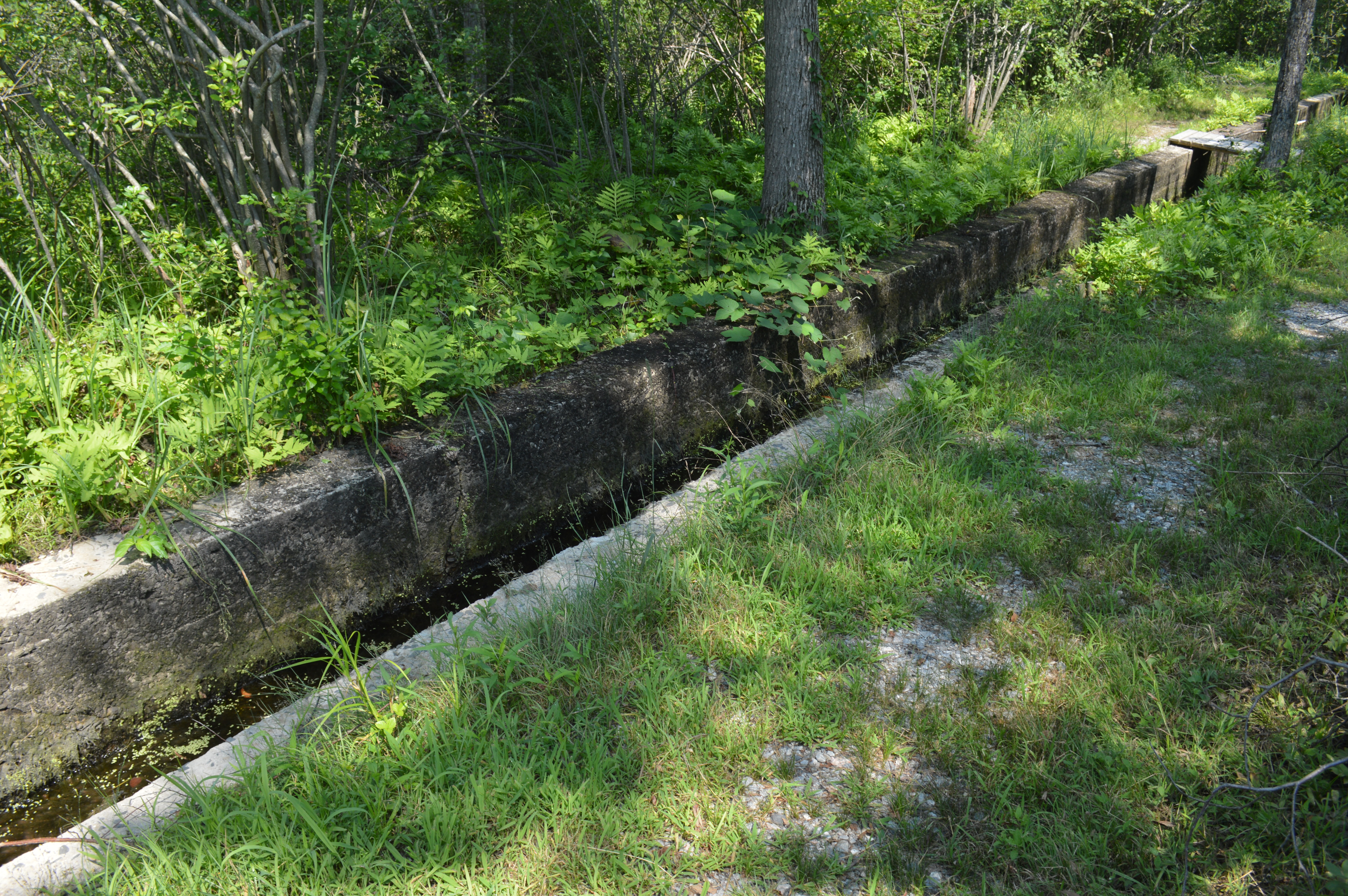
Prior to the conveyor belt system, ice was floated to the ice house via this canal.

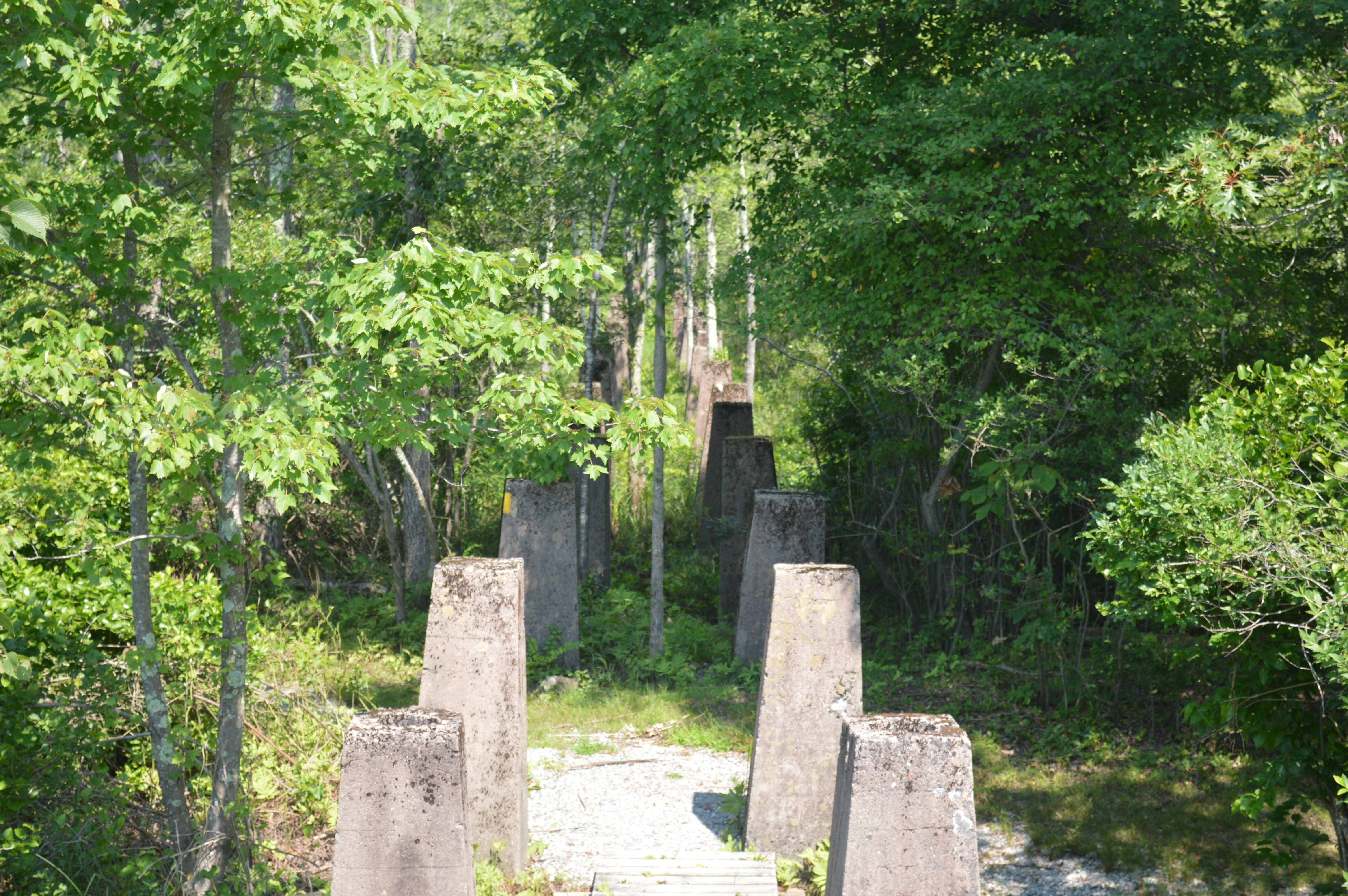
Channels were cut into the lake, and the workers (who were paid 60 cents an hour and worked seven days a week in the mid 1920s) utilized poles to float the ice to a ramp on which rested a conveyor belt.  The concrete pillars of this system still stand as ghostly sentinels in the swampy grounds of White Memorial; the final pillars today support an observation tower on the shores of Bantam Lake.  The conveyor belt was powered by a 100-horse power engine that derived its energy from the Bantam Falls power plant.

DSC_0241

Concrete pillars mark the path of the old conveyor belt.

The conveyor belts ran approximately 1000 feet from the lake to the ice house.  In the summer months, a spur of the Shepaug Valley Railroad ran from the Lake Station (today, the Cove Shops on Route 202) to the ice house, where it split to run parallel so cars could be filled from both sides of the structure.  Up to 20 box cars a day were filled, and the ice was transported as far as Bridgeport.   Alain White, in his History of Litchfield, described the “long trains,” which “pull out daily in the summers, carrying concentrated relief from the Litchfield Hills to the larger cities southward.”

DSC_0278

Remains of the ice house foundation, at the southern end of the Butternut Brook trail.

The spread of electricity and refrigerators to households in the 1920s led to a severe decline in the demand for harvested ice.  On August 8th, 1929, a massive fire swept through the facility.  Some have speculated that the fire was caused by spontaneous combustion of either the hay or sawdust at the site, while others reported that their were several cases of arson in the area.  Either way, over $350,000 in damages resulted from the destruction of the ice house building, nine railroad cars, and over 50,000 tons of ice valued at $200,000.  The next year the Southern New England Ice Company sold its land to the White Memorial Foundation; as a result, the foundations remain to remind us of this once vibrant industry.

For the Litchfield.bz video of the Bantam Lake ice house, click here

Hidden Nearby: Henry Obookiah’s Cornwall Grave

220px-Henry_Obookiah,_memoir_illustration_(cropped)

Henry Opukahaia (spelled Obookiah in his lifetime) was born on the island of Hawaii in 1792.  His parents were killed in a civil war and as a fifteen-year old, Henry was taken aboard the merchant ship Triumph, commanded by Captain Britnall and bound for New Haven.  While on board the ship, Henry befriended Thomas Hopu, a Hawaiian cabin boy who taught his fellow islander English.

DSC_0206

Henry Obookiah’s grave in the Cornwall Cemetery along Route 4.

While in New Haven, Opukahaia studied under Reverend Edwin Dwight, a recent graduate of Yale.  In addition to the traditional curriculum of tutors and pupils of the time, Opukahaia focused especially on English grammar.  During the course of his education, Opukahaia was exposed to Christianity and he not only converted but asked for training so that he could spread the gospel on his home islands.  This resulted, in part, in the founding of the Foreign Mission School in Cornwall.  Over its ten years of operation, the school educated 100 students, including 43 Native Americans and 20 Hawaiians.

While a student in Cornwall, Opukaiah worked on farms in Torrington and Litchfield to support himself.  The Litchfield community encouraged Henry to systemize the Hawaiian language through the writing of a dictionary and books on common grammar and spelling.  Opukaiah also wrote his memoirs.

Hawaiian-themed mementos on Obookiah's gravesite.

Hawaiian-themed mementos on Obookiah’s gravesite.

Unfortunately, before these projects could be completed, Henry fell ill.  Diagnosed with typhoid fever by Dr. Calhoun of Cornwall, Henry died in February 1818.  He last words were reportedly “Alloah o e,” which translates to “My love be with you.”

Lyman Beecher

Lyman Beecher

The Reverend Lyman Beecher of Litchfield presided over Opukahaia’s funeral, stating:

He came to this land and hearing of Him on whom without hearing,

he could not believe, and by the mouth of those who could never

have spoken to him in Owyhee.

DSC_0204

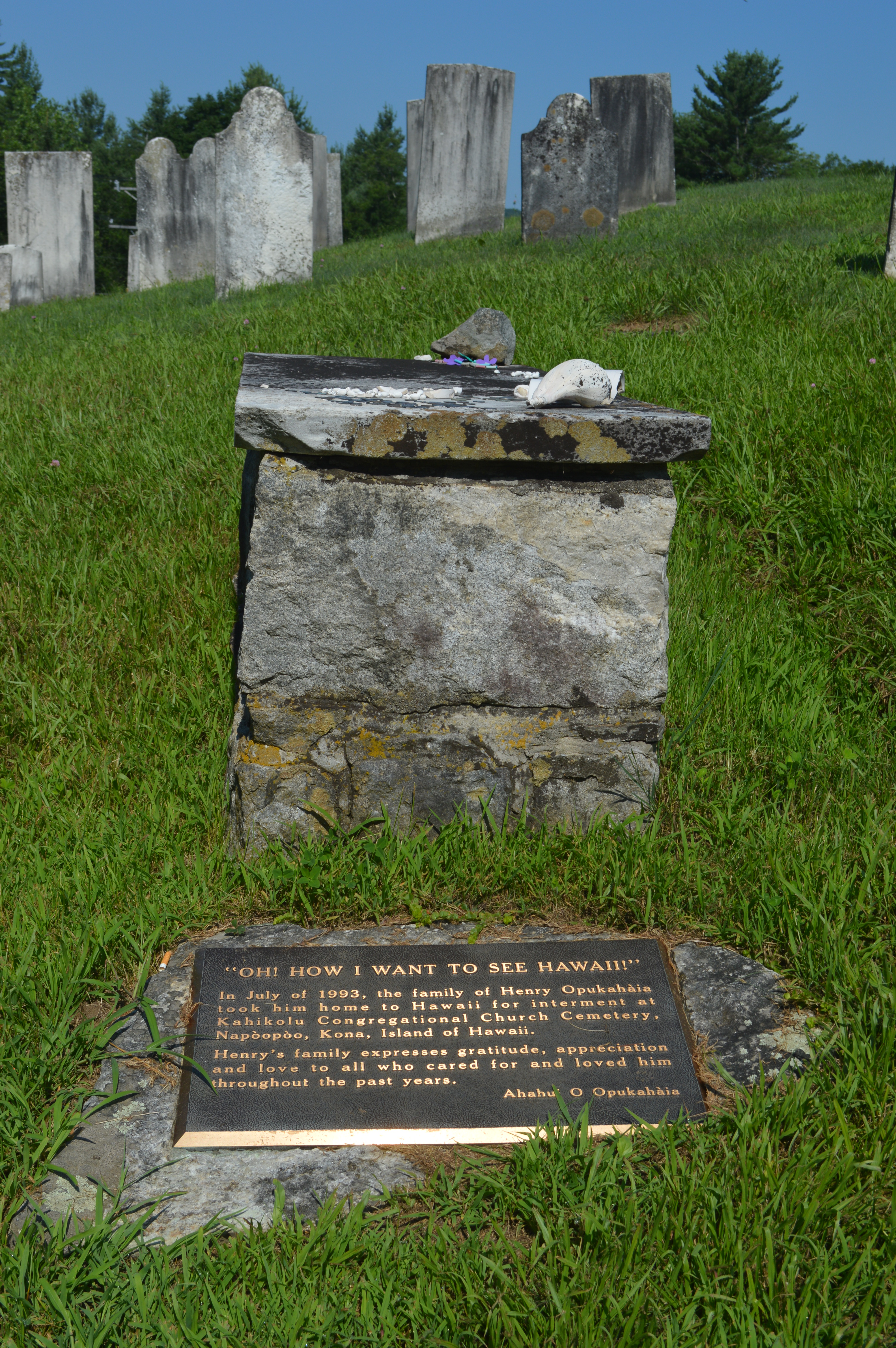
Opukahaia was buried in the Cornwall Cemetery, but in 1993 family members in Hawaii had his body reinterred at the Kahikolu Congregational Church in Kona, Hawaii.  The Cornwall gravesite is marked with a plaque thanking the community for caring for Henry, and is topped with his words, “Oh ! How I want to see Hawaii!”

The Litchfield Garden Club

DSC_0024

This stone flower urn stands at the intersection of North Street and Norfolk Road in Litchfield.  There are no markers or inscriptions to tell the curious passerby when or why it was built, or by whom.  Further investigation, however, reveals that this is one of the many contributions made by the Litchfield Garden Club to beautify the town.

LGC-CentLogoFinal_jan2012_722013 marks the 100th anniversary of the Litchfield Garden Club.  On September 9, 1913, nine women from the Litchfield area met at the home of Edith and Alice Kingsbury on North Street and organized the club, with annual dues of two dollars.  S. Edson Gage, an architect who had designed the Litchfield Playhouse that stood at the  site of the current town hall, was elected president.

2013-06-29 08.36.45

The old Litchfield train station on Russell Street.

The organization’s first civic project took place in 1914, when – in cooperation with the Village Improvement Society – they spent ten dollars for plantings at the town’s train station on Russell Street.  After the First World War the club was active in maintaining the plantings at the train station as well as beautifying the grounds of the town’s schools and library, and in creating Litchfield’s Wild Gardens on land leased from White Memorial.

trough

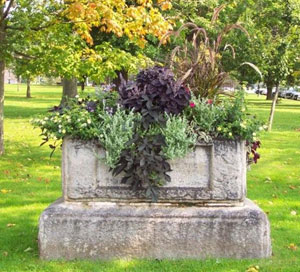
Flowers planted by the Garden Club in the trough of Litchfield’s Water Monument.

The Norfolk Road planter was installed in 1954 (the club’s website indicates there may have been others along Norfolk Road), flowers were planted at traffic intersections, and the organization was also instrumental in getting Litchfield’s Historic District added to the National Registrar of Historic Places.  More recently, the club has replanted the trees along North and South Street that were originally planted by Oliver Wolcott, Jr. to commemorate the original 13 states and installed period lighting on the Litchfield Green.

Happy 100th anniversary to the Litchfield Garden Club, which has done so much to enhance the natural beauty of our town!