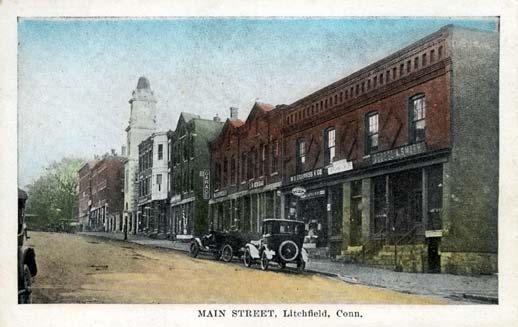
A Post on Posts (or, Hold Your Horses!)

They stand as vestiges of a bygone era of transportation, reminders of the age of the horse.  More than a dozen hitching posts remain along the streets and sidewalks of Litchfield.  They evoke, in the imaginative passerby, images of riders in the saddle, of wagons or coaches, of landaus or sleighs.

Illustration from John Barber, “Connecticut Historical Collections,” (1838) showing horse-drawn traffic entering Litchfield.

Americans were a restless people in the 18th and 19th centuries, crossing the Appalachians and pushing the frontier first to the Mississippi and ultimately to the Pacific.  This was accomplished primarily on horseback or with wagons.  The horse played a vital role in Litchfield’s commercial life; as the railroad did not reach the town until 1872 and there is no navigable waterway, all goods had to enter town via horse-drawn conveyances.

Hitched horses, RIchmond, VA, 1865.
Photo courtesy of hmdb.com

The hitching post was the parking space of the 18th and 19th century.  Most houses had them; it is likely that nearly all commercial enterprises had them.  Hitching racks secured several horses at one time.

Upon arriving at his or her destination, the rider would dismount the horse or vehicle, and tie the reins which were attached to the horse’s bridle to the post with a “hitch”, a type of knot or tie.  Hitches varied in style, and travelers could opt for the simple clove hitch if they had only a horse and were in a hurry, or the more difficult but secure rolling hitch to secure a wagon or carriage.

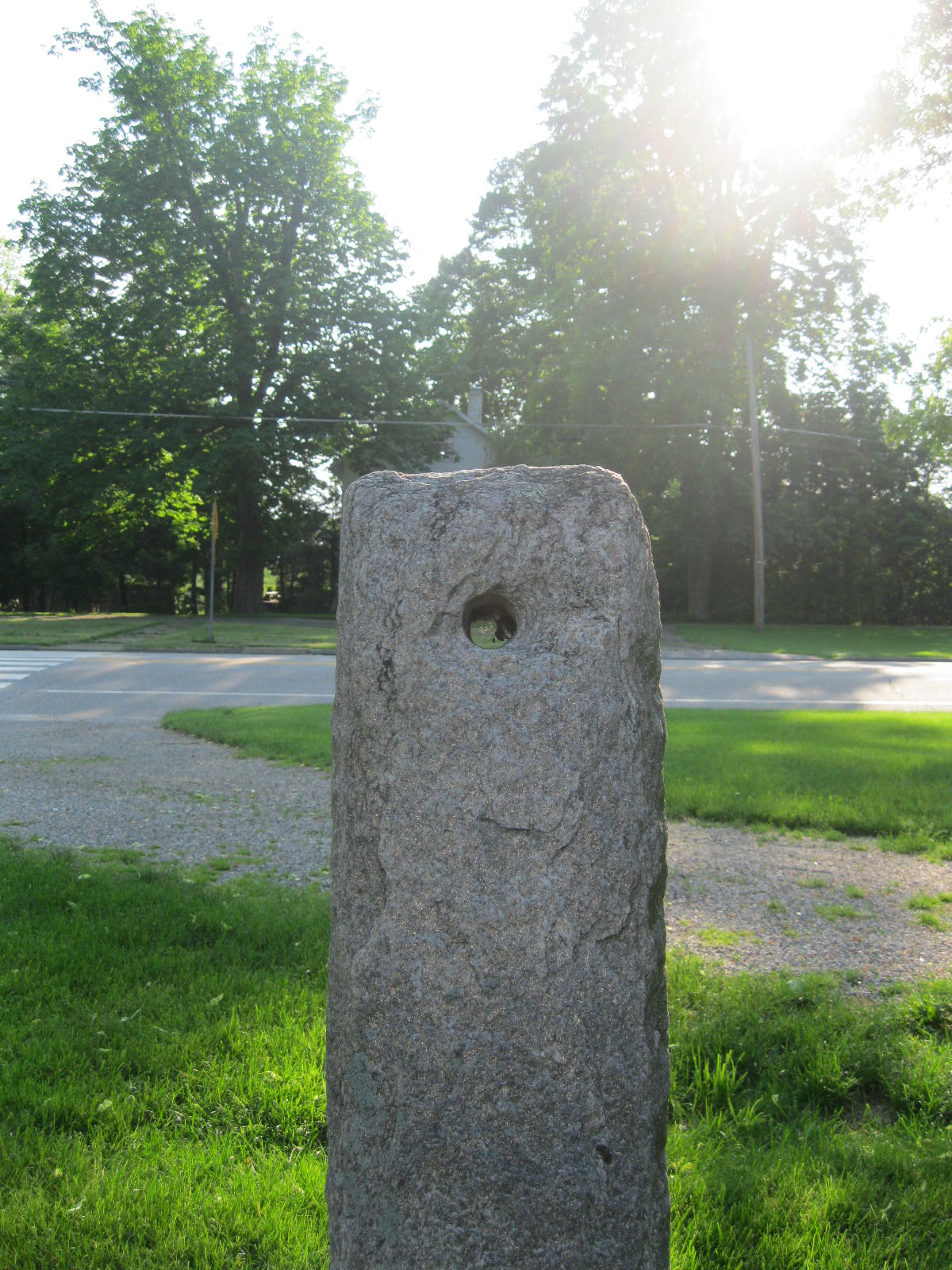


Hitching posts are of different materials and sizes, and present a variety of ways in which a rider could secure his horse.  Those that remain in Litchfield are most often made of granite, although there are examples of sandstone posts as well.  One wonders about the industries that grew up to fabricate the posts.  Were they presided over by local craftsmen, or were they brought in to Litchfield from distant manufacturers?

Most often the posts are found near the present sidewalks.  One walking the sidwalks on North and South Streets sees many examples of hitching posts.  They stand close to the sidewalks, most often as solitary sentinels.  However, the careful observer will see a house on Prospect Street with twin hitching posts.
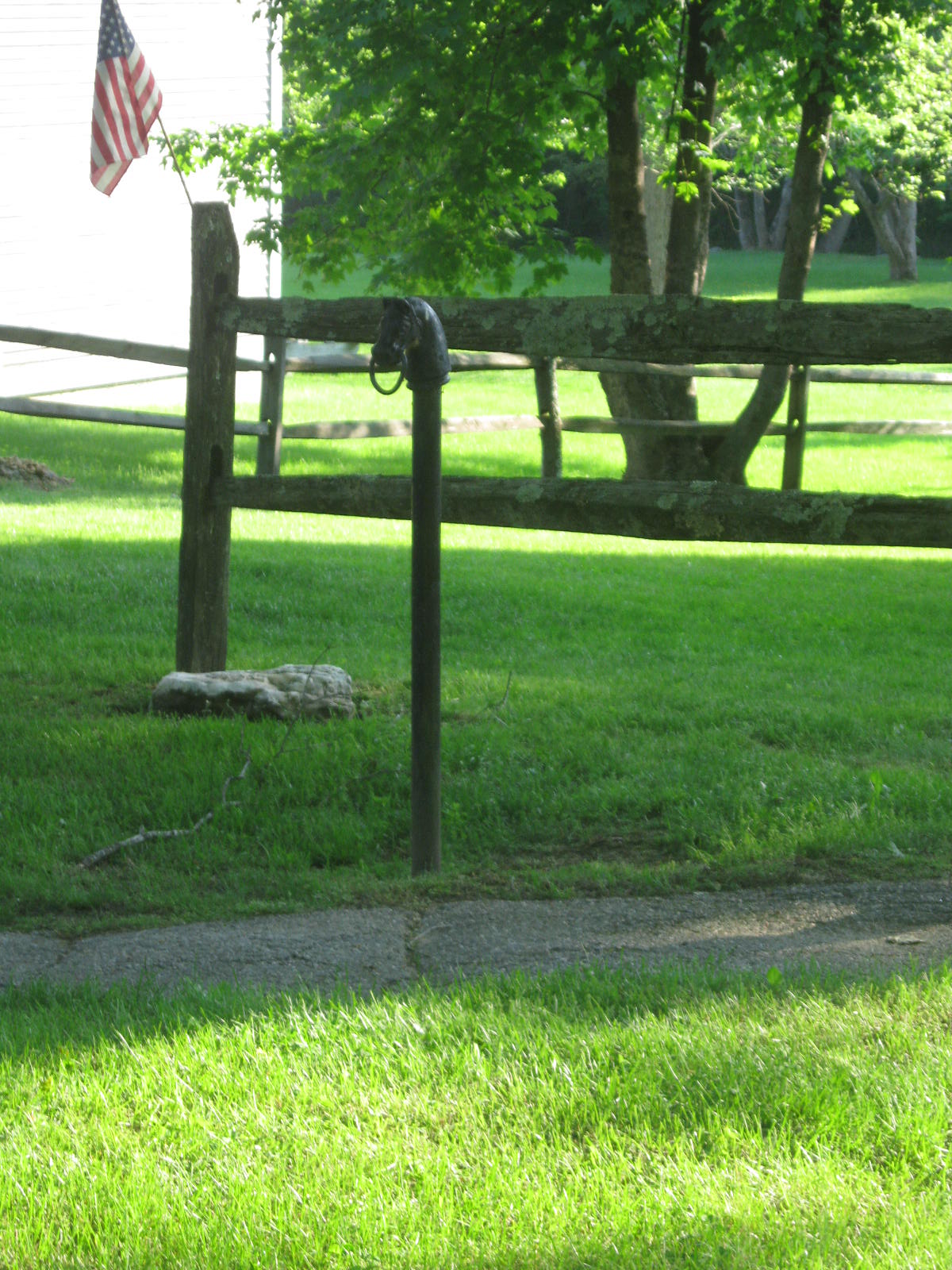
This cast iron hitching post was likely made outside of town.  Molten iron was cast into the desired design and allowed to cool.  A simple search for “hitching post images” reveals many different designs of cast iron posts.

Why do more not remain?  Perhaps many were made of wood and eroded over the years.  Did owners remove their hitching posts when automobiles made them unnecessary?  Did the paving of the roads widen existing roadways and necessitate the removal of posts?  Are those that remain all original, or were they erected simply to be ornamental?  Many of those that still stand have house numbers posted on them.

While obsolete, there is a sort of grace and beauty to them.  It is doubtful that anyone will ever say the same about parking meters.

The Colvocoresses Oak

A small marker sits beneath a stately oak tree on the western portion of the Litchfield Green.  It is located in close proximity to the post office, restaurants, and the historical society, yet one wonders how many people stop to read its simple text:  “The Colvocoresses Oak.  A memorial of the Battle of Manila Bay.” Upon examination, the curious passerby asks why this small monument to a largely forgotten event of American history stands in the center of a small Connecticut town.

George Partridge Colvocoresses was born in Norwich, Vermont in 1847.  His father, also George Colvocoresses, was the son of a prominent Greek businessman.  At the age of six, he, along with other members of his family, was kidnapped by Turks.  While six of his his brothers were killed, George was sold into slavery.  His father was able to purchase his freedom, and the son was sent to America.  He was adopted by Alden Patridge, who founded the Norwich Military Academy in Vermont, from which George graduated in 1831.

The U.S.S. Supply, in left background.

The elder Colvocoresses enjoyed a distinguished career in the United States Navy, achieving some fame for his exploits on blockading duty during the Civil War.  While in command of the U.S.S. Supply, Colvocoresses was joined in the service by his son, George Patridge, named for the family’s American benefactor.  Following the war, the elder Colvocoresses was made captain and retired from the service, moving to Litchfield.  He was murdered in Bridgeport in 1872.

George Patridge returned to Norwich and graduated from the school in 1866.  He embarked on a distinguished naval career of his own, serving in many foreign ports, at the Naval Hydrographic Office, and as an instructor of drawing at the United States Naval Academy.  In that capacity he designed the monument to the crew of the U.S.S. Jeanette that stands in the Academy’s cemetery.

Colvocoresses’ crowded hour came at Manila Bay on May 1st, 1898.  While Congress declared the Spanish-American War on April 25th of that year, two months earlier Assistant Secretary of the Navy Theodore Roosevelt had sent a coded telegram to US Asiatic Fleet commander Commodore George Dewey to attack the Spanish fleet in Manila Bay should war be declared.  In seven hours of fighting, Dewey (who had opened the battle with the famous phrase, “You may fire when ready, Gridley!”), had secured the surrender of the Spanish fleet and Manila Bay, at the cost of ten American casualties and one damaged ship.  When the war ended, the Philippines became an American colony, which they remained until granted independence in 1946.

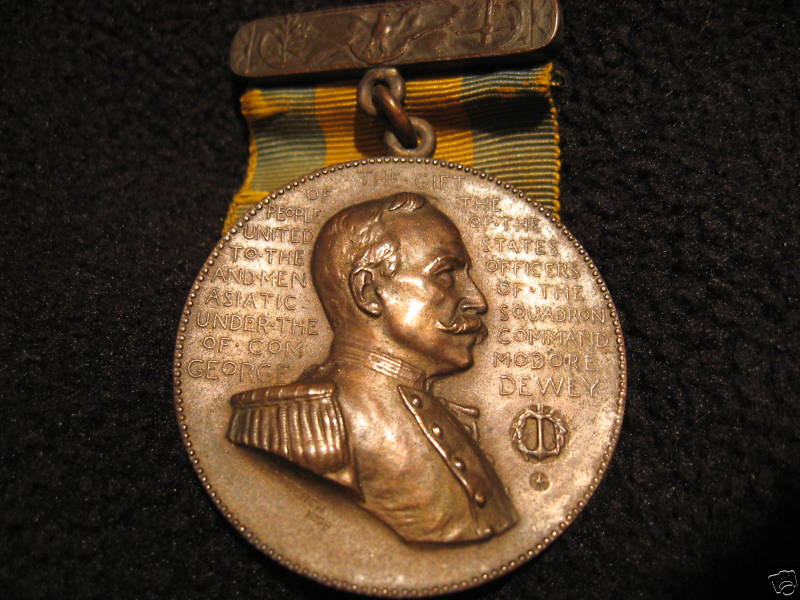
At the battle Colvocoresses served as the executive officer aboard the U.S.S. Concord, which sank the Spanish vessel Mindanao.  His actions were noted by a superior, who wrote, “Each and every one of my subordinates did his whole duty with an enthusiasm and zeal beyond all praise. I am particularly indebted to the executive officer, Lieut. Commander George P. Colvocoresses, for the cool, deliberate, and efficient manner with which he met each phase of the action, and for his hearty cooperation in my plans.” He was later transferred to the Olympia, Dewey’s flagship. For his service in the battle, Colvocoresses was awarded the Dewey medal.

The Dewey Medal

There is nothing on the small marker to indicate when it was erected.  However, the following appeared in the New York Times on November 11, 1899:

Alain White’s history of Litchfield indicates that Colvocoresses himself planted the tree using a silver trowel ordered for the occasion by Mary Quincy.  Perhaps the maker was erected in connection with this event as well.

Following the war, Colvocoresses served as the commandant of the United States Naval Academy.  He retired to Litchfield.  His children and grandchildren continued the family legacy of attending Norwich and serving in the United States military.  George Partridge Colvocoresses died on September 10, 1932, and is buried in Litchfield’s East Cemetery.  His services at Manila Bay live on, however, commemorated by a small marker and a stately oak tree on the Litchfield Green.

Hidden in Plain Sight

Welcome to Hidden in Plain Sight.  In his wonderful book Outside Lies Magic, Harvard professor John Stilgoe writes,

“Learning to look around sparks curiosity, encourages serendipity.  Amazing connections get made that way; questions are raised — and somtimes answered — that would never be otherwise.  Any explorer sees things that reward not just a bit of scrutiny but a bit of thought, sometimes a lot of thought over years.  Put the things in spatial context or arrange them in time, and they acquire value immediately.  Moreover, even the most ordinary of things help make sense of others, even of great historical movement.  Noticing dates on cast-iron storm-drain grates and fire hydrants intoduces something of the shift of iron-founding from Worcester and Pittsburgh south to Chattanooga and Birmingham.  The storm-drain grate and the fire hydrant are touchable, direct links with largers concepts, portals into the past of industrialization.” 

This crystallizes the philosophy of this blog.  There are tales of the past all around us.  By opening our eyes and asking questions, they may emerge from the shadows of the decades or even centuries.  Hidden in Plain Sight hopes to reveal the history of one small town – Litchfield, Connecticut – by exploring its landscape for clues to its past.   This is a town with a rich history, some well known, some not.  Occasionally, sites beyond the borders of Litchfield will be visited.

Look for a new post every other week or so.